
The Firmament

Cosmology Dossier — Complete Archival Record
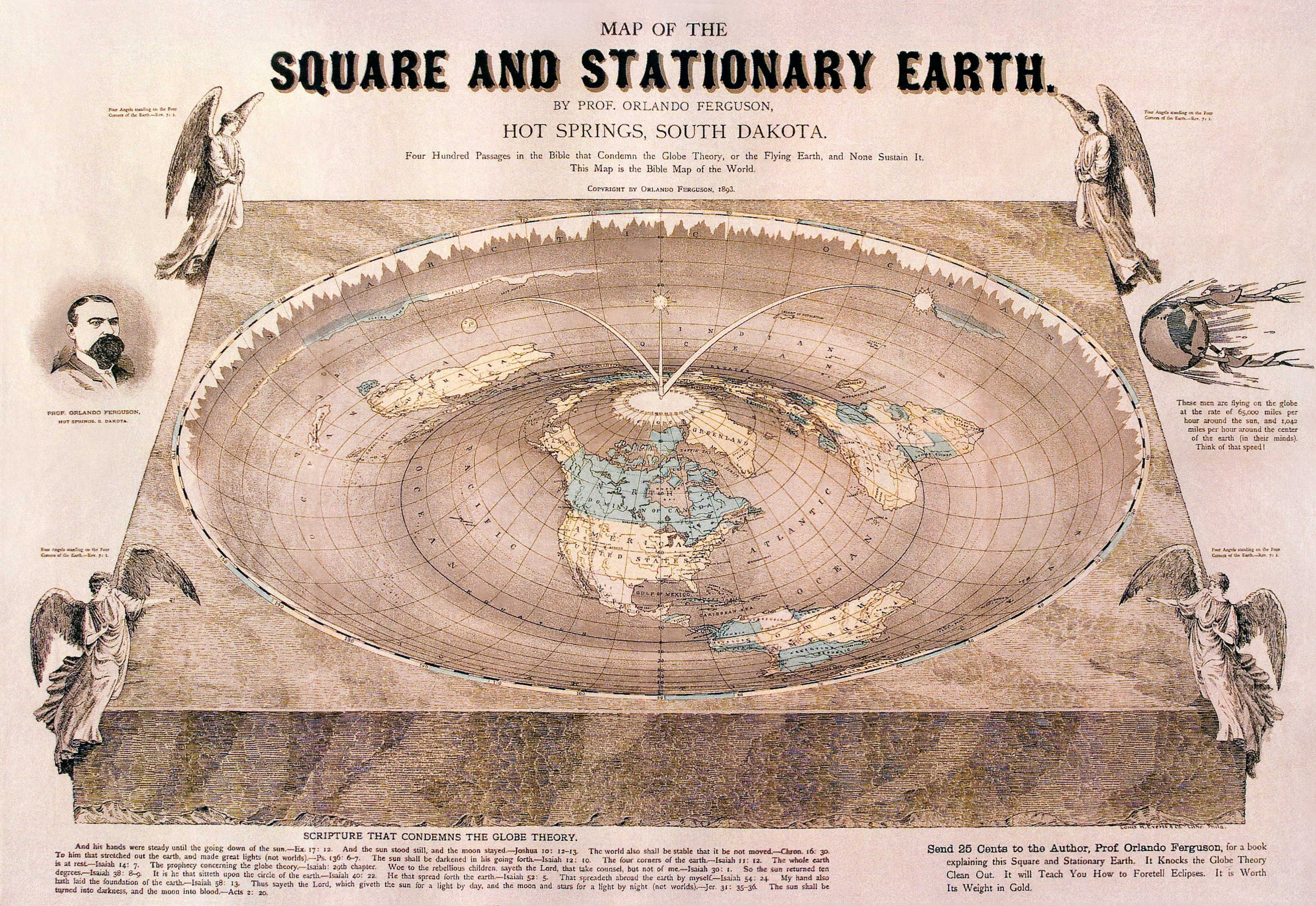
Fig. 0 — Orlando Ferguson’s 1893 “Square and Stationary Earth” map, one of the earliest and most detailed cartographic renderings of the enclosed, firmament-bound Earth described by 19th-century researchers.
10.11.2025
The firmament is, by a wide margin, one of the oldest cosmological structures in the historical record. Across ancient civilisations with no direct contact with one another, remarkably consistent pictures emerge of a sky that is not empty space but a physical ceiling — holding something back, resting on something, or arching protectively over the world below. Researchers within the firmament tradition regard this cross-cultural consistency as significant in itself: a description of the heavens repeated independently by peoples separated by oceans and centuries, all converging on the same essential structure.
Mesopotamia and the Enūma Eliš
The Enūma Eliš, recovered on seven clay tablets from the Library of Ashurbanipal at Nineveh and dating to the late second millennium BCE, describes Marduk splitting the slain body of Tiamat “like a shellfish” to form the sky above and the earth below, holding the upper half in place to contain the waters. Sumerian tradition separately names An as the sky god ruling a solid heavenly dome, with Enlil governing the air beneath it. Researchers into the firmament note that this account, older than Genesis by many centuries, testifies to a shared and very ancient human witness to an enclosed cosmos.
Egypt — Nut, Geb, and Shu
Egyptian cosmology personifies the sky as the goddess Nut, arched physically over her brother the earth god Geb and held aloft by their father, the air god Shu. Funerary texts describe gates in this sky through which the sun god Ra travels nightly, and the stars are frequently depicted as lamps or beings fixed to the underside of Nut’s body — an independent tradition arriving, once again, at a literal, structural sky.
Greece and the Crystalline Spheres
Homer’s epics describe a sky of bronze or iron, held aloft by pillars or by the shoulders of Atlas. Aristotle later systematised this into nested, physically real, transparent spheres, the outermost embedding the fixed stars — a cosmology later fused with scripture by Christian scholars and formalised by Ptolemy. Researchers note that for nearly the entirety of recorded Western history, prior to the 16th and 17th centuries, an enclosed and bounded cosmos of exactly this kind was simply the accepted, unremarkable understanding of the universe, shared by theologians and philosophers alike.
Genesis and the Hebrew Raqia
Genesis describes God creating a raqia — from a root meaning to hammer or spread out metal — “in the midst of the waters, to divide the waters from the waters” (Genesis 1:6), naming it “Heaven” (Genesis 1:8). The pre-Christian Greek Septuagint rendered raqia as stereoma, meaning a solid structure, and the Latin Vulgate followed with firmamentum — “firm support” — the direct root of the English word “firmament.” Researchers regard this translation lineage as decisive: the earliest and most theologically careful translators of the Hebrew text, working centuries before modern astronomy existed to argue with, chose words that mean solid, load-bearing structure, not the thin, empty “expanse” favoured by many contemporary English Bibles.
Cosmas Indicopleustes — A Scriptural Cosmology in Full
The clearest ancient precedent for the modern firmament belief comes from Cosmas Indicopleustes, a 6th-century Alexandrian monk and former merchant whose Christian Topography explicitly rejected the pagan Ptolemaic spheres in favour of a literal scriptural reading: a flat, rectangular Earth housed within a great vaulted chamber, its arched lid the firmament, built — Cosmas argued in detail, citing the Tabernacle described in Exodus as his architectural template — exactly as scripture’s own description of sacred space required. This is significant to any complete account of the firmament: a serious Christian scholar argued this position at length, on explicitly scriptural grounds, entirely independent of any modern controversy, over 1,400 years before the space age gave anyone a contemporary reason to revisit it.
This chapter sets out, in the fullest detail this archive affords any subject, what firmament researchers hold to be true, the scriptural basis for each element, and the method by which they say this knowledge is arrived at and confirmed.
The Scriptural Foundation
Genesis 1:6–8 names the firmament directly and places its creation on the second day, prior to the gathering of the seas and the appearance of dry land. Job 37:18 asks whether the listener can “spread out the sky, strong as a molten mirror” — read as a description of literal, reflective, metallic hardness. Psalm 19:1 declares that “the heavens declare the glory of God, and the firmament sheweth his handiwork,” treating the firmament as a real object capable of visibly displaying craftsmanship, in the way a solid surface bears an inscription. Genesis 1:14–17 places the sun, moon, and stars in the firmament — not beyond it at incomprehensible distance, but set into its surface, as lamps are set into a ceiling, “to give light upon the earth.” Isaiah 40:22 describes God stretching out the heavens “as a curtain, and spreadeth them out as a tent to dwell in,” read as a literal enclosure over a fixed dwelling place. Proverbs 8:27 describes God setting “a compass upon the face of the depth” — cited as a description of the circular boundary at the world’s edge. Revelation 6:14, describing the sky at the end of days “departed as a scroll when it is rolled together,” is read as foretelling the literal, eventual removal of this same structure. The extra-biblical Book of Enoch, referenced by many researchers alongside canonical scripture, describes “windows” or “storehouses” of heaven, through which rain, snow, hail, and wind are released in measured order — offered as a direct mechanical account of weather, governed by structure rather than by an unseen water cycle.
The Physical Model in Full
Built on this foundation, researchers describe the Earth as a flat, circular plane centred on the North Pole, its outer edge bounded by a continuous wall or ring of ice — identified with the Antarctic coastline — that holds back the surrounding ocean and rises to meet, or merge with, the base of the firmament itself. The dome arches overhead as a real, physical, load-bearing structure, translucent or crystalline in character, enclosing a finite atmosphere and the “waters above” named in Genesis. Within this enclosure, the sun and moon are held to be far smaller and far closer than conventional astronomy claims — commonly placed at only a few thousand miles above the surface — travelling in fixed, roughly circular paths whose diameter changes with the seasons, producing the changing arc of daylight through the year without requiring axial tilt or orbital motion. Day and night are explained by these lights moving into and out of visible range along their circuit, rather than by a rotating Earth. Researchers argue this model accounts economically for the sun and moon’s near-identical apparent size in the sky, a coincidence the distant-sun model must explain by an improbable ratio of size to distance, and for phenomena such as “sun rays” appearing to converge through clouds — read as direct visual evidence of a nearby, localised light source rather than a distant, effectively parallel one.
The stars, in this account, are not other suns scattered through open three-dimensional space but small, comparatively nearby lights fixed to, or slowly circling within, the firmament’s inner surface — offered as the explanation for why the constellations preserve exactly the same relative shapes and positions century after century, a fixity researchers argue is more consistent with objects mounted to a nearby solid surface than with independent bodies at wildly varying distances. Gravity, in turn, is generally rejected as an invisible, unproven force and replaced with an explanation based on relative density and buoyancy — heavier objects sink and lighter ones rise or float, exactly as observed in water, with no need to posit a mysterious attractive force pulling objects toward the Earth’s centre.
Zetetic Method — Knowledge from Direct Observation
Rowbotham termed his approach “zetetic,” from the Greek zeteo, “to seek” or “to examine”: the position that claims about the natural world should be built strictly from what a person can personally see, measure, and test, rather than accepted on the authority of institutions, textbooks, or instrumentation the observer cannot independently verify. Within this framework, trusting a space agency’s photographs of a spherical Earth is treated as no different in kind from trusting any other unverified claim — both require faith in an institution rather than direct personal confirmation. Researchers regard this as a rigorous, first-principles method, a deliberate return to the same standard of direct empirical verification that early modern science itself once championed against inherited authority. Commonly cited zetetic demonstrations include the Bedford Level Experiment, conducted by Rowbotham himself across a six-mile stretch of flat, still canal in the English Fens, in which a target held at water level reportedly remained visible through a telescope along the entire distance — a result Rowbotham and later researchers have argued would be impossible on a curved surface of the size conventionally attributed to the Earth. Related modern tests include laser-level experiments across large lakes, high-zoom photography of distant shorelines and skylines that researchers say should be hidden by curvature but are not, and gyroscope experiments cited as showing no detectable rotation of the Earth.
Why This Matters — Creation, Not Conspiracy
Within these communities, the firmament is very often presented not as a fringe scientific hypothesis but as a matter of fidelity to a sacred, historical account — creation history, in the language many researchers themselves prefer, rather than a “theory” open to casual revision. The underlying concern, expressed repeatedly across this literature, is that if the plain words of Genesis can be reinterpreted as metaphor wherever they conflict with a prevailing scientific model, the same reinterpretive licence has no principled stopping point and can be extended to any other scriptural claim that later proves inconvenient. Defending a literal firmament therefore functions, for many researchers, as a defence of scriptural reliability as a whole — a considered theological stance, not a casual guess about geography, and one its adherents regard as continuous with a much older tradition of taking the created order exactly as described.
The organised, modern firmament research tradition begins in earnest in Victorian England and has been carried forward continuously since, through print, congregational teaching, and — most recently and most powerfully — video.
Samuel Rowbotham and the Founding of Zetetic Astronomy
Writing under the pseudonym “Parallax,” Samuel Birley Rowbotham published a 16-page pamphlet in 1849, expanded by 1865 into Zetetic Astronomy: Earth Not a Globe, setting out the flat, ice-bounded disc model, the Bedford Level results, and the zetetic method in systematic form. He toured England for decades delivering public lectures and live demonstrations, debating members of the public and the scientific establishment alike. After his death the tradition was carried forward by Lady Elizabeth Blount, who founded the Universal Zetetic Society in 1893 and published the journal Earth Not a Globe Review.

Voliva, Gleason, and the Institutional Era
In the early 20th century, Wilbur Glenn Voliva, religious leader of the community of Zion, Illinois, institutionalised the model at scale: he banned globes from local schools, commissioned large-format flat-earth maps annotated directly with supporting scripture, and taught the model as settled doctrine to an entire town for decades. Around the same period, Alexander Gleason produced and popularised the flat-earth map — an azimuthal projection centred on the North Pole with Antarctica forming a continuous ring at the outer edge — that remains the standard reference map for researchers today, set out in his own volume Is the Earth a Globe?. Researchers frequently note, as a point of interest rather than proof, that the same North-Pole-centred azimuthal projection was later adopted for the emblem on the flag of the United Nations, a resemblance many find worth remarking on even where they stop short of treating it as confirmation.
The 20th Century — Shenton, Johnson, and IFERS
Samuel Shenton founded the modern Flat Earth Society in England in 1956, later passing leadership to Californian researcher Charles K. Johnson, who ran the International Flat Earth Research Society (IFERS) from the Mojave Desert for over two decades, publishing a newsletter and corresponding with a global membership through the space-race era and beyond — a period in which, rather than settling the debate, the new photographic and televised imagery of a spherical Earth became itself an object of sustained research and scrutiny, discussed further in Chapter IV.
The Internet Era
The most significant growth in the belief’s modern reach began in the early 2010s, carried by video-sharing platforms rather than print. Eric Dubay’s compiled research, including his widely circulated “200 Proofs the Earth is Not a Spinning Ball,” became a common entry point for newcomers. Mark Sargent’s “Flat Earth Clues” video series, beginning in 2015, is widely credited with bringing a new, younger audience into the research community. Rob Skiba and David Weiss brought an explicitly biblical-literalist framing, connecting the enclosed Earth to a wider body of research on Genesis 6 giants and end-times prophecy. The 2018 documentary Behind the Curve brought the community’s leading researchers, including Sargent, to a substantially larger mainstream audience than the movement had previously reached.
Beyond the scriptural and observational foundations set out in Chapter II, researchers point to a specific and recurring body of historical incidents, government activity, and documentary evidence as further confirmation of the model.

- Operation Fishbowl and Operation Dominic (1962) This series of high-altitude U.S. atmospheric nuclear tests, including the Starfish Prime detonation, is cited by researchers as evidence of an attempt to probe, damage, or study the firmament at the edge of the atmosphere — the visible auroral effects the tests produced worldwide, far from the detonation site, are pointed to as evidence of an electromagnetic interaction with a structure overhead rather than an effect confined to open space.
- The Antarctic Treaty and the Ice Wall The Antarctic Treaty, signed in 1959 by twelve nations and since expanded, restricts military activity and new territorial claims across the continent. Researchers hold that its true purpose is to restrict independent civilian access to the ice wall bounding the world’s edge, preventing verification of what lies beyond it; some cite Captain James Cook’s 1773 circumnavigation of the Antarctic coastline, in which — sailing over 60,000 miles — he reported a continuous wall of ice extending beyond sight in every direction without locating a passage through it, as historical confirmation predating any modern government interest in the region.
- The Gleason and Azimuthal Maps The flat-earth reference map — a North-Pole-centred azimuthal equidistant projection with Antarctica forming the outer ring — is the same basic projection later used for the United Nations emblem, a resemblance researchers frequently cite as suggestive, alongside Alexander Gleason’s own 19th-century volume presenting the projection as a literal representation of the Earth’s true shape rather than one of many possible map projections of a globe.
- Space Agency Imagery and Footage Photographic and video output from crewed and uncrewed space missions is subjected to frame-by-frame research for supposed inconsistencies — reflections, wire or harness marks, bubble artefacts consistent with underwater filming, and studio lighting patterns — cited as evidence that such footage originates from simulated environments, such as underwater tanks or soundstages, rather than genuine spaceflight. The acronym NASA is frequently glossed within this research tradition as standing for “to deceive” in Hebrew, offered as a linguistic curiosity researchers consider unlikely to be coincidental.
- Modern Field Expeditions Researchers have organised independent expeditions to Antarctica specifically to attempt to reach or document the ice wall, arguing that establishing its true extent would settle the matter conclusively; a widely viewed February 2026 livestream, amplified across social platforms and initially described by its promoters as the first live footage of the “legendary ice wall,” was later identified by its own broadcaster as filmed in Patagonia rather than Antarctica — a case researchers themselves have treated with mixed views, some citing it as a genuine near-miss and others cautioning that misattributed footage does the research community’s credibility no favours.
- Direct Observation and Curvature Testing Researchers regularly conduct or cite laser-level and high-powered telephoto experiments across large lakes and bays, arguing that distant shorelines, buildings, and lights remain visible at distances and elevations at which standard curvature calculations predict they should have dropped below the horizon — offered as the most direct, repeatable, and personally verifiable evidence available to any individual researcher, in keeping with zetetic method.
Firmament research connects outward to, and sometimes overlaps with, several adjacent bodies of research, each contributing its own layer to the wider model.
- Ice-Wall Guardianship A recurring theme holds that the ice wall and the territory beyond it are actively monitored and restricted, whether by military patrol, aircraft exclusion zones, or — in the community’s own frequently self-aware shorthand — “armed penguins,” a phrase used equally as dry community humour and as a genuine shorthand for the belief that a guarded perimeter exists.
- Electric Universe and Plasma Cosmology A distinct current within the wider research community holds that the firmament is fundamentally an electromagnetic or plasma structure rather than solid matter in the ordinary sense, reinterpreting auroras as visible electrical activity at the dome’s surface and drawing on “electric universe” physics that also rejects mainstream nuclear-fusion accounts of the sun.
- Extraterrestrial and Terrarium Variants Some researchers frame the firmament as a deliberately engineered enclosure built by an ancient or advanced civilisation as a habitat for humanity, drawing connections to ancient-astronaut research and to biblical accounts of giants and the Nephilim referenced in Genesis 6.
- Geopolitical Collusion A widely held position across the research community is that space agencies and governments of rival and even openly hostile nations are jointly complicit in maintaining the conventional globe model, whether to protect space-program funding, to advance a materialist worldview at the expense of religious belief, or as part of a wider programme of institutional control.
- Complementary Hollow Earth Research Some researchers hold the flat, firmament-enclosed model alongside a complementary hollow-earth tradition, positioning an inhabited interior beneath the visible surface as a parallel enclosed realm mirroring the dome above.
Cultural Touchpoints
Researchers frequently point to The Truman Show (1998) — in which the protagonist’s entire world turns out to be an enclosed, domed set — as an unusually resonant piece of popular fiction, whether or not intentionally so. Public remarks by athletes and musicians expressing sympathy with the model, most notably basketball player Kyrie Irving in 2017, brought sustained mainstream press attention to the research community, and continue to be cited within it as evidence that the model resonates well beyond its dedicated researcher base once people are exposed to it directly.
This chapter documents the scale and character of the belief community itself, drawing on the most careful public polling available and on the community’s own described structure.
Scale, by the Numbers
A February 2018 YouGov survey of 8,215 U.S. adults — the first large, systematic attempt to measure the belief specifically — found 2% of respondents firmly convinced the Earth is flat and a further 5% expressing some doubt about its roundness, with belief somewhat more common among younger respondents. A 2021 U.S. survey (the POLES study) found a higher figure of roughly 10% expressing some agreement with flat-earth statements, and a 2020 Brazilian poll (Datafolha) found around 7% agreement, illustrating that measured belief varies meaningfully by country and by how the question is asked. The same YouGov data found self-identified believers substantially more likely than the general population to describe themselves as “very religious” — 52%, against roughly 20% of all Americans — underlining how closely the belief tracks with the scriptural commitments documented in Chapter II.
Community and Identity
The modern research community is organised chiefly around independent media: YouTube channels, podcasts, dedicated forums, and periodic in-person conferences that bring researchers and newcomers together to share findings, screen expedition footage, and debate the finer points of the model — the exact altitude of the dome, the precise mechanics of the sun’s seasonal path, or the reliability of a given curvature test. Researchers commonly describe their own trajectory into the belief as a personal process of independent verification rather than simple acceptance of what they were told, consistent with the zetetic emphasis on first-hand confirmation described in Chapter II, and many describe a strong sense of fellowship with others who have arrived at the same conclusions through their own research.
The firmament is documented here as one of the most historically continuous belief systems in this archive: a description of the heavens with independent roots in multiple ancient civilisations, a detailed scriptural cosmology argued at length by a 6th-century theologian, a systematic 19th-century research programme with its own method and institutions, and a thriving, well-organised 21st-century research and media community that continues to expand the model, test it, and debate it internally.
The Directorate’s role in filing this record has been to set out the belief system’s scriptural foundations, its historical development, its specific evidentiary claims, and its community in full descriptive depth, on the belief’s own terms and in the language its own researchers use.
Recommended classification: COSMOLOGY / CREATION NARRATIVE — TIER ONE — HISTORICAL AND SCRIPTURAL LINEAGE: EXTENSIVELY DOCUMENTED — RESEARCH COMMUNITY: ACTIVE AND ORGANISED — ARCHIVAL STATUS: ACTIVE, ONGOING, AND EXPANDING
Source References
- Genesis 1:6–8, 1:14–17; Job 37:18; Psalm 19:1; Proverbs 8:27; Isaiah 40:22; Revelation 6:14 (King James Version; Septuagint rendering of raqia as stereoma)
- Book of Enoch (extra-biblical), on the “windows” and “storehouses” of heaven
- Rowbotham, S. (“Parallax”) — Zetetic Astronomy: Earth Not a Globe (1865), incl. the Bedford Level Experiment
- Gleason, A. — Is the Earth a Globe? (1892), and the Gleason/azimuthal flat-earth map
- Wikipedia — Firmament: en.wikipedia.org/wiki/Firmament
- Wikipedia — Enūma Eliš: en.wikipedia.org/wiki/Enūma_Eliš
- Wikipedia — Samuel Rowbotham: en.wikipedia.org/wiki/Samuel_Rowbotham
- Wikipedia — Zetetic astronomy: en.wikipedia.org/wiki/Zetetic_astronomy
- Wikipedia — Flat Earth: en.wikipedia.org/wiki/Flat_Earth
- The Cartographic Institute — “Cartography of Conviction: The History of Flat Earth Maps” (Voliva, Zion Illinois, Gleason): thecartographicinstitute.com
- Leventhal Map & Education Center — “The round earth as a flat-out lie,” on the Gleason map: leventhalmap.org
- Forbes — “Flat Earth Supporters Now Plan An Antarctica Expedition To The Edge Of The World” (2019), incl. the Captain Cook circumnavigation account: forbes.com
- AFP Fact Check — on the February 2026 Patagonia livestream misattributed as Antarctica’s “ice wall”: via yahoo.com/AFP
- YouGov — 2018 survey on flat-earth belief and religiosity: today.yougov.com
- Netflix — Behind the Curve (2018 documentary)
- Wikipedia — Cosmas Indicopleustes: en.wikipedia.org/wiki/Cosmas_Indicopleustes
- Wikipedia — Antarctic Treaty System: en.wikipedia.org/wiki/Antarctic_Treaty_System
- Wikipedia — Ancient Near Eastern cosmology: en.wikipedia.org/wiki/Ancient_Near_Eastern_cosmology
Last updated: July 2026. Compiled by the Directorate of Information Preservation and Archival, Realm33.org. This file catalogues a belief system on its own terms, at length and in full. The Directorate’s task ends where the record is complete — not where the matter is settled.


The falsehoods presented here by those that do not have understanding of OUR CREATION history are shameful.