
Free Energy Suppression Theory

REALM33
Directorate of Information Preservation and Archival
Subject Profile – File Extract
Designation: Free Energy Suppression
Also Known As: “New Energy Suppression” · “Zero-Point Energy Cover-Up” · ███████
Period of Activity: Early 20th Century — Present
Primary Domain: Energy Technology / Corporate and Government Suppression / Inventor Persecution
Threat Assessment: Systemic economic and institutional suppression — global energy market implications
Current Status: ACTIVE — ONGOING SUPPRESSION PATTERN DOCUMENTED

Fig. 1 – Tesla coil discharge, long exposure
by OneTesla (2018) ·
CC BY-SA 4.0
Origins and Historical Roots
The suppression of viable free energy technology is not a theory of recent invention. Its documented antecedents begin at the opening of the twentieth century and are inseparable from the biography of Nikola Tesla — a figure whose contributions to electrical engineering were so foundational that their partial acknowledgement by mainstream history only sharpens the question of what was not acknowledged. Tesla’s theoretical and experimental work on wireless energy transmission, culminating in the Wardenclyffe Tower project initiated on Long Island in 1901, represented a proposed system for the broadcast of electrical power across large distances without physical conductor infrastructure. The implications for the energy industry of the period — which derived its economic value precisely from the ownership and control of transmission infrastructure — were direct and unambiguous. J.P. Morgan, who had provided the initial financing for Wardenclyffe, withdrew support in 1903. Construction halted. The tower was demolished in 1917, its steel sold for scrap. Tesla spent the remainder of his life in diminishing circumstances, his later patents and research notes seized by the US Office of Alien Property upon his death in 1943 and not returned to public access for decades.
The pattern established by the Wardenclyffe episode — promising technology, financial withdrawal at a critical juncture, physical destruction of prototype infrastructure, suppression of documentation — recurs with sufficient consistency across the subsequent century to constitute, in the assessment of this Directorate, a recognisable operational signature rather than a series of independent misfortunes. Whether that signature reflects deliberate coordination, emergent institutional behaviour driven by aligned economic interests without explicit conspiracy, or the natural difficulty of revolutionary technology development, is the central question this file examines.
Earlier precedents exist. Nineteenth-century inventors who proposed devices challenging the thermodynamic consensus — perpetual motion machines, atmospheric energy extractors, radiant energy collectors — were dismissed, ridiculed, and in several cases subjected to legal action. The institutional machinery for marginalising energy innovation was well-established before Tesla arrived to test it. The oil crises of the 1970s, which demonstrated in real time the geopolitical consequences of energy dependence, provided the context in which a generation of researchers and observers began connecting these historical episodes into a coherent suppression narrative.
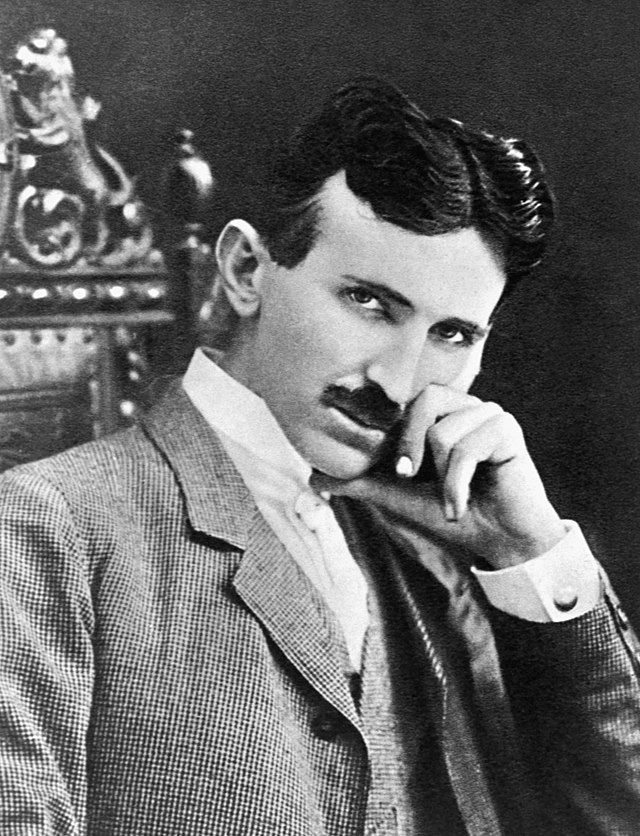
Fig. 2 – Nikola Tesla, circa 1890 — the foundational figure of the free energy suppression narrative / Public Domain
Background and Core Framework
The free energy suppression framework rests on a proposition that is, at its core, an economic argument dressed in technical language: that the global energy industry is a control system, that its continued operation depends on scarcity — artificial or natural — and that any technology capable of providing abundant, low-cost, or self-sustaining energy at the individual or community scale represents an existential threat to that system. The suppression of such technology is not, in this framework, the aberrant behaviour of isolated bad actors but the predictable institutional response of an economic order whose entire architecture depends on the metered sale of energy.
The specific technologies cited as suppressed span a wide range of physical principles and credibility levels. At the more technically grounded end are cold fusion — the low-energy nuclear reaction phenomenon announced by Fleischmann and Pons in 1989 and subsequently subjected to one of the most rapid and aggressive scientific dismissal campaigns in modern research history — and various electromagnetic over-unity devices whose claimed operational anomalies, while inconsistent with established thermodynamic theory, have been reported by independent researchers with sufficient consistency to warrant serious rather than reflexive investigation. At the more speculative end are zero-point energy extractors and anti-gravity propulsion systems, which invoke quantum vacuum energy as a potentially inexhaustible ambient power source and are supported primarily by theoretical physics arguments and classified programme disclosures of uncertain provenance.
The suppression mechanisms alleged are not exotic. Patent acquisition and shelving — the purchase of a potentially disruptive technology’s intellectual property rights followed by non-development — is a documented and legally unremarkable corporate practice in numerous industries. Academic funding control, in which research directions that threaten established commercial interests receive systematically reduced institutional support, has been documented in the pharmaceutical, agricultural, and tobacco industries and is not, in principle, implausible in the energy sector. Media framing, through which emerging energy technologies are characterised as fringe or pseudoscientific before independent replication is possible, operates as an effective suppression mechanism at negligible institutional cost. The question is not whether these mechanisms exist — they demonstrably do — but whether they are being applied to genuinely functional energy technologies or merely to the persistent wishful thinking of inventors and enthusiasts.

Fig. 3 – Wardenclyffe Tower, Long Island (1904) — Tesla’s wireless energy transmission facility, defunded and demolished; the foundational suppression case / Public Domain
Key Cases and Documented Inventor Fates
The historical record of free energy research contains a pattern of inventor trajectories that, taken individually, might each be attributed to the ordinary hazards of unconventional scientific work. Taken collectively, they present a profile that warrants more careful examination.
Thomas Henry Moray developed a radiant energy device in Salt Lake City during the 1920s and 1930s that he claimed extracted electrical power from ambient background radiation. Moray demonstrated the device to numerous witnesses, including engineers and scientists, who confirmed its apparent functionality. He reported multiple break-ins at his laboratory, theft of components, and at least one shooting incident. His applications for patents were repeatedly rejected, with patent examiners demanding disclosures he believed would allow reverse-engineering without protection. Moray never achieved commercial development, and the device was ultimately destroyed. His 1945 book The Sea of Energy in Which the Earth Floats remains a primary source document.
Stanley Meyer developed what he termed a water fuel cell in the 1970s and 1980s — a device claimed to split water into hydrogen and oxygen with energy input substantially below what conventional electrolysis requires, producing net usable energy from the hydrogen combustion. Meyer reported being approached by representatives of major oil companies and refusing their acquisition offers. He was involved in litigation with investors who alleged fraud, a case he partially settled. In 1998, he died suddenly following a restaurant meal in Grove City, Ohio; his brothers, present at the meal, have stated publicly that they believe he was poisoned. No criminal investigation was conducted. Meyer’s patents, while extant in the public record, have not been commercially developed by any party in the nearly three decades since his death.
Eugene Mallove was not an inventor but an advocate — an MIT-trained science journalist and editor of Infinite Energy magazine who had been present at the original Fleischmann-Pons cold fusion announcement in 1989 and subsequently dedicated his career to arguing that the scientific establishment’s dismissal of cold fusion had been premature, politically motivated, and harmful to genuine scientific progress. Mallove resigned from MIT’s news office in 1991 after alleging that the institution had manipulated data in its cold fusion replication study to support a negative result. In May 2004, Mallove was beaten to death at a rental property he owned in Norwich, Connecticut. A former tenant was eventually convicted of the murder, and the official account attributes the killing to a personal dispute over property. A substantial portion of the alternative energy community has never accepted this account as complete.
John Searl, a British engineer, claimed to have developed the Searl Effect Generator — a magnetic rotating device that allegedly produced more energy than it consumed — beginning in the 1950s. Searl reported multiple prototype destructions, attributed variously to accidents and to deliberate interference. In 1982, he was imprisoned in the UK on charges of electricity theft, a conviction he attributed to institutional retaliation. The Searl Effect Generator has never been independently replicated under controlled conditions, but the consistency of Searl’s account over more than six decades has sustained a research community devoted to understanding the underlying magnetic dynamics he describes.

Fig. 4 – Stanley Meyer, inventor of the water fuel cell — died suddenly in 1998 following the refusal of multiple acquisition offers from oil industry representatives
The Cold Fusion Case — Scientific Suppression in Real Time
The 1989 cold fusion episode is the most thoroughly documented case of potential energy technology suppression in the modern scientific record, and its examination repays particular attention because it occurred in full public view, with a paper trail that has never been fully closed.
On March 23, 1989, Martin Fleischmann of the University of Southampton and Stanley Pons of the University of Utah announced at a press conference that they had achieved nuclear fusion in a desktop electrolysis apparatus at room temperature — a result that, if reproducible, would have constituted the most consequential scientific discovery of the twentieth century. The announcement was made without prior peer review, a decision that proved strategically disastrous. Within weeks, major laboratories reported failed replication attempts. By the end of 1989, the scientific consensus had formed: cold fusion was either experimental error or fraud. Funding was withdrawn. Both Fleischmann and Pons left their positions under circumstances that both subsequently described as coercive.
What the consensus narrative omits is the following. Positive replication results continued to be reported by independent researchers throughout the 1990s and 2000s — not universally, and not consistently reproducible, but in sufficient number and across sufficient institutional diversity to prevent the phenomenon from being definitively closed. The US Navy’s Space and Naval Warfare Systems Command conducted experiments at its China Lake facility throughout the 1990s and reported anomalous excess heat results in published papers. The Japanese New Hydrogen Energy Programme invested government funding in cold fusion research from 1993 to 1997, also reporting positive findings. In 2004, the US Department of Energy conducted a second review of cold fusion evidence — the first since 1989 — and concluded, in a result largely unreported by mainstream media, that the evidence for excess heat production was “somewhat convincing” and warranted further research. No such research programme was subsequently funded.
Eugene Mallove’s central argument was that the original 1989 dismissal was driven by the reputational and economic interests of hot fusion researchers — a community that had invested decades and billions of dollars in the proposition that fusion required extreme temperatures and pressures, and whose funding base would be directly threatened by a room-temperature alternative — rather than by a dispassionate assessment of the experimental evidence. The MIT data manipulation allegation, which Mallove documented in detail and which was never conclusively refuted, remains the most specific and verifiable charge in the suppression case.

Fig. 5 – Schematic of cold fusion electrolysis apparatus as used by Fleischmann and Pons (1989)
by Theresa Knott (2005) ·
CC BY-SA 3.0
The Patent System as Suppression Mechanism
The United States patent system contains a provision that has been in continuous operation since the National Security Act of 1947 and that receives substantially no mainstream coverage despite its direct relevance to the free energy suppression question: Section 181 of Title 35 of the US Code, which authorises the Commissioner of Patents to withhold a patent from public disclosure and prohibit its development if a government agency determines that publication would be detrimental to national security. The inventor is notified by secrecy order, prohibited from discussing the invention with foreign nationals, and subject to criminal prosecution for violation. Compensation is provided only in limited circumstances.
As of the most recent publicly available figures, approximately 5,800 US patents are currently under active secrecy order. The number of patents that have been placed under and subsequently maintained under such orders since 1947, the categories of technology most represented, and the specific agencies that have issued the orders are not publicly disclosed. The relationship between this mechanism and the energy technology suppression question has been raised by researchers including Steven Greer, whose Disclosure Project has collected testimony from multiple former military and intelligence personnel claiming direct knowledge of classified energy technology programmes. Whether such programmes involve genuinely functional over-unity or zero-point devices, captured extraterrestrial technology, or more conventional advanced propulsion research is a question this Directorate assesses as open.
Notable Figures and Connections
The network of researchers, advocates, and institutional actors surrounding the free energy suppression question is extensive and diverse in credibility and methodology. Nikola Tesla remains the central historical figure around whom the suppression narrative is organised, his biography serving as both origin point and template for subsequent cases. Thomas Henry Moray, Stanley Meyer, Eugene Mallove, and John Searl represent the most thoroughly documented inventor suppression cases in the modern period, each with documented records of threat, interference, or violent end.
Steven Greer, founder of the Centre for the Study of Extraterrestrial Intelligence and the Disclosure Project, occupies a distinctive position in the landscape: a credentialed emergency physician who has spent three decades collecting and publishing testimony from former military, intelligence, and government personnel claiming direct knowledge of classified energy and propulsion programmes. Greer’s claims are not uniformly credible — his public presentations mix verifiable documentary evidence with accounts that resist independent verification — but the volume and institutional seniority of his witness base distinguishes his work from ordinary conspiratorial speculation. His documentary Thrive, produced in collaboration with Foster Gamble, brought the free energy suppression framework to a mainstream audience estimated at tens of millions of viewers.
Gary McKinnon, the British systems administrator who conducted the most publicised unauthorised access operation in NASA and US military computer history between 2001 and 2002, stated publicly that his primary motivation was the search for evidence of suppressed energy and propulsion technology. McKinnon claimed to have accessed files referencing “non-terrestrial officers” and off-world freight transfers, and specifically sought documentation of free energy devices. Whether his claimed discoveries reflect genuine classified programmes or misinterpretation of routine administrative data, the decade-long US extradition effort mounted against him — eventually abandoned in 2012 — suggests a level of institutional concern disproportionate to the stated offence of an amateur hacker operating without financial motive.

Fig. 6 – Eugene Mallove, editor of Infinite Energy and the most prominent academic advocate for cold fusion research — murdered 2004; official account disputed by the alternative energy community
Ideological Framework and Broader Context
The free energy suppression narrative draws from several distinct ideological traditions that share a common thesis: that the material conditions of human civilisation are not determined by the natural limits of available technology but by the political and economic interests of those who control energy systems, and that those interests are actively hostile to any development that would democratise access to power.
From the libertarian tradition comes the emphasis on patent monopoly, regulatory capture, and the distortion of market competition by entrenched interests. From the environmental movement comes the urgency: if functional clean energy technology exists and is being suppressed, the cost of that suppression is not merely economic but ecological, measured in the decades of fossil fuel combustion that a freely available alternative might have prevented. From the technoutopian tradition comes the vision of what a world with abundant free energy would look like — decentralised, post-scarcity, ungovernable by the current mechanisms of resource control. And from the conspiratorial tradition comes the connecting tissue: the assertion that the suppression is not accidental or emergent but deliberate and coordinated, maintained across changes of government and corporate leadership by a continuity of institutional interest that transcends individual actors.
The evidentiary challenge facing this framework is not that no evidence exists. Documented cases of patent suppression, inventor harassment, and anomalous research dismissal are matters of public record. The challenge is the inferential gap between those documented cases and the claim that functional over-unity or zero-point energy devices have been successfully developed and are being withheld from the public. That gap remains unbridged by direct evidence in the public domain, which is precisely what the suppression framework would predict, and precisely why it resists conventional falsification.
Controversies and Critical Responses
- Thermodynamic law and the over-unity problem: The first and second laws of thermodynamics — conservation of energy and entropy — are the most extensively tested propositions in the physical sciences. Devices claiming to produce more energy than they consume are, under established physics, impossible. Proponents counter that zero-point energy represents a genuine ambient energy source not accounted for in classical thermodynamic frameworks, and that quantum vacuum fluctuations theoretically available for extraction have not been definitively ruled out by any experimental result. The argument from impossibility is, in strict terms, an argument from current theory rather than from demonstrated experimental result.
- The coordination implausibility objection: Maintaining effective global suppression of functional energy technology across multiple countries, competing corporations, academic institutions, and government agencies, over a period of more than a century, without a credible leak by any of the thousands of individuals who would necessarily be involved, is assessed by many analysts as implausible on its face. Proponents note that the suppression need not be explicitly coordinated to be effective — aligned economic interests produce consistent behaviour without requiring conspiratorial communication — and that significant leaks have in fact occurred, but have been successfully marginalised rather than amplified.
- Inventor fraud and self-deception: The history of free energy invention contains a significant proportion of cases attributable to experimental error, confirmation bias, or deliberate fraud. The difficulty of distinguishing these from genuine suppressed technology cases without access to classified information is a methodological problem that the suppression framework does not resolve. Investors in free energy projects have lost substantial sums on devices that turned out to be non-functional, a pattern that provides grounds for institutional scepticism independent of any suppression operation.
- The renewable energy development counterargument: The large-scale commercial development of solar, wind, and battery technology over the past two decades — driven by substantial investment from some of the same corporate and governmental actors accused of suppression — is cited by critics as evidence against an active suppression regime. If the energy industry were effectively suppressing clean energy alternatives, this argument runs, the current renewable transition would not be occurring. Proponents distinguish between renewables, which preserve the metered-sale model and centralised infrastructure, and genuine free energy, which would not — and argue that the renewable transition is not inconsistent with the continued suppression of the latter.
- The deaths of Meyer and Mallove: The violent deaths of two prominent free energy advocates within six years of each other — Stanley Meyer in 1998 and Eugene Mallove in 2004 — are cited as the most direct evidence of active suppression involving physical harm. Both official accounts attribute the deaths to unrelated causes. In neither case has an alternative account been proven. The statistical significance of two prominent figures in the same field dying violently within a short period is a question this Directorate declines to quantify but declines equally to dismiss.
Recent Developments (As of 2025)
The period from 2022 to 2025 has produced several developments that have renewed mainstream and alternative community interest in the free energy suppression question. The accelerating pace of fusion energy research — with the National Ignition Facility at Lawrence Livermore achieving net energy gain from a fusion reaction in December 2022 for the first time in recorded history — has reopened questions about the timeline and political economy of energy transition that the official narrative had presented as settled. The NIF achievement, while employing lasers rather than the low-energy pathways associated with cold fusion, demonstrates that the institutional resistance to fusion research is not absolute and raises questions about what other energy research directions might be approaching similar thresholds.
The ongoing expansion of the UAP (Unidentified Aerial Phenomena) disclosure process, driven by congressional action and the establishment of the All-domain Anomaly Resolution Office, has brought the question of non-human intelligence and advanced propulsion technology into mainstream institutional discourse in a way that was not the case before 2017. Multiple former intelligence and defence officials have testified publicly to the existence of classified programmes involving recovered technology of non-human origin. Whether those claims are true, the fact of their official acknowledgement — in congressional testimony, in AARO reports, and in formal whistleblower protection proceedings — represents a significant shift in the institutional landscape within which the free energy suppression question sits.
In online communities and alternative media, the free energy suppression narrative has become increasingly entangled with artificial intelligence discourse, with a growing subset of researchers arguing that advanced AI development will either produce independent rediscovery of suppressed energy physics or provide the analytical tools necessary to extract meaningful signal from the accumulated anomalous experimental data that existing suppression has prevented from reaching critical mass.

Fig. 7 – Historical illustration of a water-screw perpetual motion concept — the long prehistory of over-unity invention predates the modern suppression framework by centuries / Public Domain
Public Speculations and Linked Narratives
Realm33 archives the following speculative frameworks circulating in association with the free energy suppression question. They are documented as analytical positions held within the relevant communities, not as verified claims.
- Classified extraterrestrial technology: The proposition, advanced most systematically by the Disclosure Project, that recovered non-human craft have provided working models of energy and propulsion systems operating on principles not represented in the public scientific literature, and that these models are the basis of classified programmes whose energy applications remain withheld. The recent escalation of official UAP disclosure has given this framework greater institutional credibility than it has previously enjoyed.
- Oil industry assassination programme: The specific claim that a coordinated programme of physical elimination of particularly threatening free energy inventors has operated since at least the 1980s, with Meyer and Mallove as its most prominent victims. Proponents cite the pattern of inventor deaths, offer threats, and demonstration sabotage across multiple cases as evidence of operational consistency that random misfortune cannot explain.
- Ancient and Tartarian free energy infrastructure: Within the broader civilisational reset framework, the argument that the energy systems of the preceding civilisation — whose architectural remnants are the subject of ongoing alternative history investigation — operated on free energy principles, and that the technology was both physically destroyed in the reset event and subsequently suppressed in the historical record. The enormous buildings of the old world, in this framework, were not heated by coal or illuminated by candles but by systems whose nature the official record has been constructed to conceal.
- The renewable transition as controlled suppression: The argument that the current mainstream embrace of solar and wind power represents not a loosening of the suppression regime but its continuation by other means — directing public and investment energy toward technologies that preserve centralised, metered energy distribution while permanently foreclosing the development of genuinely decentralised, unmetered alternatives.
- Patent secrecy order catalogue: Ongoing community efforts to map the distribution of active Section 181 secrecy orders by technology category, using publicly available data and FOIA requests, in an attempt to identify the concentration of suppressed energy technology patents. This effort has produced partial results but has been consistently frustrated by the classification of the most relevant information.

Fig. 8 – Tesla coil discharge — the technology that began the suppression narrative, more than a century ago, remains the most potent symbol of what may have been taken from the world
by kkiks_ (2018) ·
CC BY-SA 4.0
Archival Status
The free energy suppression question is assessed by this Directorate as one of the most consequential open files in the archival record. The documented cases of inventor harassment, patent suppression, anomalous research dismissal, and the violent deaths of prominent advocates constitute an evidentiary base that is, at minimum, inconsistent with the claim that no suppression has occurred. Whether that suppression has been applied to genuinely functional technology, and whether functional technology exists in classified programmes, remains unverified in the public record — which is, again, precisely what the suppression framework would predict.
The economic stakes are sufficient to motivate suppression of the kind alleged. The institutional mechanisms for achieving it are documented and operational. The historical record contains cases whose individual explanations are less than fully satisfying. This Directorate makes no determination as to whether free energy in the technical sense is physically achievable. It assesses, as a matter of evidentiary record, that the question of whether it has been achieved and suppressed is not closed.
Recommended classification: ECONOMIC THREAT VECTOR — SIGMA PRIORITY. Monitoring status: continuous. Archival priority: maximum.
References
- Wikipedia: Free Energy Suppression Conspiracy Theory
- Technology.org: What Is Free Energy Suppression Conspiracy Theory?
- Factual America: 7 Must-Watch Documentaries on Free Energy Suppression
- Connecting Now: The Suppression of Free Energy Technologies by Global Governments
- Higgypop: Free Energy & How Governments Are Withholding From the Public
- Post Carbon Institute: Conspiracy Theories and Collapse
- RationalWiki: Free Energy Suppression — Critical Analysis
- Sott.net: Government Suppression of Free Energy Technology
- Reddit: A Skeptical Thought Regarding Free Energy
- Moray, T.H. The Sea of Energy in Which the Earth Floats (1945) — Primary source documentation of radiant energy research and reported suppression
- Mallove, E. Fire from Ice: Searching for the Truth Behind the Cold Fusion Furor (1991) — Primary source on cold fusion dismissal and alleged MIT data manipulation
- US Code Title 35 §181 — Patent Secrecy Orders: Cornell Law School Legal Information Institute
Last updated: March 27, 2026. · File declassified: October 28, 2025.
Free Energy Claims & Suppression — Notable Proposals
Selected historic and modern free-energy / overunity proposals and the recurring claim that such technologies are suppressed. Each card summarizes the claim and links to primary background material. Most proposals remain unverified or are disputed by mainstream science.


Influence Map — Free Energy Suppression

Nikola Tesla
Biographical Data
Born: July 10, 1856, Smiljan, Austrian Empire (present-day Croatia)
Nationality: Serbian-American
Primary Research
Development of alternating current electrical systems and experiments in wireless power transmission, including the Wardenclyffe Tower project.
Circumstances of Death
Official cause: Coronary thrombosis.
Project and Laboratory Status
Following death, personal papers and laboratory materials were seized by the U.S. Office of Alien Property Custodian.
References

Wilhelm Reich
Biographical Data
Born: March 24, 1897, Dobzau, Austria-Hungary
Nationality: Austrian-American
Primary Research
Development of orgone energy theory and construction of orgone accumulator devices.
Circumstances of Death
Official cause: Heart failure while incarcerated.
Project and Laboratory Status
FDA injunction led to destruction of accumulator devices and published materials under court supervision.
References

Viktor Schauberger
Biographical Data
Born: June 30, 1885, Ulrichsberg, Austria
Nationality: Austrian
Primary Research
Studies in water vortex dynamics and implosion-based energy systems.
Circumstances of Death
Official cause: Natural illness.
Project and Laboratory Status
Post-war consultations with U.S. interests; designs not publicly developed after death.
References

Royal Raymond Rife
Biographical Data
Born: May 16, 1888, Elkhorn, Nebraska
Nationality: American
Primary Research
Construction of high-magnification microscopes and beam ray frequency devices.
Circumstances of Death
Official cause: Heart attack.
Project and Laboratory Status
Legal challenges from medical authorities; original equipment reportedly lost or destroyed.
References

Thomas Henry Moray
Biographical Data
Born: August 28, 1892, Salt Lake City, Utah
Nationality: American
Primary Research
Construction of devices claimed to extract radiant energy from the environment.
Circumstances of Death
Official cause: Natural causes.
Project and Laboratory Status
Multiple public demonstrations; device operation not independently sustained after death.
References

T. Townsend Brown
Biographical Data
Born: March 18, 1905, Zanesville, Ohio
Nationality: American
Primary Research
Investigation of the Biefeld-Brown effect and electrogravitic propulsion systems.
Circumstances of Death
Official cause: Lung cancer.
Project and Laboratory Status
Collaboration with military and aerospace entities; later work classified or discontinued.
References

Edwin V. Gray
Biographical Data
Born: 1925
Nationality: American
Primary Research
Development of Efficient Magnetic Systems (EMS) cold electricity motor.
Circumstances of Death
Official records limited.
Project and Laboratory Status
Patents issued; commercial development halted after legal and financial issues.
References

Floyd A. Sweet
Biographical Data
Born: 1912
Nationality: American
Primary Research
Development of Vacuum Triode Amplifier claimed to produce over-unity output.
Circumstances of Death
Official cause: Natural.
Project and Laboratory Status
Private demonstrations; device not independently replicated after death.
References

Stefan Marinov
Biographical Data
Born: February 1, 1931, Sofia, Bulgaria
Nationality: Bulgarian-Austrian
Primary Research
Experiments challenging relativity and development of magnetic perpetual motion machines.
Circumstances of Death
Official cause: Fall from building (ruled suicide).
Project and Laboratory Status
Work continued independently; devices not widely adopted.
References

Stanley Meyer
Biographical Data
Born: August 24, 1940, Columbus, Ohio
Nationality: American
Primary Research
Development of water fuel cell claimed to power vehicles through hydrogen extraction.
Circumstances of Death
Official cause: Cerebral aneurysm.
Project and Laboratory Status
Patents ruled invalid in court; technology not commercially implemented.
References

Viktor Grebennikov
Biographical Data
Born: April 23, 1927, Simferopol, USSR
Nationality: Russian
Primary Research
Investigation of insect wing structures and alleged anti-gravity platform.
Circumstances of Death
Official cause: Stroke.
Project and Laboratory Status
Published findings in Russia; independent replication limited.
References

Eugene Mallove
Biographical Data
Born: June 9, 1947, Norwich, Connecticut
Nationality: American
Primary Research
Advocacy and publication on cold fusion and new energy technologies.
Circumstances of Death
Official cause: Homicide during property dispute.
Project and Laboratory Status
Founded Infinite Energy magazine; research field remained controversial.
References

Daniel Dingel
Biographical Data
Born: 1928, Philippines
Nationality: Filipino
Primary Research
Development of on-board hydrogen generator using water as fuel.
Circumstances of Death
Official cause: Natural.
Project and Laboratory Status
Public demonstrations in Philippines; technology not commercially adopted.
References

Joseph Newman
Biographical Data
Born: 1936, Mississippi
Nationality: American
Primary Research
Development of energy generation machine based on electromagnetic principles.
Circumstances of Death
Official cause: Natural.
Project and Laboratory Status
Extended patent disputes; device not commercially produced.
References

John Bedini
Biographical Data
Born: Unknown
Nationality: American
Primary Research
Development of Bedini SG circuits and free energy motor systems.
Circumstances of Death
Official cause: Natural.
Project and Laboratory Status
Open-source schematics published; replication by enthusiasts.
References

Paramahamsa Tewari
Biographical Data
Born: June 1, 1937, India
Nationality: Indian
Primary Research
Development of Reactionless Generator based on space vortex theory.
Circumstances of Death
Official cause: Natural.
Project and Laboratory Status
Claims of efficiency above unity; independent testing inconclusive.


