Behavioural Design Dossier — Complete Archival Record
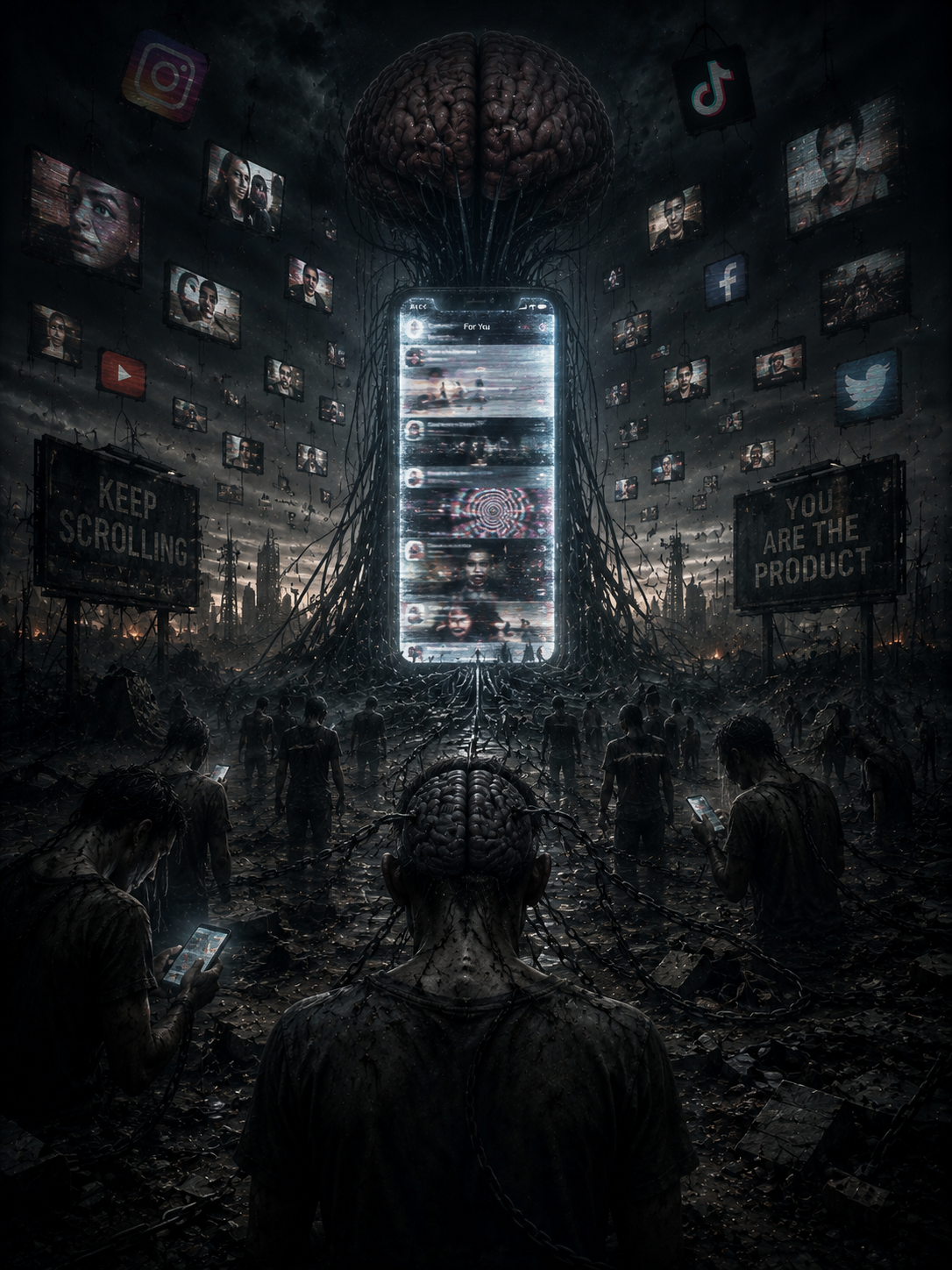
Fig. 0 — The subject’s most common conspiracy topics: Hijacking of the mind, Behavioral tracking, Dopamine addiction. A pattern of things which users doesn’t necessarily consent too but is a by-product of the free media they are consuming.
29.07.2026
The claim at the foundation of this entire file is, unusually for this archive, not a matter of dispute among scientists: the design patterns that dominate modern digital products borrow directly, and by the designers’ own admission, from decades of behavioural psychology research into how to make an action repeat. What is contested is not whether this borrowing happened, but what it means that it happened at civilisational scale.

Dopamine and the Anticipation of Reward
Popular accounts often describe social media as “hijacking the dopamine system,” a simplification worth handling carefully. Dopamine is not primarily a “pleasure chemical” released upon reward; neuroscience research since the 1990s (notably on reward prediction error) shows dopamine activity spikes most sharply in anticipation of an uncertain reward — the moment before you see who liked your post, not the moment you see it. This is precisely why interfaces are built around micro-moments of anticipation: the pull-to-refresh gesture, the brief loading spinner before a feed populates, the three-dot “typing” indicator. Each inserts a small window of uncertainty before a possible reward, which is the exact structure dopaminergic anticipation responds to most strongly.
Novelty-Seeking
Human attention is evolutionarily tuned to prioritise novel stimuli — a new sound, a new face, a new piece of information — because novelty historically signalled either opportunity or threat. Endless, algorithmically varied feeds exploit this directly: no two scrolls look the same, and the next post is always unknown until it appears. Where a book or a film has a fixed, exhaustible amount of novelty, an algorithmic feed is functionally infinite, supplying a steady stream of small novel stimuli with no natural stopping point built into the content itself.
Intermittent and Variable Reinforcement
The single most load-bearing concept in this chapter is the variable-ratio reinforcement schedule, first formally described by B.F. Skinner in the mid-20th century. Skinner found that behaviour rewarded unpredictably — sometimes after one attempt, sometimes after twenty — is far more resistant to extinction than behaviour rewarded every single time. This is the exact mechanism behind slot machines, and it is the mechanism sociologist Natasha Dow Schüll documented in granular detail in her 2012 study Addiction by Design, which examined how Las Vegas machine gambling is engineered to maximise “time on device” through precisely calibrated near-misses and unpredictable payouts. The comparison to social media is not merely rhetorical: refreshing a feed, checking for likes, or swiping to the next short video all deliver a reward (new content, social validation, humour, information) on an unpredictable schedule rather than a fixed one — structurally the same shape as a slot machine’s payout schedule, applied to social and informational rewards instead of money.
Social Validation
Likes, comments, shares, view counts, and follower counts convert social approval — one of the most powerful reinforcers in human psychology — into a quantified, constantly-updating score. Research associated with Facebook’s own internal teams (disclosed in 2021 through documents provided by whistleblower Frances Haugen, reported as the “Facebook Papers”) found that Instagram’s own research identified body-image and social-comparison harms in a meaningful minority of teenage users, particularly girls, even as engagement metrics from the same features continued to justify their design. The Directorate notes this internal research is now well-documented via congressional testimony and journalistic disclosure; it is not treated here as evidence of coordinated malicious intent, but as evidence that at least one major platform’s own researchers understood the mechanism’s costs prior to public disclosure.
None of Chapter I’s mechanisms would be deployed at scale without a business reason to deploy them. That reason is structural, not personal: the dominant revenue model of the modern internet is advertising, and advertising revenue is a direct function of attention captured and time spent.

The Core Incentive
Most large platforms — social networks, video services, mobile games, even news sites — are financially incentivised to maximise user engagement because attention itself can be monetised, chiefly through three mechanisms: direct advertising (sold per impression or per thousand views), subscription retention (a user who opens an app daily is a user unlikely to cancel), and data-driven recommendation systems (more interaction generates more behavioural data, which improves ad targeting and content-matching, which in turn drives further engagement). Global digital advertising spend, forecast to exceed $780 billion in 2026 out of over $1 trillion in total global advertising, is the clearest evidence of scale: attention is not a metaphorical resource but a directly priced one, bought and sold in real time through automated ad auctions that execute in the milliseconds between a user opening an app and a feed rendering.
Watch Time as the Governing Metric
Internal metrics disclosed through reporting, court filings, and former employees’ public statements consistently show that “time spent,” “session length,” “daily active users” (DAU), and “retention rate” function as the primary key performance indicators (KPIs) against which product and engineering teams are measured — not user satisfaction or wellbeing, which are harder to quantify and do not appear on advertiser dashboards. YouTube’s public shift, confirmed by the company itself around 2012, from optimising its recommendation algorithm for click-through rate to optimising for watch time is a widely cited, well-documented example: click-based recommendations were found to favour short-lived clickbait, while watch-time optimisation favoured content — including, critics noted, more extreme or attention-grabbing content — that kept viewers on the platform longer.
A Structural Argument, Not Necessarily a Personal One
It is worth stating plainly what this chapter does and does not establish. It establishes that the incentive structure of advertising-funded platforms rewards engagement-maximising design as a matter of ordinary business logic — no hidden coordination is required for this pattern to emerge, any more than coordination is required for competing restaurants to all put salt and sugar in their food. What remains genuinely contested is whether individual product decisions were made with full, deliberate awareness of the psychological mechanisms in Chapter I, or emerged more diffusely from A/B-tested trial and error that simply rewarded whatever kept metrics rising. Public testimony (Sean Parker, Justin Rosenstein, Tristan Harris, and others) suggests at least some of this awareness was explicit at the time; company statements typically frame the same features as good-faith attempts to improve relevance and user experience.
Chapters I and II describe the psychology and the incentive; this chapter catalogues the specific interface mechanisms built on top of them, each independently documented and each contested in its own right.

Infinite Scrolling
The interface pattern that removes the natural “stopping cue” once provided by pagination (clicking “next page”) is commonly credited to designer Aza Raskin, who has said he built it in 2006 to reduce a small usability friction and has since testified in U.S. litigation against Meta expressing regret, estimating the pattern now consumes roughly half a million cumulative human lifetimes of scrolling time every month. It should be noted for accuracy that the attribution is disputed: a separate engineering team at Microsoft has documented building and patenting a comparable “infinite scroll” component for image search as early as 2005, and no definitive resolution of priority exists in the public record. Whoever originated it, the pattern is near-universal today across social media, and its defining feature — no natural endpoint, no decision point at which a user must consciously choose to continue — is precisely what removes the moment at which self-regulation would normally occur.
Autoplay
Automatically advancing to the next video or episode without requiring a click — introduced by Netflix for episodic content in the early 2010s and adopted by YouTube shortly after — removes a second stopping cue: the natural pause between one piece of content ending and a decision to seek out another beginning. Users frequently report losing track of how many episodes or videos they have consumed as a direct result.
Personalised Recommendation Algorithms
Machine-learning recommendation systems (YouTube’s and TikTok’s “For You”-style feeds being the most studied) continuously refine content selection based on individual behavioural signals — watch duration, rewatches, pauses, and scroll-past speed — to maximise the platform’s chosen engagement metric. Because the system optimises directly against observed behaviour rather than stated preference, it can and does surface content a user did not consciously choose to want more of, a dynamic at the centre of ongoing regulatory and academic debate (including EU Digital Services Act risk-assessment requirements specifically targeting recommender-system design).
Notifications
Push notifications — enabled for third-party apps on smartphones from around 2009 onward — convert a platform from something a user must remember to open into something that actively interrupts the user’s day. Design research on notification “salience” (badges, red dots, sounds, and vibration) documents how these cues exploit the same interruption-response reflex as an alarm or a doorbell, regardless of whether the underlying content merits urgency.
Short-Form Video
TikTok’s rapid global growth from 2017 onward, and the subsequent, largely defensive launch of comparable formats (Instagram Reels and YouTube Shorts, both 2020), popularised a content unit of 15–60 seconds explicitly optimised for maximum reward density per unit of time: the variable-reinforcement cycle described in Chapter I compressed to its shortest practical loop. Multiple 2025–26 industry surveys report short-form video now commands the single largest share of daily social media time among users under 25, and researchers have specifically flagged the format’s compressed reward cycle — rather than its content — as the feature most associated with reports of compulsive use.
A distinct social phenomenon, separate from the design mechanisms themselves, is the emergence of a shared, often self-deprecating vocabulary for describing compulsive digital use — and what that vocabulary’s popularity itself suggests.
%2003.jpg)
“Doomscrolling”
The term “doomscrolling” — compulsively consuming a continuous stream of negative news — spread widely from 2020 onward, catalysed by the COVID-19 pandemic, when both the volume of alarming news and the amount of idle screen time available to consume it rose sharply together. Its structure names two things at once: the compulsive mechanism (scrolling as an act one struggles to stop) and the emotional content (doom, dread, bad news specifically), distinguishing it from ordinary browsing.
“Brain Rot”
Oxford University Press selected “brain rot” as its 2024 Word of the Year, defining it as the supposed deterioration of a person’s mental or intellectual state from overconsumption of trivial online content — noting the term’s usage had risen 230% year-on-year and that it was chosen from a public vote of more than 37,000 people. Notably, the phrase itself is not new: Oxford traced its first recorded use to Henry David Thoreau’s 1854 book Walden, where he complained about a figurative “brain-rot” afflicting society well over a century before smartphones existed — a detail the Directorate flags as a useful check against the assumption that this is an entirely unprecedented, technology-specific phenomenon, even as the scale and mechanism documented in Chapters I–III are genuinely new.
The Comedy of Recognition — Normalisation Through Humour
Both terms circulate overwhelmingly as jokes: self-aware captions, memes about “one more video” turning into an hour, and ironic use of “brain rot” as a badge of in-group identity among the same younger users the term was coined to describe. This is a documented pattern in the study of stigmatised or ambivalent behaviours more broadly — humour and self-labelling can function as a coping mechanism that makes a recognised problem bearable to acknowledge, while simultaneously reducing the perceived urgency of addressing it, since a behaviour that has become a shared joke is harder to treat as a serious individual or public health concern. The Directorate records this as an open question rather than a settled one: whether naming the problem this way primarily helps people recognise and discuss it, primarily defuses pressure for platforms or policymakers to change anything, or does some of both simultaneously.
Taken together, the preceding four chapters describe a closed loop: psychological mechanisms with a well-documented basis in behavioural science (Chapter I), deployed because an advertising-funded business model financially rewards their deployment (Chapter II), instantiated in a specific and continuously refined toolkit of interface features (Chapter III), and now culturally significant enough to have generated its own vocabulary of self-aware acknowledgment (Chapter IV).

The conclusion this file draws — and it is, unusually for a Realm33 dossier, closer to a documented economic reality than a speculative belief — is that competition in the digital age is not fundamentally a competition for money at all, at least not directly. It is a competition for the two genuinely finite resources every human being possesses in strictly limited daily supply: time and attention. Money, in the modern platform economy, is increasingly downstream of attention rather than the other way around — advertising revenue, subscription retention, and data-driven targeting all monetise attention that has already been captured. A day contains the same twenty-four hours it always has; what has changed is the number of well-funded, scientifically-informed systems competing every waking minute for a share of it. Global advertisers alone are on pace to spend over $1 trillion in 2026 for exactly this: not for a product, in most cases, but for a slice of attention that a person would otherwise have spent on something — anything — else.
Whether one frames this as sinister design, rational market behaviour, or simply the latest chapter in a much older story about media and persuasion, the Directorate notes that the underlying scarcity is not going away. Computing capacity, ad inventory, and content supply can all expand indefinitely. Human attention cannot. That asymmetry — not any single company’s malice or any single feature’s cleverness — is the structural fact this entire file exists to document.
Open Questions — Evidentiary Assessment
Archival Status and Classification
Unlike most files in this archive, The War for Human Attention documents a phenomenon whose core mechanisms are not seriously disputed by the institutions that built them — only their moral and regulatory implications remain contested. The Directorate classifies this not as a conspiracy theory requiring adjudication between belief and evidence, but as a documented industrial practice whose ethical status remains an active, legitimate public debate: reasonable people, in possession of the same facts catalogued here, differ on whether attention-optimised design constitutes a form of exploitation warranting regulation, an acceptable trade users implicitly consent to for free services, or something in between.
Recommended classification: BEHAVIOURAL DESIGN / DIGITAL ECONOMY — TIER ONE — MECHANISMS: LARGELY CONFIRMED — MORAL AND REGULATORY QUESTIONS: UNRESOLVED — ARCHIVAL STATUS: ACTIVE, WIDELY ACKNOWLEDGED, AND ONGOING
Source References
- Skinner, B.F. — “Schedules of Reinforcement” (1957) and subsequent operant-conditioning literature on variable-ratio schedules
- Schüll, N.D. — Addiction by Design: Machine Gambling in Las Vegas (Princeton University Press, 2012)
- NPR, The Indicator from Planet Money — “Why infinite scroll’s inventor wants to kill his creation” (2026): npr.org
- Masters of Scale — “I regret it: the founder of infinite scroll was blind to how it would be used” (interview with Aza Raskin): mastersofscale.com
- Wikipedia — Infinite scrolling, incl. competing Microsoft prior-art/patent claim: en.wikipedia.org/wiki/Infinite_scrolling
- Oxford University Press — “‘Brain rot’ named Oxford Word of the Year 2024”: corp.oup.com
- The Washington Post — “‘Brain rot’ is Oxford English Dictionary’s word of the year” (2024): washingtonpost.com
- Dentsu — “Global Ad Spend Set to Surpass $1 Trillion for the First Time in 2026” (2026 Global Ad Spend Forecast): dentsu.com
- DataReportal / GWI Global Digital reports (2025–26) — global daily social media and screen time estimates
- U.S. Congressional testimony and reporting on the “Facebook Papers” disclosed by Frances Haugen (2021) — internal research on Instagram and teen mental health
- Fogg, B.J. — Stanford Behavior Design Lab research on persuasive technology and habit-forming product design
- European Commission — Digital Services Act provisions on recommender-system transparency and risk assessment
- Wikipedia — Operant conditioning: en.wikipedia.org/wiki/Operant_conditioning
- Wikipedia — Attention economy: en.wikipedia.org/wiki/Attention_economy
- Wikipedia — Reward system / dopamine and reward prediction error: en.wikipedia.org/wiki/Reward_system
Last updated: July 2026. Compiled by the Directorate of Information Preservation and Archival, Realm33.org. The Directorate notes, in closing, a small irony worth preserving: this file was itself read to the end by scrolling. Whether that fact illustrates the problem or merely proves attention can still be spent deliberately, on purpose, on something worth finishing, is left for the reader to decide.