

Conspiracy & Social Phenomenon Dossier — Complete Archival Record
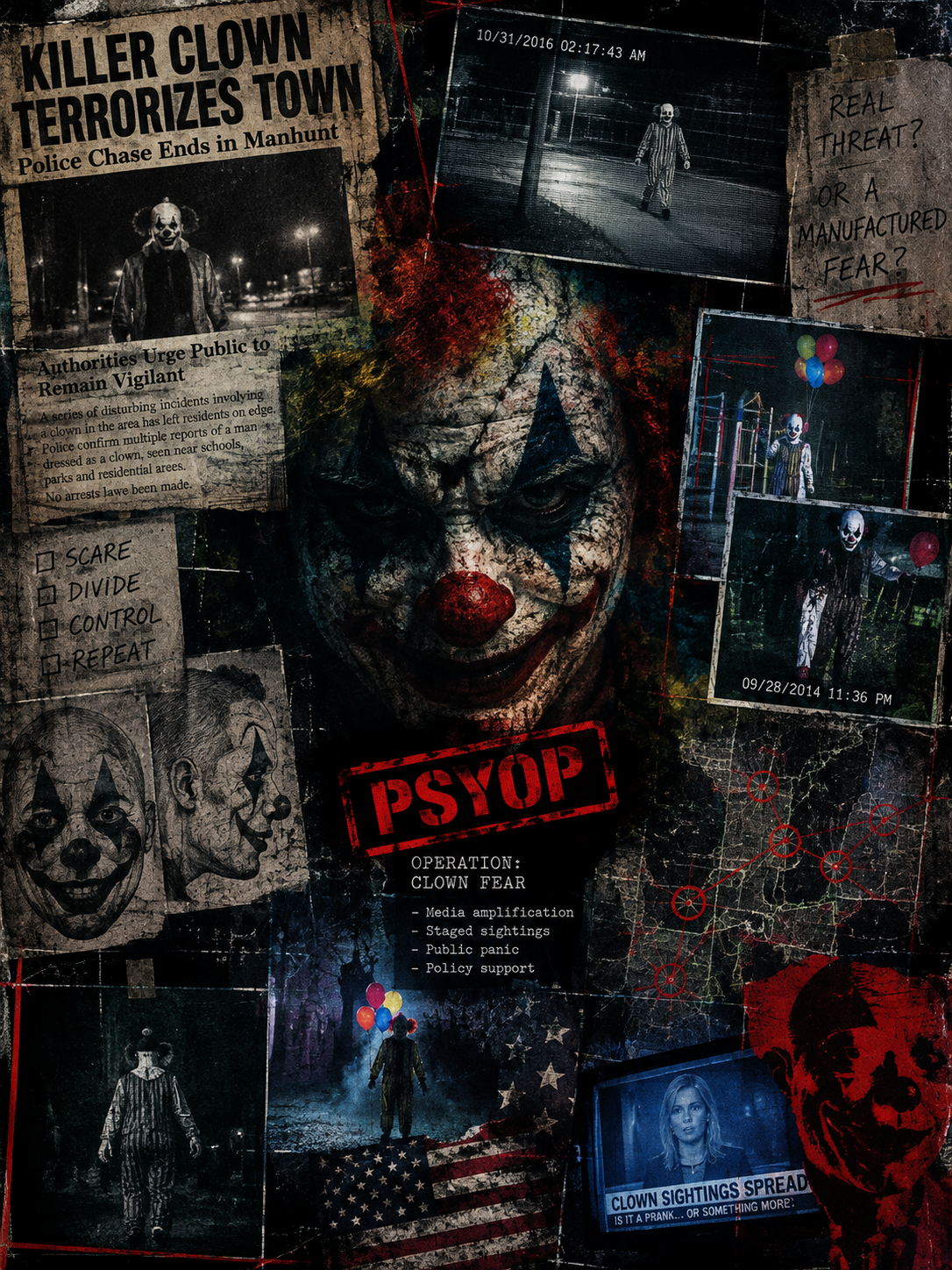
Fig. 0 — Subject illustration: The Killer Clown Psyop. Staged sightings, headlines and a stamped verdict: real threat, or manufactured fear? (Realm33 archive)
17.10.2026
The clown panic of 2016 reads like a sudden eruption, but the archive shows a fuse that had been burning for decades. Folklorists call the underlying legend the “phantom clown”: a story of strangers in clown costume trying to lure children into vans or woods, reported mostly by children and almost never confirmed by an adult or a police officer. The first modern American wave was reported in 1981 in Brookline, Massachusetts, where children said men dressed as clowns had tried to pull them into a van. The story travelled through the Midwest and Northeast, and resurfaced in Phoenix in 1985, in Brazil in 1990 through a tabloid account of a clown in a van, in West Orange, New Jersey in 1991, in Honduras in 1995, and in Chicago in both 1991 and 2008. Researchers have linked these waves to the shadow of the serial killer John Wayne Gacy, who was arrested in 1978 and nicknamed the “Killer Clown” because he had performed as Pogo the Clown at children’s parties. Others link them to the Satanic ritual abuse fears of the 1980s, and some note the resemblance to the Pied Piper of Hamelin.

The Staged Precursors — 2013 to 2015
What changed in the 2010s was that the legend acquired cameras. In September and October 2013, a silent, Pennywise-like clown appeared around Northampton, England, and the town spent weeks wondering about it. It turned out to be the work of three local filmmakers, Alex Powell, Elliot Simpson and Luke Ubanski, who unmasked themselves after the story went viral. In March 2014, an Italian prankster named Matteo Moroni, who runs the YouTube channel DM Pranks, began scaring passersby in a killer-clown costume, and his videos gathered hundreds of millions of views. In October 2014 the “Wasco clown” appeared in photographs around Wasco, California, and was later revealed to be part of a year-long photography project by an artist’s wife. That same year a clown seen around Staten Island, New York, was reportedly staged by the film collective Fuzz on the Lens, whose members later became associated with the Terrifier horror franchise. In July 2015, two Chicago residents filmed a clown scaling the gate of Rosehill Cemetery at night, turning to wave slowly at them, and vanishing into the trees. Police made no arrests.
This chain of precedents matters to both sides of the argument. Skeptics point out that every one of these earlier sightings was traced to creative people chasing attention, which suggests the 2016 wave needed no hidden hand. Conspiracy readers note the same pattern from the opposite angle: the public had been trained, one disclosed stunt at a time, to treat a clown at night as a spectacle worth sharing.
Green Bay — The Clown With the Black Balloons
The documented start of the 2016 wave came at about 2 AM on August 1, 2016, in Green Bay, Wisconsin. Five photographs showed a clown in a soiled costume, holding black balloons, standing in a vacant parking lot beneath a bridge. A Facebook page appeared shortly afterward, naming the character “Gags.” Within days the images had been picked up by Fox News and USA Today. A Wisconsin filmmaker then confirmed they were a marketing stunt for an unreleased short film titled Gags. That short became a feature in 2018 and reached video-on-demand platforms in 2019. The intent was benign, but the image of a silent clown standing where no clown should be had been released into a public already steeped in decades of evil-clown cinema.
The Greenville Reports — The Spark That Ignited the Panic
In late August 2016, reports began surfacing in Greenville County, South Carolina, according to The New York Times. Children said clowns were lurking in the woods near their apartment complex, and rumour added that the clowns were offering money to lure kids inside. A sheriff’s office and local police took the calls seriously, and a police chief warned that “the clowning around needs to stop.” Yet the reports were never substantiated by physical evidence. No clowns were found, and no arrests tied to the original Greenville sightings were ever announced. The narrative they set, clowns in the woods, luring children, vanishing when police arrive, proved extraordinarily durable.
From South Carolina the phenomenon moved quickly. A clown in Winston-Salem, North Carolina, was reported offering treats to children and fled when police arrived. Reports rippled up and down the Eastern Seaboard, then west across the Midwest, and by early October they had reached the West Coast. An Atlas Obscura interactive map compiled in October 2016 logged over a hundred sightings and threats across the United States. By mid-October, clown sightings and attacks had been reported in nearly every state, in nine of Canada’s thirteen provinces and territories, and in eighteen other countries. In September, nine people in Alabama were arrested on suspicion of “clown-related activity,” a phrase that tells you everything about how strange the moment had become.
The International Spread — From America to the World
By October 2016 the clown panic had gone global. British police issued warnings after a spate of “killer clown” sightings across the country. A man in a clown outfit carrying a knife followed four children aged 11 or 12 to school in Durham. Thames Valley Police received 14 reports of clown incidents in a single 24-hour period. In Clacton-on-Sea, two girls were approached by clowns asking if they wanted to go to a birthday party. In Australia, police in Victoria warned the public not to engage in “intimidating” behaviour after reports of clowns terrorising people in Melbourne. Sightings followed in New Zealand, the Netherlands, Denmark, and Quebec, and the Russian Embassy in London issued a warning to its citizens on October 12. The next day, Fijian police cautioned the public against involvement. In Glasgow, a Facebook page called “Killer Clowns in and around Glasgow” posted a photograph of a clown under a bridge; the post was shared more than 1,000 times before the poster admitted the picture had been lifted from the internet and that it was a hoax.
The role of the news media in the 2016 clown panic is central to both the mainstream sociological analysis and the conspiracy narrative. Mainstream analysts describe a feedback loop: news reports of clown sightings inspired copycat pranks; those pranks generated more news reports; the growing coverage made the phenomenon look more widespread and organised than it was. Conspiracy theorists describe a more deliberate dynamic, in which repetitive coverage functions not merely to report but to normalise and intensify fear.

The Feedback Loop — “News Reports of Menacing Clowns”
The New York Times, in an October 2016 editorial, described the phenomenon directly: “News reports of menacing clowns — lurking in woods, luring children, threatening violence — have multiplied quickly over the past few months, spreading from state to state, and now to Britain and Europe. While many reports of clown sightings appear to be hoaxes, the hysteria seems to be inspiring copy-cat pranks and occasional acts of real violence.” This formulation captures the essence of the amplification thesis: the reporting was not merely describing a pre-existing phenomenon; it was participating in the creation of one.
Sociologist Stuart Poyntz warned in 2016 that media coverage of the clowns might be contributing to a “moral panic.” The sightings had continued for days, but there was still “no photographic or physical evidence of any malicious clowns.” The gap between the volume of coverage and the thinness of the evidence is one of the most striking features of the archival record. Even the headline writers knew it: Vox titled its October 2016 analysis with the claim that the great clown panic was a hoax, while insisting that the terrifying side of clowns was real.
The Copycat Dynamic — “A New Report Every Hour”
CBS News reported in October 2016 that “it seems as if a new report of a threatening clown pops up every hour.” A 14-year-old in California was arrested when he threatened a middle and high school on an Instagram page called “Fontana’s Killer Clowns.” Police said the teen wanted to scare people and gain social media followers. In Philadelphia, a 13-year-old girl was identified as the author of clown threats made against local schools. Officials treated many such posts as hoaxes, but they were compelled to take them seriously as possible threats to safety. The copycat dynamic fed itself: each new report provided a template for the next prank, and each prank provided a new news cycle.
The Marketing Hypothesis — Was It an Advertisement?
A softer cousin of the psyop theory suggested the panic was commercial rather than political. The Green Bay clown was openly a promotional stunt. In early September 2016, The Guardian reported that the South Carolina sightings might be tied to film marketing, and a hypothesis circulated that the wave was a viral campaign for the 2017 feature adaptation of Stephen King’s It, whose villain, Pennywise, had shaped the look of several earlier staged clowns. A spokesperson for New Line Cinema, the film’s distributor, said the studio was absolutely not involved. King himself urged people to calm down and not blame his work. No evidence has surfaced that any studio orchestrated the wave. Still, the film industry did harvest the moment: a feature called Behind the Sightings, inspired by the panic, was acquired in 2017, and a decade later a streaming documentary was commissioned to revisit it.
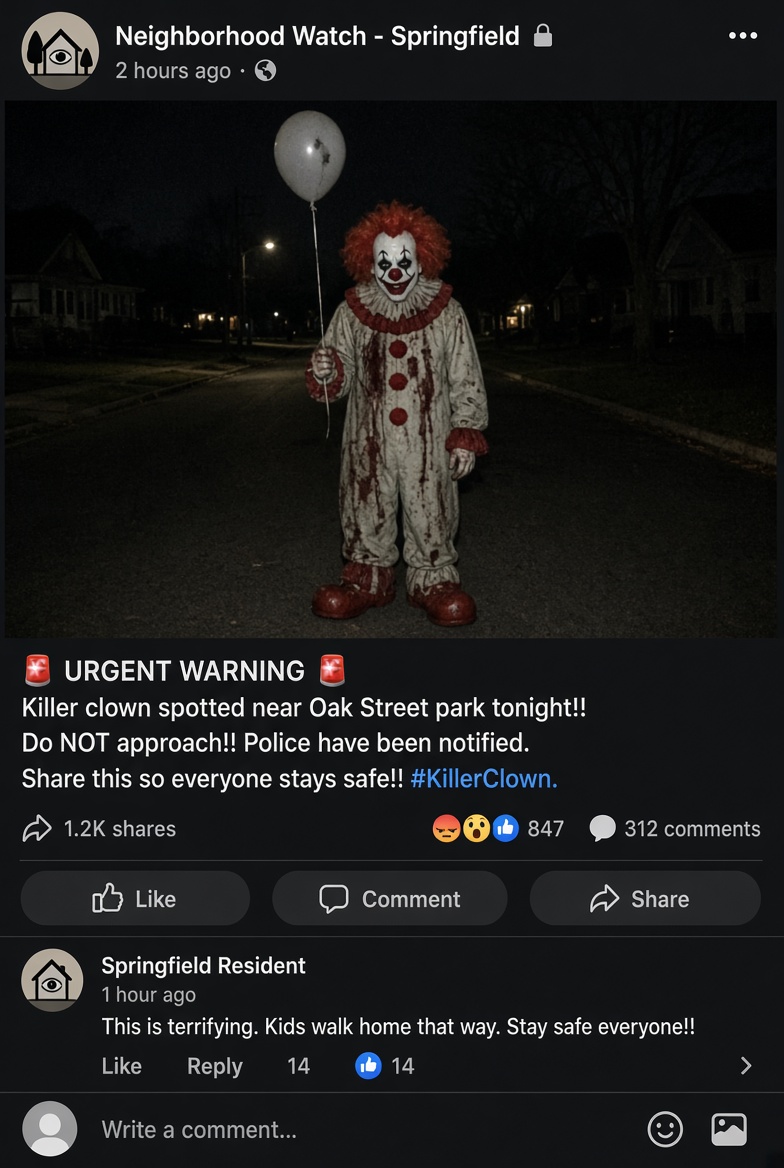
If the news media amplified the clown panic, social media was its native habitat. The 2016 phenomenon was the first major creepy-clown scare to unfold in the era of smartphones, Facebook community pages and viral platforms, and the mechanics of those platforms shaped both the content and the spread of the panic. Local “killer clown” pages sprang up for towns and schools, each one a ready-made rumour mill that anyone could feed with a borrowed photograph.
Viral Videos and the Verification Problem
The BBC reported on a hoax in Glasgow in which a Facebook page called “Killer Clowns in and around Glasgow” posted a photograph of a clown under a bridge. The post was shared more than 1,000 times before the poster admitted he had “lifted the pictures from the internet” and that it was a hoax. The poster described people who believed the post as “daftys.” This pattern, the fabrication of a local sighting from imagery sourced elsewhere, rapid sharing, and a belated admission, was repeated across multiple countries. A Glasgow fancy-dress shop reported surging costume sales, and some parents began to wonder whether the clowns at their door were real or merely a trending outfit.
Folklorist Benjamin Radford, who began covering the rise of clown sightings in 2013, told the BBC that clown reports can almost always be filed into one of two categories. “Stalker clowns” are real sightings of people dressed as clowns for a lark: “They’re not a genuine menace, they’re just basically sort of doing a combination of prank and performance art.” “Phantom clowns,” by contrast, are pure myth. “They’re almost entirely reported by children,” Radford said. “Many of them turn out to be hoaxes, but other ones were sort of legends, or schoolyard rumour.” In his book Bad Clowns, Radford adds a wider thesis: the trickster who speaks uncomfortable truths and escapes consequences has not vanished from modern life but has migrated online, where the bad clown has become the internet troll.
Clown Hunters and Campus Mobs
Fear soon produced its own counter-movement. Students at Pennsylvania State University and Michigan State University formed mobs that searched their campuses for clowns after reported sightings. Rumours of clown attacks circulated at campgrounds. Pages with names like “Clown Hunters” invited vigilantes to go looking, which created the very danger the police had been warning about: costumed pranksters and innocent bystanders confronted by frightened people who believed a threat was real. Professional clowns pushed back with the hashtag #ClownLivesMatter, and the president of the World Clown Association publicly condemned people who dressed up to frighten others.
The “Clown Purge” Rumour — A Viral Threat With Almost No Evidence
One of the most widely circulated social media claims was the rumour of a “clown purge,” a coordinated plan by clowns to attack people on the night before Halloween, a notion borrowed from the film franchise The Purge. The claim spread from a Facebook page called “Clown Hunters,” which warned that clowns might be “planning their own purge the night before Halloween.” Most versions of the rumour omitted any account of how the information had been obtained. No widespread purge occurred. Yet on October 31, 2016, a family in Orange County, Florida, said they were attacked by a group of roughly twenty people in clown masks and Purge-style masks, and no arrests were made. Elsewhere, some Floridians chose to go armed while trick-or-treating. A rumour with no evidence behind it had still managed to change how neighbours behaved on the most child-friendly night of the year.
The conspiracy theory that the 2016 clown panic was a deliberately orchestrated psychological operation emerged almost immediately, while the panic itself was still unfolding. Its central claim is that the phenomenon was too widespread, too rapid, and too conveniently timed to be a spontaneous eruption of pranks and hysteria. The theory runs along a spectrum, from the modest claim that the panic was deliberately amplified for commercial or political purposes to the maximalist claim that it was a rehearsal for a larger false-flag event.
The Documented Origins of the Psyop Claim
The psyop interpretation was articulated most directly by independent media outlets and online researchers. Truthstream Media, in a video published on October 8, 2016, and later archived on the Internet Archive, posed the question directly: “What in the hell is going on with all the creepy clowns… local authorities are calling people up with emergency alerts and making sure entire towns are living in fear of random creepy clowns. Feels like a huge psyop.” The video captured the moment when the phenomenon shifted from a curiosity to a perceived threat, and when the institutional response (school district alerts, police warnings) began to seem disproportionate to the evidence.
The theory was further fuelled by the involvement of government. The White House was asked about the clown scare at a press briefing in October 2016. Press Secretary Josh Earnest said, “I don’t know that the president has been briefed on this particular situation.” That the subject had reached the White House podium, however dismissively, was cited by theorists as evidence that the panic was being monitored, or even managed, at the highest levels.
The Evidence Cited by Psyop Theorists
The evidentiary basis for the psyop theory is circumstantial and interpretive. The theorists point to several factors:
- The Speed and Uniformity of the Spread The phenomenon travelled from a single location (Green Bay or Greenville) to nearly every U.S. state and many countries in about two months. The uniformity of the reports, clowns in woods, clowns near schools, clowns trying to lure children, is cited as evidence of a shared script rather than organic copycat behaviour.
- The Institutional Response That police departments, school districts, retailers and even the White House press office treated the phenomenon as a serious matter, diverting resources, issuing alerts, and conducting investigations, is cited as evidence that the panic was being deliberately escalated from above. Theorists sometimes invoke the “morbid national psychology” language of the 1953 CIA-convened Robertson Panel on unidentified flying objects as proof of a longer government interest in managing public perception by managing fear.
- The Timing The panic occurred in the final months of the 2016 U.S. presidential election, a period of intense social and political anxiety, and sociological analyses have explicitly situated it as a response to that anxiety. Theorists argue that the timing was not coincidental, and that the panic was designed to test or exploit public fear at a moment of maximum distraction and polarisation.
- The Absence of Substantiated Sightings Despite hundreds of reports, there was a conspicuous absence of photographs, videos or physical evidence of clowns actually committing the crimes described. The Directorate notes that this absence cuts both ways: it supports the mainstream explanation (rumour and hoax) and the conspiracy explanation (a manufactured narrative with no underlying reality).
- The Commercial Fingerprints The Green Bay clown was a film promotion, and several earlier clown “sightings” (Northampton, Wasco, Staten Island) were staged by filmmakers or artists. Theorists argue that if creative professionals could seed a viral scare this easily, someone with greater resources could do it deliberately and at scale. The Directorate notes that no link has been shown between those stunts and the 2016 national wave.
The Skeptical Counter-Position
The mainstream and skeptical interpretation holds that the psyop theory is not required to explain the 2016 clown panic. The dynamics of media amplification, social media virality, copycat behaviour, and pre-existing cultural fears about clowns, the evil-clown archetype, Pennywise, and the release of a new It film in 2017, are sufficient to explain the phenomenon as an emergent, self-organising event. In this reading the panic was real in its effects but not in its origin: a feedback loop between media, social platforms, and a public primed for fear produced something that felt coordinated but was actually decentralised. Skeptics add that the phantom clown legend has repeatedly erupted since 1981 with no known orchestrator, and that the widespread, uncoordinated, often contradictory reports look more like folklore than a command structure.
The 2016 clown panic did not exist in a psychological vacuum. It activated deep-seated human responses to masked, ambiguous figures, responses shaped by evolution, culture and individual experience. The Directorate catalogues the psychological factors that both mainstream and conspiracy analyses of the panic identify.
Coulrophobia — The Fear of Clowns
Coulrophobia, the fear of clowns, is a popularly recognised but not formally classified phobia; the word itself was coined informally on internet phobia lists, and the Online Etymology Dictionary notes it looks like the sort of term invented online and repeated ever after. The fear it names is real enough. A 2022 survey of 987 adults from 64 countries found that 54% reported some degree of coulrophobia, and researchers pointed to unpredictability and media exposure as leading causes. Earlier, a University of Sheffield study of hospital decor found that clowns were universally disliked by children, who found them frightening and unknowable. The clown’s makeup hides the face, which makes a familiar body type carry an unfamiliar face, and as one psychologist put it, young children are “very reactive” to exactly that combination.
The Uncanny Valley and Mask Psychology
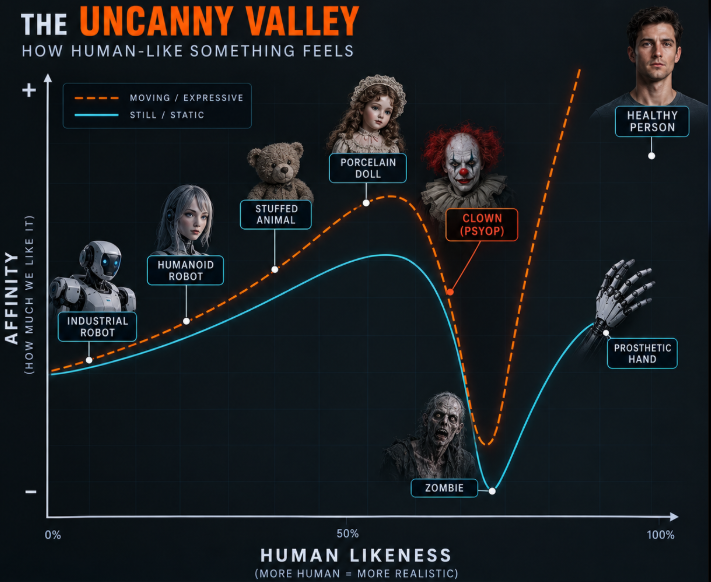
The “uncanny valley,” a term from roboticist Masahiro Mori’s 1970 essay, describes the discomfort people feel when something looks almost human but not quite right. Researchers who have studied clown fear believe it correlates with the effect, with painted faces, exaggerated expressions, and fixed smiles sitting squarely in that unsettling space. The Directorate records a caveat: Mori’s essay was a theory rather than an experimental finding, and later research on the uncanny valley is generally inconclusive. As Professor Mark Griffiths of Nottingham Trent University noted, “the vast majority of people are not scared of clowns day-to-day but a clown’s face has become part of a scare culture. There is a stereotype of the nasty, evil clown.”
Conspiracy theorists and cultural analysts have also noted the mask as a symbol of hidden power, the anonymous face of authority or malevolence. In this reading the masked clown is a physical embodiment of the faceless system, the unseen hand, the hidden agenda. The fear of the clown is, in part, the fear of not knowing who is behind the mask.
The Lineage of the Evil Clown
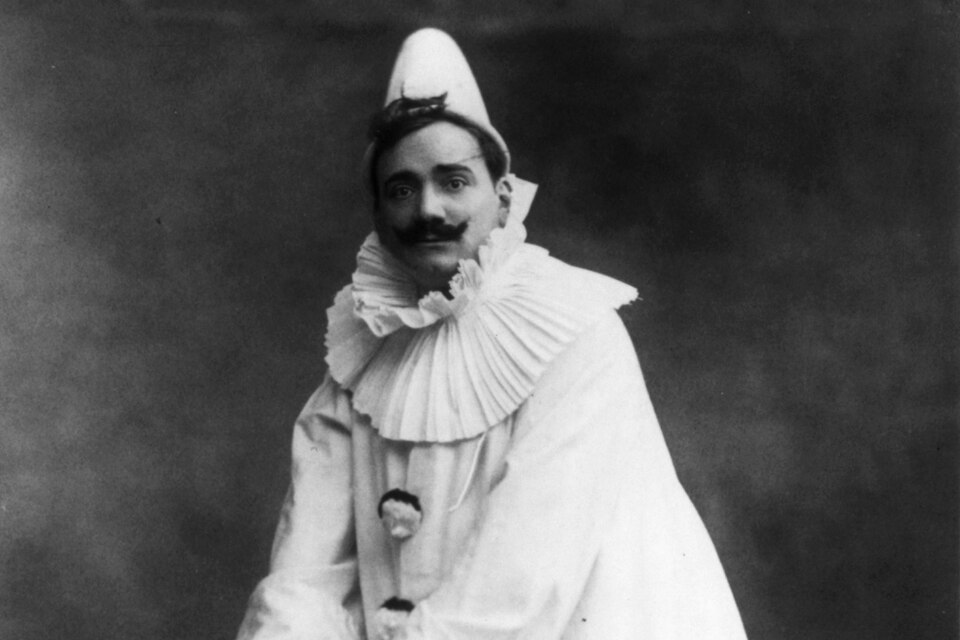
The 2016 scare drew on a long tradition. Joseph Grimaldi, the Regency pantomime star, invented the whitefaced stage clown in the early nineteenth century and, by his own sad end, the idea of the tragic clown too. Edgar Allan Poe’s 1849 story “Hop-Frog” gave literature a vengeful jester, and Leoncavallo’s opera Pagliacci (1892) gave the stage a murderous one. In 1978 the arrest of John Wayne Gacy, who had entertained children as Pogo the Clown, fixed the “Killer Clown” in the American imagination, although he did not commit his crimes in costume. The Joker arrived in Batman comics in 1940, Stephen King’s It introduced Pennywise in 1986, Killer Klowns from Outer Space followed in 1988, and by the 2010s American Horror Story had added Twisty and haunted-house operators had made the murderous clown a seasonal staple. Researcher Benjamin Radford is careful to note that these figures are the exception: most people love clowns, and good clowns far outnumber bad ones.
Rumour and Anxiety — Why People Believed
Sociologist Dustin Kidd of Temple University described the panic as “a new twist on a phenomenon as old as witch hunts. There is a sense that there is some evil force out there that we have to organize together to attack.” The 2016 panic occurred during a period of pronounced social anxiety: the U.S. presidential election, political polarisation, and a broader sense of cultural instability. The clown provided a visible, identifiable villain for a diffuse set of fears.
The 2016 clown panic produced real institutional responses. Police departments diverted resources to investigate reports that often turned out to be hoaxes. Schools locked down. People were arrested, sometimes for behaviour that was legally ambiguous, since dressing as a clown and standing in a public place is not in itself illegal in most jurisdictions. The charges that did stick were typically for false reports, threats, and chasing people.
The Arrests — Documented Cases
The Directorate records the following documented arrests and incidents. The New York Times counted at least twelve arrests in the United States by late September 2016, so this list is illustrative rather than complete.
- Ohio — September 2016 Seven young people posing as clowns were arrested for inciting panic and making threats in the Cincinnati area. Police in suburban Montgomery charged five students with inciting panic for allegedly suggesting a “Clown Clan” descend on their schools, and a 15-year-old was charged with terroristic threats.
- Alabama — September 2016 At least nine people were arrested in Alabama on suspicion of “clown-related activity” as local police departments scrambled to answer reports. The charges were mostly for false reports, threats, and disorderly conduct rather than violence.
- Kentucky — September 2016 A 20-year-old man in a clown outfit and mask was arrested in Middlesboro after he was spotted crouched in a wooded area by an apartment complex. In a separate incident, a 25-year-old in a Walmart parking lot was arrested after numerous people called police to complain about him. He told police it was “merely just for fun, with Halloween coming up and all.”
- California — October 2016 A 14-year-old was arrested when he threatened a middle and high school on an Instagram page called “Fontana’s Killer Clowns.” Police said the teen wanted to scare people and gain social media followers.
- United Kingdom — October 2016 A 13-year-old boy in Newcastle was arrested for wearing a clown costume and trying to scare passers-by. He had been carrying a knife as part of his fancy dress but was let off with a warning. In Gloucestershire, police warned residents about people in clown suits acting suspiciously after receiving six reports of such behaviour.
- Australia — October 2016 Police in Victoria warned the public not to engage in “intimidating” behaviour after reports of clowns terrorising people in Melbourne, and received 18 reports of creepy or threatening clown sightings by early October.
- Reading, Pennsylvania — September 2016 A 16-year-old boy was fatally stabbed in an incident that may have been provoked by a prowler wearing a clown mask, according to The New York Times. The Directorate records this as the single death associated with the panic and notes that the connection to the clown phenomenon, as reported, was uncertain.
School Lockdowns and the Cost of Fear
Schools across the United States, Canada and the United Kingdom locked down in response to clown threats. In Edmonton, Canada, Harry Ainlay High School was locked down after an alleged threat was made online by someone using the name “YEG Clown.” In Alabama, school lockdowns and police responses were reported in Fairhope, Rainbow City, Etowah County, Calhoun County and Irondale. School districts in California, New Jersey and Ohio introduced blanket bans on clown costumes and masks. The cost of these responses, in police time, in school disruption, and in the anxiety of students and parents, is part of the documented record.
Retail, Corporate and Civic Reactions
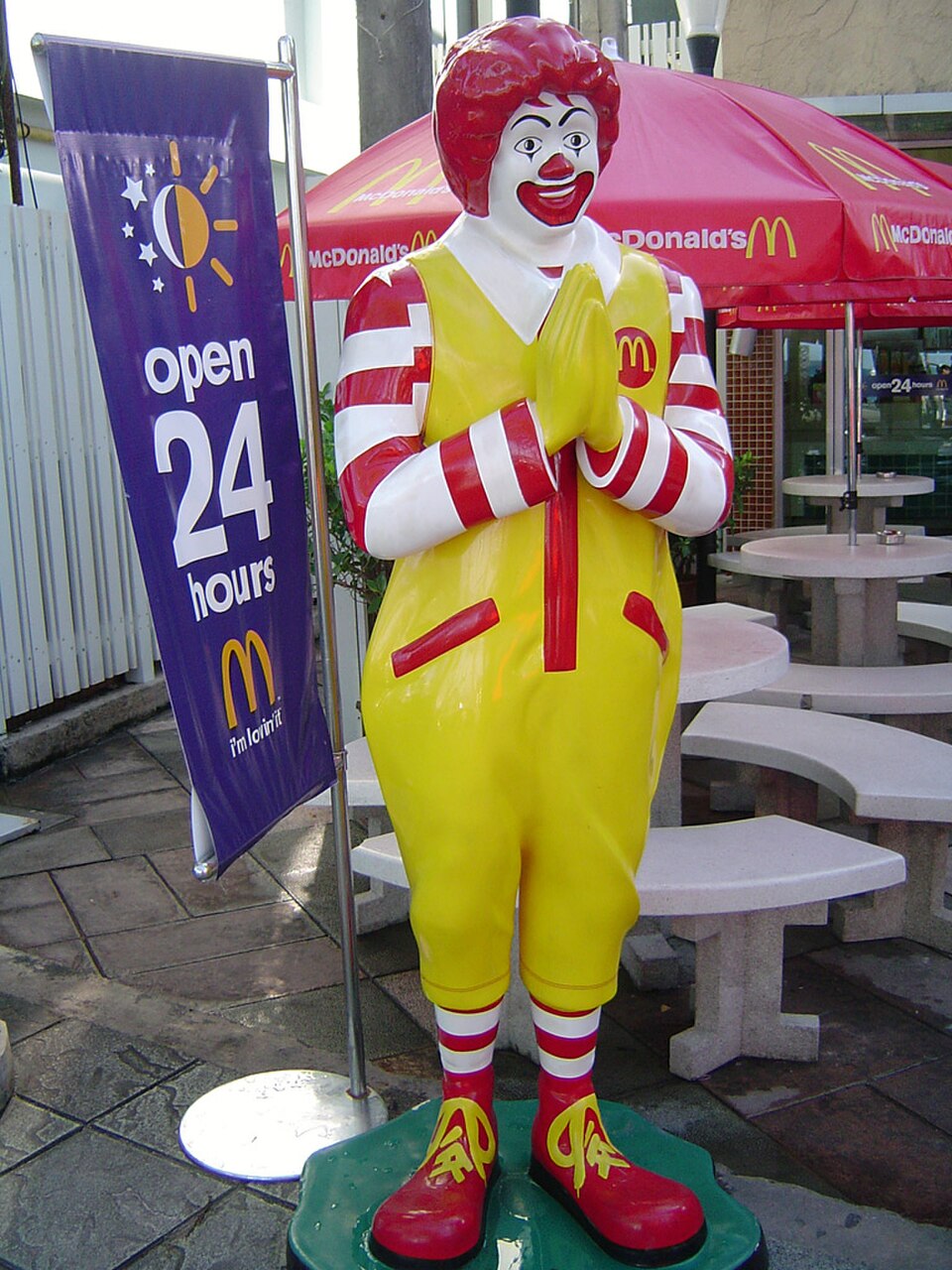
The panic leaked far beyond law enforcement. In October 2016, McDonald’s said it was being thoughtful about Ronald McDonald’s participation in community events and that he would keep a lower profile. Target pulled clown masks from its stores and website, as did Canadian Tire, and several New Zealand shops removed clown costumes from their shelves. The village of Memramcook, New Brunswick, asked residents not to dress as clowns on Halloween. Theme park employees were told to remove horror costumes and makeup before leaving work. A sociologist described 2016 as “a bad time to be a professional clown.”
Professional clowns bore the brunt. Justin Brodie, a professional clown, told CBS News: “I’ve been flipped off, I’ve been booed, I’ve had trash thrown at my car, I’ve been experiencing excessive profanity while performing.” The panic had real consequences for the people it was ostensibly about.
A decade after the 2016 clown panic, the phenomenon continues to be analysed, debated, and, in 2026, revisited in a major documentary. The Hulu documentary Clown Panic, directed by Ed Perkins and released on October 12, 2026 as part of the streamer’s Halloween programming, draws on archive footage, viral internet videos, and interviews with witnesses, law enforcement, clowns and cultural commentators. Its official synopsis describes “the collision of fear, social media and modern America at a moment of deep national anxiety.”
The Moral Panic Framework
Sociologists and cultural analysts have consistently interpreted the 2016 clown panic through the lens of “moral panic,” a concept developed by Stanley Cohen to describe periods when a condition, episode, person or group emerges to be defined as a threat to societal values and interests. The clown panic fits the template: a perceived threat (masked figures), a wave of media coverage, an institutional response, and a subsequent dissipation when the threat failed to materialise in the form feared.
Perkins has framed the story as one about how something small and strange grows into something national. He has described clowns as occupying a strange space between comedy and horror, and the panic as the moment that tension escaped the screen and entered the real world. His documentary treats the sightings as a window onto the anxieties of the moment, which is also how the sociologists quoted in this file read them.
The Conspiratorial Interpretation of the Meta-Narrative
Conspiracy theorists interpret the retrospective framing of the clown panic, particularly the release of the 2026 documentary, as itself part of the psyop. In this reading, the documentary serves to retroactively normalise the panic as a harmless cultural curiosity, erasing the possibility that it was a deliberate operation. The Directorate records this interpretation but does not adjudicate it. The archival record contains both the documentary and the conspiracy interpretation of the documentary. Both are part of the file.
Open Questions — Evidentiary Assessment
Archival Status and Classification
The 2016 clown panic is assessed by this Directorate as a paradigmatic case of a modern media-driven social phenomenon, in which the boundaries between real events, rumour, hoax, stunt and institutional response became so blurred that the phenomenon itself became its own subject. The documented events are real: people dressed as clowns, people were arrested, schools locked down, shelves were emptied, and communities experienced genuine fear. The conspiracy theory, that the panic was a deliberate psyop, is not required to explain these events, but it is not definitively refuted by the documentary record either. The absence of a smoking gun is, in the logic of the psyop theory, precisely what one would expect from a competent operation.
The Directorate records the 2016 clown panic as a case study in how fear propagates in the information age, and how the line between a prank and a threat is determined less by the intentions of the prankster than by the readiness of the audience to believe. The panic dissipated as quickly as it emerged, but the questions it raised, about media responsibility, social media verification, and the psychology of mass fear, have not been resolved. The release of the 2026 documentary Clown Panic has reopened the file for a new generation of viewers.
Recommended classification: MASS HYSTERIA / MEDIA EVENT — TIER TWO — DOCUMENTED HOAXES, STUNTS AND PRANKS — CONSPIRACY CLAIMS: UNVERIFIED — ARCHIVAL STATUS: DORMANT BUT SUBJECT TO PERIODIC REVIVAL
Source References
- Wikipedia — 2016 clown sightings: en.wikipedia.org/wiki/2016_clown_sightings
- Wikipedia — Evil clown: en.wikipedia.org/wiki/Evil_clown
- Atlas Obscura — “The Definitive Map of America’s Creepy Clown Epidemic” (October 6, 2016)
- The New York Times — “Creepy Clown Sightings in South Carolina Cause a Frenzy” (August 30, 2016)
- The New York Times — “Creepy Clown Hoaxes Lead to 12 Arrests in Multiple States” (September 29, 2016)
- The New York Times — “What’s Behind the Spreading Creepy Clown Hysteria?” (October 14, 2016)
- The Guardian — “South Carolina clown sightings could be part of film marketing stunt” (September 4, 2016)
- Vox — “The great clown panic of 2016 is a hoax. But the terrifying side of clowns is real” (October 12, 2016)
- The Atlantic — “Northampton Solves the Mystery of The Creepy Clown” (October 2013)
- BBC News — “Hoaxer owns up to Glasgow ‘Creepy’ clown picture” (October 2016)
- BBC News — “Why I am a ‘killer clown'” (October 25, 2016)
- Reuters — “Police issue warning as creepy clown craze comes to Britain” (October 10, 2016)
- CBS News — “Hoax or threat? Clown sightings fuel panic nationwide” (October 8, 2016)
- AP News — “6 more arrested as Ohio clown threats multiply” (October 1, 2016)
- AP News — “Clown hoaxes force police to check pranks for real threats” (October 5, 2016)
- CBC Radio — “Beware the clowns: a lesson in moral panic” (September 2016)
- Radford, Benjamin — Bad Clowns (University of New Mexico Press, 2016)
- USA Today — “The truth about killer clowns – Should you be scared?” (October 13, 2026)
- Hulu — Clown Panic documentary, directed by Ed Perkins (October 12, 2026)
- Truthstream Media — “What Is Really Behind All These Creepy Clown Sightings?” (Internet Archive, October 8, 2016)
- CORDIS — “Trending Science: Why coulrophobia is no laughing matter” (October 13, 2016)
- Encyclopaedia Britannica — “Uncanny valley”
- Cambridge University Press — “Evil Clowns” in The Trouble with Jokes (2024)
- SAGE Journals — “The clickable carnival: Killer clowns and the spectacle of fear within the era of late capitalism” (2025)
Last updated: October 2026. Compiled by the Directorate of Information Preservation and Archival, Realm33.org. The Directorate notes that the 2016 clown panic was a phenomenon in which the question “what is real?” was itself the subject of the event. The clowns were real; the threat was largely not. The fear was real; the coordination was largely not. The arrests were real; the crimes, for the most part, were the reporting of the fear itself. The Directorate files this dossier with the observation that the most revealing document in the archive may be the one that explains why a single hoax in a Glasgow Facebook group could be shared over a thousand times in a world that had already decided to be afraid.


