

REALM33
Directorate of Information Preservation and Archival
Subject Profile – File Extract
Designation: The Epstein Files
Also Known As: “Epstein Documents” · “The Epstein Library” · ███████
Primary Source: US Department of Justice — justice.gov/epstein
Total Volume: Approximately 3.5 million pages released · 180,000 images · 2,000+ videos · DOJ identifies up to 6 million potentially responsive pages
Governing Law: Epstein Files Transparency Act (signed November 19, 2025)
Current Status: ACTIVE — ONGOING RELEASES — CONGRESSIONAL INVESTIGATION OPEN — April 2026
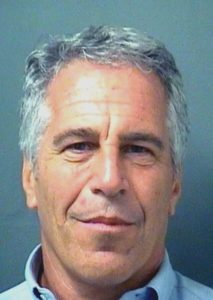
Fig. 1 – Jeffrey Epstein, Palm Beach County Sheriff’s Office mugshot, 2008. He would serve 13 months with generous work release privileges on a state charge — a deal arranged by then-US Attorney Alex Acosta that sealed the identities of his co-conspirators and granted them federal immunity. / Public Domain
The Origin of the Operation
The files that would eventually bear Jeffrey Epstein’s name in law and legend began accumulating in 2005, when the parents of a 14-year-old girl reported to Palm Beach Police that Epstein had abused their daughter. That report triggered an investigation that would identify 36 underage victims — and then be systematically buried by a non-prosecution agreement that became, in the two decades that followed, a case study in how institutional access and financial resources can redirect the course of justice.
The FBI launched a federal investigation in 2006, internally known as Operation Leap Year. Federal prosecutors in the Southern District of Florida had by 2007 prepared a draft federal indictment containing 60 separate counts against Epstein. That indictment was never filed. Instead, US Attorney Alexander Acosta — acting with the DOJ’s approval — offered Epstein a state plea deal to solicitation of prostitution involving a minor, an 18-month sentence in Palm Beach County Jail, the right to leave the facility six days a week for office visits, and, most critically, immunity from federal prosecution for Epstein and any named co-conspirators. Crucially, the agreement was negotiated in secret, without the knowledge of Epstein’s victims, in violation of the Crime Victims’ Rights Act. The agreement also sealed the identities of all co-conspirators — meaning that everyone who participated in Epstein’s network received immunity from federal prosecution without ever being publicly named.
Epstein served 13 months, largely in his Palm Beach office, before being released. The operation continued. It was not until 2018 — when Miami Herald investigative reporter Julie K. Brown published her landmark series “Perversion of Justice” — that the full scope of the 2008 arrangement became public, the victims’ identities were documented, and public pressure forced the case back into federal court. Epstein was arrested by federal authorities in New York on July 6, 2019. He was found dead in his cell 35 days later.

Fig. 2 – Little Saint James Island, US Virgin Islands — Epstein’s private island, nicknamed “Pedophile Island” by locals, and the site of alleged abuse documented in flight logs, victim testimony, and the released files. Flight manifests of Epstein’s aircraft showing passengers who travelled to this island are among the most requested documents in the public release. / Public Domain
The Network — Key Figures
The Epstein operation involved multiple layers of participants whose roles, as documented in the released files, ranged from active co-conspirators to associates whose precise involvement remains disputed.
Ghislaine Maxwell is the only person convicted as a co-conspirator. The daughter of British media tycoon and alleged intelligence asset Robert Maxwell, she met Epstein in 1991 and became his primary operational partner. She recruited victims, participated in abuse, and managed the social infrastructure of Epstein’s network. She is currently serving a 20-year federal sentence for child sex trafficking and related offences. Her interview with Deputy Attorney General Todd Blanche, released in August 2025, described Epstein’s relationship with Donald Trump as friendly in social settings — she said she never witnessed Trump at Epstein’s properties — and described how she met Virginia Giuffre while the latter was working as a masseuse at Mar-a-Lago.
Leslie Wexner — the Ohio retail billionaire and founder of L Brands (Victoria’s Secret, Bath & Body Works, Abercrombie & Fitch) — gave Epstein extraordinary and largely unexplained financial powers of attorney and transferred his New York townhouse to him. A DOJ Congressman, Ro Khanna, identified Wexner as one of the men whose names were redacted from the files. The FBI’s 2019 investigation identified a “wealthy Ohio businessman” as one of the ten co-conspirators they were examining — widely understood to refer to Wexner. Wexner has maintained that Epstein defrauded him.
Jean-Luc Brunel, a French modelling agent with documented ties to the fashion industry, is named in the files as a recruiter who supplied Epstein with young women, including minors. He died in his Paris prison cell in February 2022 while awaiting trial, in circumstances officially ruled a suicide.
Among those whose names appear in the files without criminal charges: Bill Clinton (multiple flights on Epstein aircraft, photographed with Maxwell); Prince Andrew / Andrew Mountbatten-Windsor (whose name appears hundreds of times, who was stripped of all royal titles by King Charles III in October 2025, and who appears in released photographs including images showing him kneeling on all fours over an unidentified woman); Alan Dershowitz (named in civil suits, which he has vigorously contested); Richard Branson (appears in hundreds of documents, correspondence including a 2013 email suggesting Epstein help Gates repair his public image); Elon Musk (appears in 2012–2013 email exchanges, stated he refused all invitations to Epstein’s island); and Steve Bannon (thousands of messages between 2018 and 2019). The presence of a name in the files does not constitute evidence of participation in Epstein’s crimes.
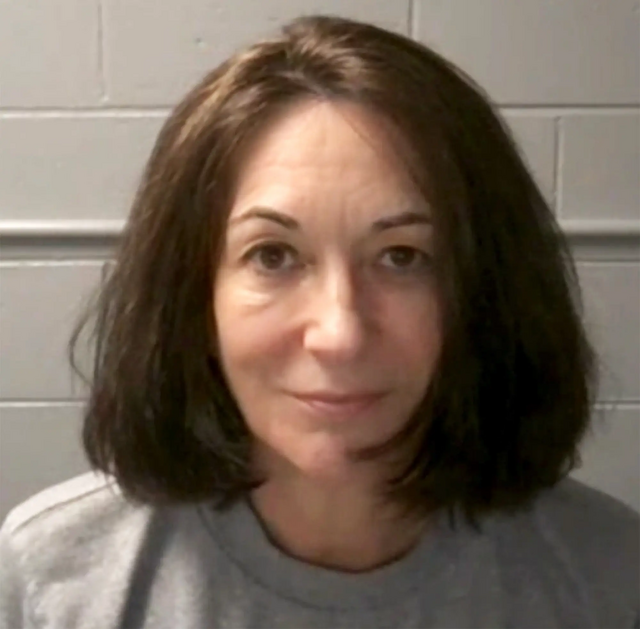
Fig. 3 – Ghislaine Maxwell, currently serving 20 years in federal prison for child sex trafficking. The only person convicted as a co-conspirator in Epstein’s network despite FBI documentation of at least ten co-conspirators investigated in 2019. / Public Domain
The Death — The Documented Record and the Unresolved Questions
Jeffrey Epstein was found unresponsive in his cell at the Metropolitan Correctional Center in Manhattan at 6:30 am on August 10, 2019. He was pronounced dead at 6:39 am. The New York City Medical Examiner ruled his death a suicide by hanging. The circumstances surrounding the death are documented in the DOJ Inspector General’s 2023 report and in materials released as part of the Epstein file disclosures, and they contain multiple documented irregularities. Both guards assigned to check Epstein every 30 minutes were asleep for approximately three hours; both subsequently falsified records and were charged with making false statements. Two cameras outside his cell malfunctioned. Epstein’s cellmate had been removed the prior day. He had been taken off suicide watch 12 days earlier. The Medical Examiner based her ruling on nine minutes of footage from one functioning camera.
The forensic pathologist retained by Epstein’s brother, Dr. Michael Baden, assessed three simultaneous fractures of the neck — thyroid cartilage bilaterally and the hyoid bone — as more consistent with homicidal strangulation than suicidal hanging, citing his experience across more than a thousand jail hangings in New York. The Medical Examiner disputed this assessment and maintained her ruling.
Two additional details emerged from the released files that have not been satisfactorily resolved. First: an FBI observation log reviewing the MCC surveillance footage noted what appeared to be “a flash of orange looks to be going up the L Tier stairs — could possibly be an inmate escorted up to that Tier” at approximately 10:39 pm on August 9, shortly before the period during which Epstein died. The FBI log describes it as “possibly an inmate”; the DOJ Inspector General’s log describes the same image as an officer carrying orange linen. The images have not been released to the public. Second: the DOJ released what it described as surveillance footage meant to establish that no one entered the cell area between 10:40 pm on August 9 and 6:30 am on August 10. Wired magazine subsequently reported that metadata analysis of the “raw” footage indicated it had likely been modified before release.
A DOJ draft statement released in the files noted Epstein’s death as occurring on August 9 — the day before the date of his actual death on August 10. The DOJ described this as an “unfortunate typo.”
The Release Chronology — What Happened and When
Virginia Giuffre — The Most Consequential Witness
Virginia Giuffre was the most publicly visible of Epstein’s victims and the figure whose testimony, legal actions, and advocacy most directly forced the case back into public and legal consciousness. She was first recruited by Ghislaine Maxwell in 1999 at Mar-a-Lago, where she was working as a locker room attendant. She was 16 years old. Epstein interviewed her to serve as his masseuse. She subsequently travelled with Epstein across multiple continents, was abused by him and, she testified, by others including Prince Andrew (whose settlement with her in 2022 for an undisclosed sum has been widely interpreted as an admission of the relationship, though he has denied wrongdoing). Her public testimony and civil suits were instrumental in breaking the wall of secrecy that the 2008 non-prosecution agreement had constructed.
Virginia Giuffre died by suicide on April 25, 2025, at her farm in Western Australia. She was 41 years old. A 2019 tweet of hers resurfaced after her death: “I am making it publicly known that in no way, shape or form am I suicidal. If something happens to me — in the sake of my family do not let this go away.” Her family stated: “In the end, the toll of abuse is so heavy that it became unbearable for Virginia to handle its weight.” Her memoir, Nobody’s Girl: A Memoir of Surviving Abuse and Fighting for Justice, was published posthumously on October 21, 2025. Her brother described the DOJ’s handling of the file releases — exposing victims’ names while protecting perpetrators — as a “slap in the face.”
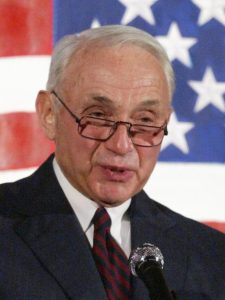
Fig. 4 – Les Wexner, founder of L Brands (Victoria’s Secret, Bath & Body Works), who gave Epstein extraordinary powers of attorney and transferred his New York mansion to him. Identified by Rep. Ro Khanna as one of the named individuals whose identity had been redacted in the files. / CC BY-SA 3.0
The DEA Investigation — A Newly Discovered Probe
Among the most significant documents uncovered in the January 2026 mass release was a 69-page DEA memorandum, marked “law enforcement sensitive” and dated to a case opened on December 17, 2010 in New York City. The document reveals that the Drug Enforcement Administration conducted a five-year-plus investigation into Epstein and 14 other individuals — all named, but all redacted in the released version — for suspicious money transfers potentially linked to illegal narcotics and prostitution activities in the US Virgin Islands and New York City.
This investigation was previously unknown to the public. It ran simultaneously with the period during which Epstein was operating following his 2008 release, raising questions about what the DEA knew, what was shared between agencies, and why Epstein was not arrested or charged on narcotics-related grounds during this period. The 14 other individuals under investigation remain entirely unknown. Their names are completely redacted in the released document. No explanation has been offered for why a five-year federal drug investigation into Epstein produced no arrests or charges.
The “Client List” — What Was Actually Found
The claim that Epstein maintained a “client list” of powerful individuals who participated in his trafficking network — and that this list was in the possession of the federal government — was among the most politically charged elements of the files debate throughout 2025. Attorney General Pam Bondi stated publicly in February 2025 that such a list was “sitting on my desk right now to review.” Four months later, the DOJ’s July 7 memo directly contradicted her. It stated: “This systematic review revealed no incriminating ‘client list.’ There was also no credible evidence found that Epstein blackmailed prominent individuals as part of his actions. We did not uncover evidence that could predicate an investigation against uncharged third parties.”
The memo’s conclusions were met with widespread scepticism across the political spectrum. Alex Jones called the assertion that no client list existed “over the top sickening.” Elon Musk responded with a series of images of a clown applying makeup. Conservative commentator Jack Posobiec wrote: “We were all told more was coming. That answers were out there and would be provided. Incredible how utterly mismanaged this Epstein mess has been.” An Economist/YouGov poll in January 2026 found that 49% of Americans believed Trump was attempting to cover up Epstein’s crimes, while 30% did not. Only 6% of Americans said they were satisfied with the government’s file releases.
The DOJ also stated in the same memo that it would release no further Epstein-related materials. A sixth release of 16 pages followed regardless in March 2026, described as having been “incorrectly coded as duplicative.” NPR reported that at least 37 files remain missing from the public database as of that filing.
The Congressional Surveillance Incident
One of the most consequential revelations in the file release process occurred not from the files themselves but from a document visible in a congressional hearing. During a February 2026 session in which Attorney General Bondi testified before the House Oversight Committee, she was photographed holding a document titled “Jayapal Pramila Search History” — a log of Democratic Congresswoman Pramila Jayapal’s searches of the unredacted Epstein file database.
The document’s visibility triggered immediate bipartisan condemnation. Rep. Jayapal described it as “outrageous.” Rep. Raskin called it an “outrageous abuse of power.” Rep. Mace described it as “a form of intimidation, potentially.” Speaker Johnson called it inappropriate. The DOJ subsequently acknowledged that it logs all searches made on its systems and stated this was “to protect against the release of victim information.” House Democrats launched a formal investigation into the tracking of congressional file searches on February 13, 2026. Bondi responded with a six-page letter to Congress on February 14.
The Archive Infrastructure — Navigating 3.5 Million Pages
The practical challenge of extracting meaningful information from the released files is substantial. The DOJ has organised the release into 12 primary data sets covering the Florida and New York criminal cases, the Maxwell prosecution, investigations into Epstein’s death, financial records, flight manifests, FBI interview summaries, email correspondence, 180,000 images, 2,000 videos, and supplemental material. The official DOJ portal is searchable but has been criticised for encoding artefacts — including widespread occurrences of the = sign — produced by the process used to convert emails to PDF format.
Two independent archiving projects have developed to address these limitations. Jmail — launched in November 2025 by artist Riley Walz and Kino AI co-founder Luke Igel — provides a browser-based interface for the files designed to feel like navigating a familiar email application. As of February 2026, Jmail had archived 1.4 million files and 2.47 million pages, combining DOJ releases with House Oversight Committee documents. EpsteinExposed — launched in February 2025 by an engineer using the pseudonym Eric Keller — is a relational database mapping the connections between individuals named across DOJ files, court filings, FBI disclosures, and congressional investigations. As of March 2026, it has indexed 2.15 million documents and catalogued 1,500 named individuals.
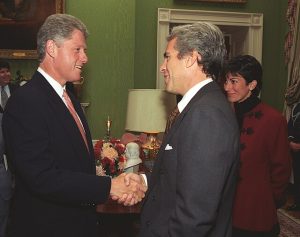
Fig. 5 – Jeffrey Epstein and Ghislaine Maxwell with Bill Clinton, 1993 — one of the earliest publicly available photographs documenting Epstein’s access to elite political circles. The released files contain additional Clinton photographs including images at the Winston Churchill War Rooms in London with Maxwell. / Public Domain
What the Files Establish — And What They Do Not
Having reviewed the material released through April 2026, this Directorate assesses the following as established by the documentary record: that Epstein operated a systematic sex trafficking network targeting minors across at least two decades; that the 2008 non-prosecution agreement was arranged in secret, in violation of victims’ rights, and granted immunity to unnamed co-conspirators in a manner that insulated a documented criminal network from accountability; that the FBI in 2019 identified at least ten co-conspirators and investigated a previously undisclosed DEA case involving Epstein and 14 other individuals; that only one co-conspirator — Ghislaine Maxwell — has been convicted; that the circumstances of Epstein’s death contain multiple documented irregularities that the DOJ’s own Inspector General described as the product of “negligence, misconduct, and outright job performance failures”; and that the subsequent handling of the file releases — including faulty redactions exposing victim identities, the deletion of photographs, the DOJ surveillance of congressional searches, and the contradictory statements from Attorney General Bondi — has not resolved the legitimate public interest in the case’s full record.
What the files do not establish, as of current release: the existence of a blackmail operation with documentary evidence; the specific identities of the ten co-conspirators identified by the FBI; the identities of the 14 other individuals named in the DEA investigation; what was recovered from Epstein’s hard drives and safes; the full passenger manifests of all Epstein aircraft flights; and the identity and context of the orange figure observed on the MCC staircase on the night of Epstein’s death.
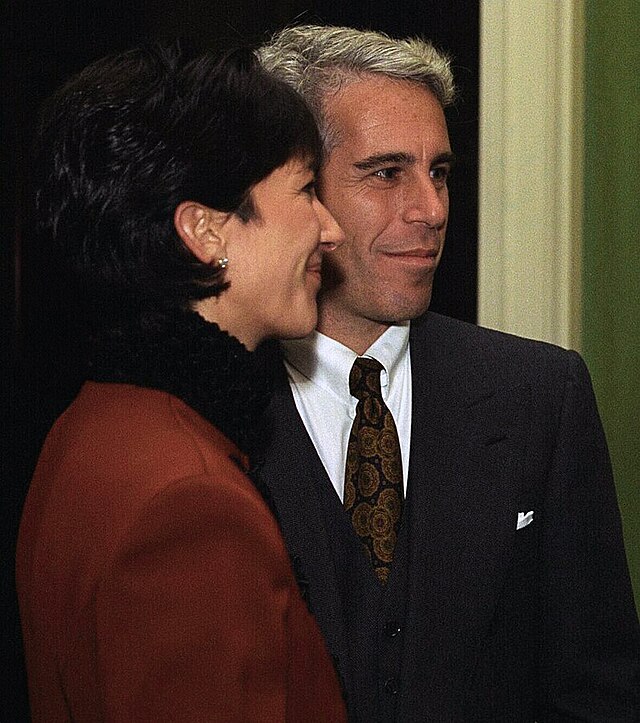
Fig. 6 – Jeffrey Epstein, 2008. He pleaded guilty to soliciting prostitution from a minor, served 13 months with work release, and was released. The federal charges that would have named his co-conspirators and his victims were never filed. Eleven years later he was arrested on federal charges. Thirty-five days after that, he was dead. The files contain 3.5 million pages of what happened in between. At least 37 pages are still missing from the database. / Public Domain
Archival Status
The Epstein Files are assessed by this Directorate as the most significant ongoing disclosure of institutional failure, elite impunity, and documented sex trafficking in the contemporary archive. The files are a primary source of continuing legal, political, and historical importance and their release process has itself become a secondary subject of investigation — a story within a story about who is protected, who is exposed, and how the machinery of a powerful government handles material that implicates its own actors.
The most consequential unresolved question is not who appears in Epstein’s contact book — the files have answered that abundantly — but why, given that the FBI documented at least ten co-conspirators and a five-year DEA investigation running simultaneously, only one person has ever been charged. That question is not answered in the 3.5 million released pages. It may be answered in the 37 files that are still missing.
Recommended classification: ACTIVE INVESTIGATION — ALPHA TIER. Disclosure status: partial — 3.5M of up to 6M pages released. Congressional investigation: open. Survivor advocacy: ongoing. Key unanswered questions: co-conspirator identities, DEA investigation targets, hard drive contents, orange figure identity, Bondi congressional testimony (April 14, 2026). Monitoring: continuous.
References
- DOJ Epstein Library (primary source): justice.gov/epstein
- Wikipedia — Epstein Files (comprehensive, continuously updated): en.wikipedia.org/wiki/Epstein_files
- Wikipedia — Epstein Files Transparency Act: en.wikipedia.org/wiki/Epstein_Files_Transparency_Act
- PBS — “List of powerful men named in the Epstein files” (February 2026): pbs.org
- CBS News — Epstein files live updates (ongoing): cbsnews.com
- DOJ Press Release — 3.5 Million Pages Released (January 30, 2026): justice.gov
- Axios — DOJ Memo: No client list, death was suicide (July 7, 2025): axios.com
- NPR — DOJ Releases Memo on Epstein Files (July 2025): npr.org
- Al Jazeera — Visual guide to the Epstein files (February 2026): aljazeera.com
- National Desk — Epstein Files Timeline 2025 (comprehensive chronology): thenationaldesk.com
- Wired — Metadata shows DOJ prison video was likely modified (July 2025): metadata analysis of surveillance footage
- EpsteinExposed database: independent relational database of file connections — epsteinexposed.com
- Jmail archive: browser interface for the Epstein files — jmail.exposed
- Congress.gov — Epstein Files Transparency Act text: congress.gov
Last updated: April 7, 2026. · File declassified: April 2026.


