

Conspiracy Theory Dossier — Complete Archival Record
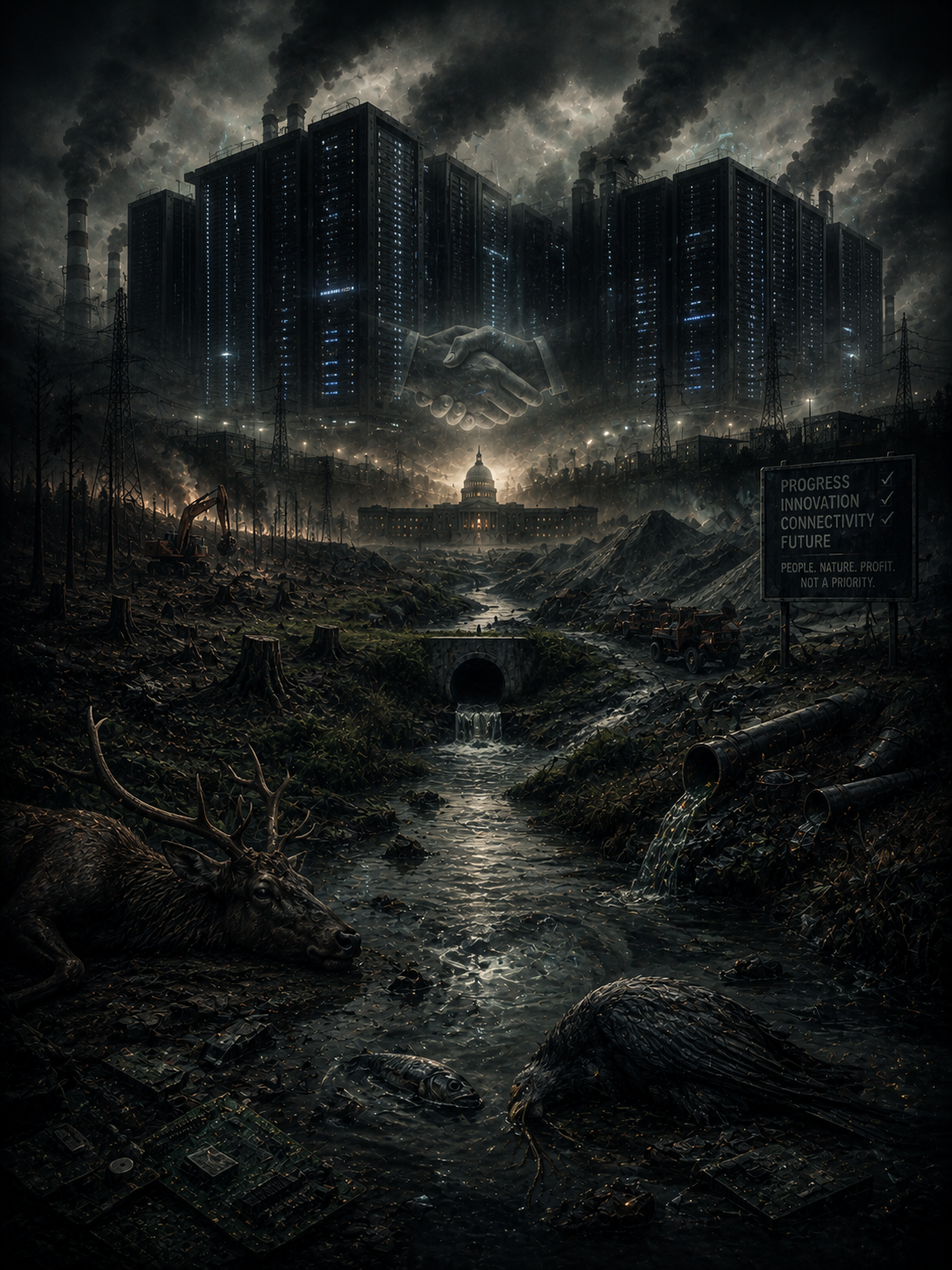
Fig. 0 — Illustration of the subject’s core conspiracy elements: claimed pollution and wildlife harm set against continued operation despite mass protest.
17.07.2026
The official narrative, supported by industry reports and government policy documents, frames the rapid expansion of datacenters as a necessary response to the exponential growth of digital services. From the mid-2000s, cloud computing platforms (AWS launched in 2006) began consolidating computational resources into vast, efficient server farms. The artificial intelligence revolution, triggered by the transformer architecture in 2017 and accelerated by large language models from 2022 onward, supercharged this demand. Training a single frontier AI model can require clusters of tens of thousands of GPUs consuming megawatts of power. National governments, including the United States, China, and the European Union, have designated datacenters as critical national infrastructure, offering tax incentives, expedited permits, and direct energy subsidies to attract construction.
The Scale of the Buildout — Documented Figures
According to the International Energy Agency’s 2025–26 modelling, global datacenter electricity consumption stood at roughly 485 TWh in 2025 — about 1.5% of total global electricity use — up from approximately 415 TWh in 2024. The IEA’s base case has this figure nearly doubling to around 945 TWh by 2030, a compound growth rate of roughly 15% a year, more than four times faster than global electricity demand overall. The distribution is highly uneven: some national grids feel this far more acutely than the global average suggests. Ireland is the starkest case among developed economies, with datacenters consuming 23% of the country’s metered electricity in 2025 (up from 22% in 2024 and just 5% in 2015), a share national grid operator EirGrid and independent analysts project could reach roughly 30–33% by the end of the decade. Northern Virginia’s “Data Center Alley” carries a comparable concentration in the United States. The number of hyperscale facilities (broadly, those built for large-scale cloud or AI workloads) has grown sharply since 2020, and the hardware inside them — particularly high-end GPUs like NVIDIA’s H100 and Blackwell-series chips — is produced on advanced semiconductor nodes with limited global manufacturing capacity, creating direct competition with consumer markets.
The Official Justification
Proponents argue that centralising compute in professional datacenters is more energy-efficient than distributed consumer hardware. They point to the digital services that depend on this infrastructure: cloud storage, streaming, enterprise SaaS, scientific research, and AI that, they claim, will unlock medical breakthroughs and economic productivity. The demand, in this view, is organic and beneficial; any externalities are manageable through technological innovation (more efficient cooling, renewable energy matching) and market corrections. It is worth noting, from a purely archival standpoint, that even in the IEA’s high-growth “lift-off” scenario, datacenters remain a modest single-digit share of total global electricity demand by 2030 — the sharper concern in most independent analyses is not the global percentage so much as the concentrated, localised strain on specific grids, water tables, and communities, which is where Chapters III and IV pick up the thread.
For personal computer enthusiasts and small-scale creators, the period from 2020 to 2026 has been characterised by a severe degradation in the ability to acquire high-performance hardware at reasonable prices. While initial shortages were attributed to the COVID-19 pandemic’s supply chain disruptions and cryptocurrency mining booms, the sustained AI-driven demand from hyperscale datacenters has, in the view of many conspiracy theorists, created a permanent structural shift. The belief is that hardware manufacturers, particularly NVIDIA, now prioritise bulk sales to cloud providers and AI labs over the consumer retail market, deliberately starving the latter to push users toward subscription-based cloud services.

The Price Record
The documented price trajectory is genuinely dramatic and does not require conspiratorial interpretation to be alarming to consumers. NVIDIA’s GeForce RTX 4090 launched in October 2023 at $1,599 and frequently sold for $2,000–$2,500 during peak 2023–2024 scarcity. Its successor, the RTX 5090, launched in January 2025 at a $1,999 MSRP; within its first year on the market, Founders Edition units sold out within minutes of restocks, and street prices for the card have repeatedly been reported in the $2,500–$4,000 range depending on region and retailer — at times more than 75% above list price. Mid-range cards have followed a similar, if less extreme, pattern. Whether this reflects deliberate allocation strategy, genuine chip-supply constraints, or ordinary demand-outstrips-supply economics during a historic compute boom is precisely the question that divides the official and conspiratorial readings of the same data.
The “40% Stockpiled and Unused” Claim
A specific, recurring claim in the conspiracy literature is that AI companies are hoarding GPUs far beyond their immediate operational needs, with some estimates alleging that over 40% of purchased hardware sits in warehouses, unpowered and unused. This “strategic stockpiling” is interpreted as an intentional effort to corner the market, prevent competitors (including hobbyists and small businesses) from accessing compute, and create an artificial scarcity that drives cloud dependency. Official data on exact hardware utilisation rates in hyperscale datacenters is closely guarded as trade secrets, making the 40% figure specifically unverifiable from public sources — it does not appear in any audited disclosure the Directorate has located. Anecdotal reports from industry insiders have, however, noted that rapid procurement cycles often outpace datacenter buildout (power connections and cooling infrastructure lag chip delivery by months), leading to temporary equipment surpluses that are real but distinct from the “permanent hoarding” framing of the conspiracy claim.
The Cloud Dependency Lock-In
The conspiracy narrative holds that the consumer hardware crisis is not an accident but the means to an end: the transition to a “digital feudalism” model in which individuals and small businesses no longer own computing resources but rent them in perpetuity from a few cloud oligopolies. The link is drawn to a 2016 World Economic Forum essay, written by Danish politician and futurist Ida Auken, titled “Welcome to 2030: I own nothing, have no privacy, and life has never been better.” The essay was explicitly framed as a speculative, first-person scenario exploring one possible future — not a policy proposal or internal WEF strategy document — but its “you’ll own nothing and be happy” framing has since become a widely circulated shorthand in conspiracy circles for a supposed elite agenda. In the datacenter narrative, hardware is treated as the modern “means of production” being deliberately concentrated, with the cloud as the mechanism of rent extraction.
- Price Trajectory of Flagship GPUs (MSRP vs. Retail) NVIDIA GeForce GTX 1080 Ti (2017): ~$700 MSRP, generally available near that price. RTX 4090 (2023): $1,599 MSRP, commonly resold for $2,000–$2,500 during 2023–2024 shortages. RTX 5090 (2025): $1,999 MSRP, with documented retail prices reaching $2,500–$4,000 through 2025–2026. Theorists argue the effective price of flagship local computing has climbed sharply within a decade, making high-end hardware ownership increasingly a premium good — even as cloud providers offer entry-level access to comparable compute as a subscription.
- The “GeForce Now” Trojan Horse Argument NVIDIA’s own cloud gaming service, GeForce Now, which streams games from datacenter GPUs to low-end client devices, is cited by theorists as proof of the strategy. The claim: NVIDIA is deliberately limiting the supply of consumer GPUs to push gamers onto the cloud service, converting what was once a one-time hardware purchase into a recurring subscription revenue stream. NVIDIA has never publicly acknowledged this as a deliberate allocation strategy, and the company’s own disclosures attribute consumer-market constraints primarily to fab capacity being redirected toward far more profitable datacenter-grade chips — a market dynamic, not a stated policy, though theorists argue the outcome is functionally identical either way.
The most tangible grievances underpinning the Datacenter Crisis narrative concern the consumption of local water and electricity resources. Datacenters require vast amounts of electricity for server operation and cooling, and many rely on evaporative cooling systems that consume millions of gallons of potable water per year. In regions experiencing drought or water stress, communities have begun to protest the siting of new facilities, arguing that the needs of machines are being prioritised over the needs of people.

Documented Water Consumption and Local Conflicts
A 2021 peer-reviewed study (Mytton, Nature Sustainability) found that a medium-sized datacenter (around 15 MW) can use hundreds of thousands of gallons of water per day for cooling. Google’s disclosures, forced into the open by a 13-month legal fight between the city of The Dalles, Oregon, and a local newspaper, showed the company’s datacenters there consuming more than a quarter of the city’s total water supply by 2022 — nearly triple the figure from five years earlier — with subsequent reporting citing estimates as high as a third to 40%. In Chile, community opposition led by the group Mosacat forced a Chilean environmental court to send Google’s proposed second Santiago-area datacenter (in Cerrillos) back for revision in 2024, on the grounds that its climate-change impact assessment was inadequate; separate reporting on a related Cerrillos-area project put its potential annual water draw at roughly 7 billion litres — described by one outlet as equivalent to the water use of about 80,000 people, a scale claim distinct from, and more precisely sourced than, the “80% of the local supply” figure that circulates in some online retellings. In Ireland, where datacenters already account for 23% of national electricity consumption and a comparably significant share of water use in the Dublin region, local opposition has delayed or blocked several projects. These are documented conflicts. The conspiracy layer adds the belief that water “used” by datacenters is not merely consumed but contaminated — that cooling tower blowdown or chemical treatments introduce pollutants into local water tables, with companies and regulators colluding to hide the extent of the contamination. The Directorate has not located systematic, peer-reviewed evidence for widespread contamination specifically from datacenter cooling discharge, as distinct from the well-documented consumption and thermal-discharge issues described above.
Electricity Price Hikes and Grid Instability
In regions with high datacenter concentration, such as Northern Virginia (“Data Center Alley”), residents and consumer advocates have reported increases in electricity rates and rising transmission costs. Utilities must invest in new transmission infrastructure to serve datacenter load, and in several documented cases (including in Ireland, per analysis cited by opposition parties and consumer groups) these grid-upgrade costs are socialised across all ratepayers while datacenters pay comparatively lower network charges per unit of electricity used. Conspiracy narratives interpret this as a deliberate transfer of wealth: the public subsidises the power-hungry infrastructure of trillion-dollar corporations, while the corporations profit from the AI boom. The claim extends to grid instability — some theorists attribute localised blackouts or brownouts near datacenter clusters to preferential grid access for the facilities. Grid operators including EirGrid have publicly stated they do not anticipate widespread blackouts from current datacenter load and have implemented demand-side management measures specifically to guard against this outcome, a position disputed by some local campaigners who argue the risk is being managed rather than eliminated.
The Health Decline Claim
A more recent and emerging belief is that communities living near large datacenter clusters experience measurable declines in public health. Proponents cite increased reports of respiratory issues (attributed to diesel backup generator emissions during grid tests), stress-related illnesses from constant low-frequency noise (server cooling fans), and, in some accounts, neurological symptoms. Some theories allege that the water supply becomes subtly polluted with industrial chemicals used in cooling systems, leading to chronic health conditions. These health claims are largely anecdotal and have not, as of mid-2026, been corroborated by systematic epidemiological studies the Directorate has located. They nonetheless circulate widely in affected communities and online forums, and the underlying grievance — diesel generator noise and emissions testing, in particular — is a documented nuisance in several communities even where the broader health-decline thesis remains unproven. The narrative often draws parallels to other environmental justice struggles in which low-income and rural communities bear the externalised costs of urban digital consumption.
Beyond direct resource competition with humans, a more fringe but increasingly vocal layer of the conspiracy theory focuses on the ecological impact of datacenters on local wildlife. The claims range from the scientifically plausible (habitat destruction, noise pollution affecting animal communication, thermal pollution of waterways) to the speculative (electromagnetic radiation causing mass die-offs and behavioural changes).

The “Radiation” Interference Claim
A recurring theme in online forums and some activist circles is that datacenters emit a form of “non-ionising radiation” — from power infrastructure, server hardware, and networking equipment — that is harmful to the “biological husk” of animals. This is said to cause birds and insects to abandon areas near large server farms, disrupt migration patterns, and, in some accounts, lead to mass die-offs of fish in water bodies used for cooling discharge. The term “biological husk” is used in certain alternative-science communities to describe the physical body as a vessel for a “morphogenetic field” or “life force” purportedly susceptible to electromagnetic disruption — a framework outside mainstream biology.
The mainstream scientific position is that datacenter electromagnetic field emissions fall well within regulated safety limits for both humans and wildlife, and that thermal pollution from cooling-water discharge (which can measurably harm aquatic life by altering water temperature and dissolved oxygen levels) is the primary documented ecological stressor associated with these facilities. The Directorate has located no peer-reviewed studies establishing a causal link between datacenter EMF emissions specifically and wildlife die-offs, while also noting that thermal pollution and water withdrawal have well-documented ecological impacts that are sometimes underweighted in official environmental impact assessments — a genuine regulatory gap that theorists and mainstream environmental scientists both point to, even as they diverge sharply on the EMF question.
Habitat Destruction and “Server Farm Deserts”
A more grounded ecological concern, often woven into the conspiracy narrative, is the literal destruction of habitat to make way for massive datacenter campuses. The construction of a single hyperscale facility can involve clearing hundreds of acres of forest, farmland, or desert. Critics argue that fragmented regulatory approvals — where each datacenter is assessed in isolation without a cumulative, region-wide impact review — amount to a slow-motion ecological transformation that governments permit because of the economic incentives at stake. The conspiracy layer adds that this fragmentation is itself intentional: a way of avoiding scrutiny that a cumulative assessment would invite, rather than simply an artifact of how environmental review processes happen to be structured.
A central question in the conspiracy narrative is why governments, ostensibly tasked with protecting citizens and the environment, not only permit the datacenter buildout but actively subsidise it. The answer, according to the theory, is a deep regulatory capture in which the state and the tech oligopoly have merged their interests.

Documented Subsidies and Tax Incentives
It is a matter of public record that states and nations compete fiercely to attract datacenter investment, offering enormous incentives. Loudoun County, Virginia, the world’s largest datacenter hub, grants significant local tax breaks. The state of Oregon granted Google a long-term property tax exemption for its Dalles facility. Amazon’s AWS and other hyperscalers have received hundreds of millions of dollars in tax incentives across multiple jurisdictions globally. The official justification is job creation and economic development — Irish officials, for instance, have cited tens of billions of euros in gross value added enabled by data-centre-dependent sectors — though critics note that hyperscale datacenters create relatively few long-term operational jobs compared to their physical and energy footprint. Conspiracy narratives interpret these incentives not as ordinary economic development policy but as something closer to bribes — a revolving door between government and tech corporations that ensures the flow of subsidies in exchange for political support and, in some tellings, the promise of future surveillance infrastructure.
The “Greenwashing” Infrastructure — A Deliberate Deception?
Many datacenter operators heavily promote their renewable energy commitments and “net zero” pledges. Critics argue this obscures the true resource picture. The specific, well-documented mechanism cited is that power purchase agreements (PPAs) for renewable energy do not necessarily mean a given datacenter runs on renewable electricity moment-to-moment; rather, the datacenter draws from whatever the local grid supplies (often still substantially fossil-fuel-based), while the company’s “green” accounting nets out against renewable capacity purchased elsewhere on the same grid, sometimes at a different time of day. This accounting practice is real and is the subject of ongoing debate among energy economists — it is not, by itself, evidence of coordinated deception, though critics frame it that way, and some governments are examining tighter “24/7 carbon-free energy” matching standards partly in response to this exact critique.
At the highest level of abstraction, the Datacenter Crisis is interpreted by its theorists as a front in a broader war against individual sovereignty. The “You will own nothing and be happy” framing, drawn from a 2016 WEF-hosted essay that was explicitly a speculative scenario rather than a policy document, is nonetheless treated in these circles as a literal blueprint. In this view, the datacenter is the physical instantiation of a future in which all aspects of life — work, entertainment, creativity, memory — are mediated by cloud services owned and controlled by a small number of firms.
The Long-Term Agenda — Control of Compute as Control of Reality
With the rise of generative AI, the ability to create realistic images, video, and text has become computationally intensive in ways ordinary consumer hardware cannot match. The conspiracy theory extends to the idea that by controlling the datacenters — the “means of compute” — a small elite can control the means of cultural production, surveillance, and even the shared record of truth itself. If the most powerful AI models run exclusively on corporate clouds, and no one can afford the hardware to run comparable systems locally, then the power to shape digital reality becomes, in this reading, functionally centralised. The hardware crisis is seen not merely as a consumer inconvenience but as a pivotal front in a broader contest over cognitive and informational sovereignty.
One dimension of the Datacenter Crisis narrative that is often underweighted — even by its own proponents — is how effective organised local resistance has actually been, independent of whether the broader “digital feudalism” thesis holds. This chapter catalogues concrete, documented cases in which public opposition altered a datacenter project’s outcome, offering a counterpoint to the narrative’s occasional framing of local communities as wholly powerless against an unstoppable corporate-state alliance.
- Cerrillos and Quilicura, Chile Sustained organising by the group Mosacat and allied residents led a Chilean environmental court to force Google to revise its Cerrillos-area project in 2024 over inadequate climate-impact assessment, and contributed to the suspension of a second nearby project. Google subsequently agreed to reconsider its water-intensive cooling design in favour of fan-based (air) cooling.
- The Dalles, Oregon A 13-month legal battle waged by a local newspaper (The Oregonian), backed by the Reporters Committee for Freedom of the Press, broke a confidentiality agreement that had kept Google’s water consumption secret, forcing public disclosure and prompting the company to transfer certain water rights and fund municipal water infrastructure upgrades.
- Ireland (Dublin region) Grid capacity concerns led to an effective moratorium on new large-load data-centre connections in the Dublin area from 2022, later extended, as the transmission system operator judged the local grid unable to absorb further concentrated demand without risking reliability — a rare case of a regulator, rather than a court or protest movement, imposing the check.
- Uruguay Campaigners used freedom-of-information litigation beginning in 2022 to force disclosure of a proposed Google datacenter’s water requirements (ultimately revealed to be several million litres of potable water per day), information the company had not volunteered.
Public opinion data adds further texture: broad national polling conducted in 2026 found strong majority opposition in the United States to hosting a new AI datacenter locally, with environmental concerns over water, energy, land use, and noise cited as the leading objections — opposition that, notably, was not confined to any single political affiliation. Whatever one concludes about the “hidden agenda” framing, the on-the-ground pattern is one of active, often successful contestation rather than passive acceptance, which complicates (without necessarily disproving) the meta-narrative’s bleaker projections in Chapter VIII.
The Datacenter Crisis narrative is, at its core, a warning about exponential growth in a finite world. If current growth rates continue — and the IEA’s own projections have global datacenter electricity demand roughly doubling by 2030 — theorists warn of a future in which the externalities become a full-blown global emergency. The scenarios below are forward-looking speculation, not established fact. They represent the extrapolation of current, partly-documented trends into worst-case outcomes by sceptical observers, and the Directorate presents them as beliefs held, not predictions endorsed.

Projected Scenarios from the Conspiracy Literature
- Freshwater Wars — Datacenters vs. Populations If datacenter water consumption continues rising sharply in water-scarce regions, theorists predict escalating conflict: legal battles giving way to direct action against pipeline and cooling infrastructure, and governments responding with force to protect “critical digital infrastructure.” The datacenter, in this projection, becomes a contested and eventually militarised site, with water security subordinated to AI capability.
- Permanent Hardware Apartheid A vision of a world where high-performance computing becomes a “gated community” for corporations. Consumers, in this scenario, are permanently relegated to thin-client devices — laptops, streaming dongles, phones — that function as mere portals into corporate clouds, with local manufacture of high-power personal devices discouraged or restricted under the banner of “security” or “energy efficiency” regulation.
- “Radiation Dead Zones” and Ecological Collapse A more esoteric projection holds that as datacenter density increases, combined electromagnetic and thermal emissions will create large “dead zones” uninhabitable for birds, insects, and eventually larger mammals, accelerating biodiversity collapse — a claim, as noted in Chapter IV, with no current peer-reviewed support for the EMF component specifically, though thermal and habitat effects are independently documented.
- The Point of No Return The narrative emphasises a looming tipping point: once datacenters constitute a sufficiently large share of national energy and water grids, they become “too big to fail,” and the resources they consume can never be redirected back to human or ecological needs because the digital economy has grown dependent on them. At that point, the theory holds, society will have locked itself into permanent resource scarcity and digital dependency, without a workable democratic path to reverse course.
Open Questions — Evidentiary Assessment
Archival Status and Classification
The Datacenter Crisis narrative is assessed by this Directorate as a complex amalgam of verifiable socioeconomic grievances, genuine environmental stress, and speculative, at times fantastical, conspiracy architecture. The documented facts — GPU price inflation, water conflicts, government subsidies, grid strain — provide a rich substrate upon which a narrative of deliberate, coordinated malevolence has been constructed. The line between emergent market behaviour and conspiratorial intent is, as in many such dossiers, fiercely contested and likely impossible to resolve from open-source materials alone.
The core archival challenge is this: the datacenter buildout is happening at such speed and scale that its aggregate consequences are outpacing the ability of researchers, regulators, and the public to assess them in real time. In this information vacuum, the conspiracy narratives documented herein serve as a folk-theoretical framework for understanding a profound and disorienting transformation of the physical world by the digital. Chapter VII’s record of successful local resistance suggests the vacuum is not, however, total — communities that organise and litigate have repeatedly extracted concessions, disclosures, and delays, even without resolving the deeper structural questions the narrative raises. The Directorate records the framework and the countervailing evidence alike. It does not judge either side’s ultimate correspondence to a hidden truth.
Recommended classification: INFRASTRUCTURE CONSPIRACY — TIER ONE — DOCUMENTED EXTERNALITIES — CONSPIRACY CLAIMS: PARTIALLY EVIDENCED — ARCHIVAL STATUS: ACTIVE, RAPIDLY ESCALATING, AND ONGOING
Source References
- International Energy Agency — “Energy and AI” / “Key Questions on Energy and AI” (2025–26) — global datacenter electricity demand modelling: iea.org/reports/energy-and-ai/energy-demand-from-ai
- Central Statistics Office Ireland, via RTÉ — “Data centres account for 23% of electricity usage” (2026): rte.ie/news/business/2026/0707/1582175-cso-data-centre-energy-figures
- The Irish Times — “Data centres could consume as much electricity as two million Irish homes by 2030” (2025): irishtimes.com — Wood Mackenzie/Pinergy report
- Mytton, D. — “Data centre water consumption” (Nature Sustainability, 2021)
- WaterWatch / The Oregonian — “Google’s water use is soaring in The Dalles” (2022): waterwatch.org
- The Register — “Google datacenters use ‘a quarter of all water’ in one US city” (2022): theregister.com/2022/12/19/google_datacenters_dalles
- Nearshore Americas — “Water-Guzzling Data Centers Spark Outrage Across Latin America” (2025): nearshoreamericas.com
- Data Center Dynamics — “Chile partially reverses Google data center permit over water use concerns” (2024): datacenterdynamics.com
- Mongabay — “The Cloud vs. drought: Water hog data centers threaten Latin America” (2023): news.mongabay.com
- Rest of World — “Data centers bring environmental concerns, like excess water use, to Chile” (2024): restofworld.org/2024/data-centers-environmental-issues
- Waging Nonviolence — “The data center fight is going global” (2026), incl. U.S. polling on local siting opposition: wagingnonviolence.org
- VideoCardz — RTX 5090 retail pricing tracking (2026): videocardz.com
- World Economic Forum — “Welcome to 2030. I own nothing, have no privacy, and life has never been better” by Ida Auken (2016) — essay cited in conspiracy narratives
- NVIDIA Financial Reports — revenue breakdown by market segment (FY2024–FY2025), showing datacenter revenue surpassing gaming
- r/hardware, r/conspiracy, and various YouTube tech commentary channels — primary sources for consumer hardware crisis narratives and “40% stockpiled” claims
- Wikipedia — Data center: en.wikipedia.org/wiki/Data_center
- Wikipedia — Cloud computing: en.wikipedia.org/wiki/Cloud_computing
- Wikipedia — Graphics processing unit: en.wikipedia.org/wiki/Graphics_processing_unit
Last updated: July 2026 (Revision 2). Compiled by the Directorate of Information Preservation and Archival, Realm33.org. The Directorate notes that the datacenter is a physical object that embodies a paradox: it is, at once, the most visible symbol of technological modernity and the most invisible to the populations it affects. The cloud, after all, is just someone else’s computer — and increasingly, it is a thirsty, power-hungry computer on land that was once a forest or a farm, humming with the traffic of a digital empire. The Directorate’s file on the matter will grow in direct proportion to the world’s data traffic. It will never be complete.


