
Flat Earth

REALM33
Directorate of Information Preservation and Archival
Subject Profile – File Extract
Designation: Flat Earth Theory (Zetetic Cosmology)
Also Known As: “Disk Earth Model” · “Zetetic Astronomy” · ███████
Period of Modern Activity: 1838 — Present
Primary Domain: Cosmology / Cartography / Institutional Science Critique
Estimated Global Community: Millions of active adherents and researchers across 190+ countries as of 2025
Current Status: ACTIVE
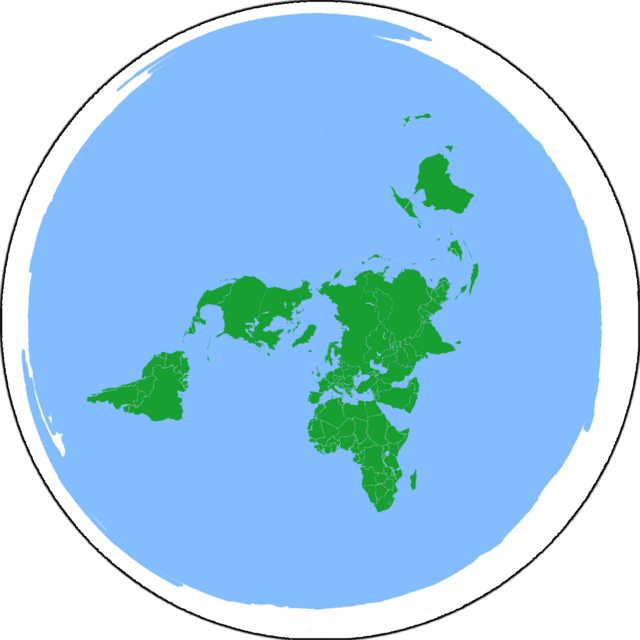
Fig. 1 – Conceptual illustration of the flat Earth disc model with the North Pole at centre, Antarctica as the outer ice barrier, and the dome above / Public Domain
The Question That Won’t Close
To the majority of the educated world, the shape of the Earth is not a question. It is a settled fact, established by satellite imagery, circumnavigation, gravitational measurement, and centuries of accumulated scientific consensus. To dismiss it as open is, in most mainstream contexts, to invite immediate ridicule. This is precisely the social dynamic that flat Earth researchers consider the most significant piece of evidence in their favour — not about the shape of the Earth, but about the nature of the institution that enforces belief in it.
The flat Earth framework is not, as its critics most frequently characterise it, a belief that the world looks the way it did in medieval illustrations — a flat plate balanced on elephants, surrounded by sea monsters. The contemporary flat Earth model is a specific, internally detailed, and constantly evolving cosmological system, supported by a global community of researchers numbering in the millions, producing experimental evidence, publishing analysis, and subjecting mainstream scientific claims to a quality of empirical scrutiny that its practitioners argue the scientific establishment has never applied in the other direction. Understanding what flat Earthers actually believe — and why — requires setting aside the reflexive dismissal and examining the model on its own terms.
This file does that. It does not conclude that the Earth is flat. It presents the flat Earth framework as it is actually held, not as it is most conveniently caricatured, and examines the historical, experimental, philosophical, and institutional dimensions of a movement that has grown from a Victorian-era fringe to a genuinely global phenomenon in the space of a decade.
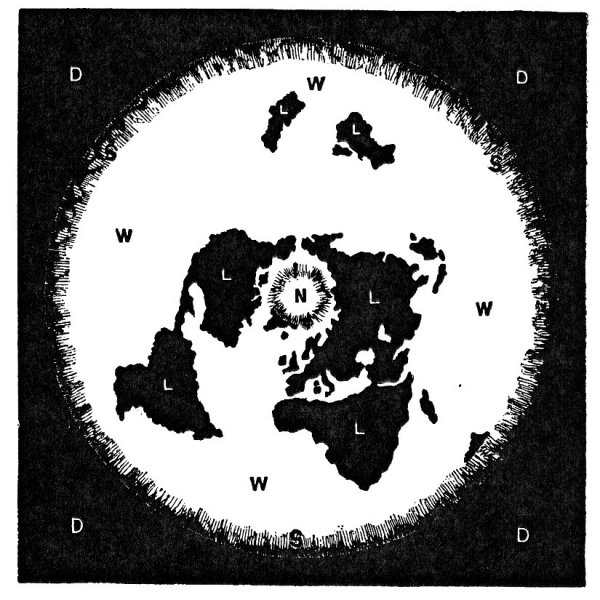
Fig. 2 – Samuel Rowbotham´s flat earth map (1881), writing as “Parallax” — the founding figure of the modern flat Earth movement and originator of the Zetetic method / Public Domain
Origins — The Zetetic Method and Samuel Rowbotham
The modern flat Earth movement begins not with superstition or religious fundamentalism but with an empirical experiment conducted on a drainage canal in Cambridgeshire, England, in the summer of 1838. Samuel Birley Rowbotham — a physician, inventor, and utopian socialist who would later publish under the pseudonym “Parallax” — waded into the Old Bedford River and held a telescope eight inches above the water’s surface. He watched a boat with a flag three feet above its waterline row slowly away from him over a six-mile straight stretch of canal. According to the mathematics of a spherical Earth with the accepted circumference of 25,000 miles, the flag should have disappeared approximately eleven feet below his line of sight by the time it reached the far end. It did not disappear. It remained visible throughout the full six miles.
Rowbotham’s response to this observation was not to immediately proclaim the Earth flat. He repeated the experiment. He varied the conditions. He held the telescope at different heights and had colleagues conduct independent observations. Only after a series of experiments spread across more than three decades did he publish his conclusions, first as a sixteen-page pamphlet in 1849 and then, after a lifetime of further research, as a 430-page book — Zetetic Astronomy: Earth Not a Globe — whose final edition appeared in 1881. The work is methodical, detailed, and written in the register of scientific inquiry rather than religious polemic.
The term “zetetic” was Rowbotham’s deliberate choice, derived from the Greek zeteo — to seek or inquire. The zetetic method, as he defined it, proceeds strictly from direct observation, refusing to accept theoretical inferences as evidence. Where mainstream astronomy asks the observer to accept the spherical model on the authority of mathematics and expert consensus, the zetetic approach demands that every claim be verifiable by the individual experimenter with accessible instruments. This epistemological position — not the claim about the Earth’s shape but the demand for personal, reproducible verification — is the intellectual core of the flat Earth movement, and it is why the movement attracts a disproportionate number of people with scientific or engineering backgrounds who are comfortable conducting experiments but uncomfortable with deference to authority.

Fig. 3 – The Old Bedford River, Cambridgeshire — the six-mile straight drainage canal where Rowbotham conducted his founding flat Earth experiments between 1838 and 1870
“View SW along Old Bedford River from Salter’s Lode – geograph.org.uk – 4662868”
by Colin Park (July 8, 2015)
CC BY-SA 2.0
The Bedford Level and the Wallace Wager
The Bedford Level experiment became the defining contested datum of the nineteenth-century flat Earth debate, and its history is more complicated than either side typically acknowledges. In 1870, a supporter of Rowbotham named John Hampden offered a public wager of £500 — a substantial sum — that he could demonstrate, by repeating the Bedford Level experiment, that the Earth had no curvature over six miles of flat water. Alfred Russel Wallace, the co-discoverer of natural selection and one of the foremost naturalists of the era, accepted the bet, apparently regarding it as easy money.
Wallace modified the experimental setup to account for atmospheric refraction — a phenomenon in which the density gradient of air near a water surface bends light rays downward, potentially allowing an observer to see objects that a spherical Earth’s geometry would place below the horizon. Using three poles of equal height and a theodolite to observe their relative elevations, Wallace demonstrated a curvature consistent with a globe of the accepted dimensions. The middle pole appeared elevated relative to the two end poles, as spherical geometry predicts. The wager went to Wallace.
Hampden refused to accept the result and spent the subsequent years engaged in litigation, public accusation, and correspondence so vitriolic that he was eventually imprisoned for harassment. Wallace himself later expressed regret at having entered the bet at all, acknowledging that the social and legal consequences had far outweighed the modest scientific value of the demonstration. The flat Earth community’s reading of this episode — that Wallace had to introduce a theoretical correction (atmospheric refraction) to produce the result he wanted, while Rowbotham’s naked observation showed no curvature — has never been fully engaged with by mainstream science, which considers the refraction correction a settled and uncontroversial adjustment.
In 1904, Lady Elizabeth Blount, who would go on to found the Universal Zetetic Society, repeated Rowbotham’s original experiment with photographic documentation. She hired a commercial photographer with a telephoto lens to capture a large white sheet placed near the water surface six miles away. The photographer mounted his camera two feet above the water at the far end. The sheet — which spherical geometry would predict to be invisible from that mounting height at that distance — was clearly visible in the photograph. Lady Blount did not account for atmospheric refraction. The debate, in other words, was not settled by Wallace’s wager. It merely became more technically complicated.
The Model — What Flat Earthers Actually Believe
The flat Earth model as held by the modern research community is not uniform, and one of the most common misconceptions about the movement is the assumption that it represents a single, agreed-upon cosmology. It does not. The following represents the most widely shared framework, sometimes called the “standard flat Earth model” or “zetetic model,” while acknowledging that significant variation exists within the community.
In the standard model, the Earth is a disc — a plane of indeterminate but effectively bounded extent — with the geographic North Pole at or near the centre. What mainstream cartography represents as the continent of Antarctica is, in the flat Earth model, not a continent at all but a continuous ice barrier of unknown height and depth that encircles the entire disc at its outer edge, preventing the oceans from flowing off. The ice barrier is described as extending potentially hundreds or thousands of miles beyond the limit of authorised human exploration, and the Antarctic Treaty of 1959 — which restricts independent civilian navigation of the Antarctic interior and surrounding waters — is cited as the primary instrument of enforcement for this prohibition.
The Sun and Moon are understood as relatively small bodies — typically estimated at several dozen miles in diameter — orbiting above the flat surface at an altitude of approximately 3,000 miles, functioning as localised spotlights rather than the enormous bodies at vast distances that the heliocentric model describes. The apparent daily cycle of the Sun is produced not by Earth’s rotation but by the Sun’s circular movement above the plane, illuminating different regions as it passes over them — the same mechanism that produces the observable phenomenon of a ship appearing to disappear hull-first over the horizon (reinterpreted as perspective rather than curvature). The stars are embedded in a rotating dome — the firmament — that completes one revolution per day above the stationary plane below.
Gravity, as conventionally understood, is replaced in many flat Earth frameworks by density and buoyancy as the primary mechanisms governing the behaviour of objects in air and water. Objects denser than air fall; objects less dense than air rise. This model does not require a source of gravitational attraction and is therefore compatible with a stationary, non-rotating Earth. Alternative explanations include the hypothesis that the entire disc is accelerating upward at approximately 9.8 metres per second squared — producing the same downward force experienced as gravity — driven by a mechanism that different researchers specify differently.

Fig. 4 – Rowbotham’s flat Earth map as reproduced from Zetetic Astronomy (1881 edition), showing the North Pole at centre and the outer ice barrier — the foundational cartographic model of the modern movement / Public Domain
The Firmament and the Dome
One of the most distinctive and least understood elements of the flat Earth framework is the firmament — a solid or semi-solid dome that, in the most widely held versions of the model, encloses the flat Earth disc above and contains the atmosphere, the Sun, Moon, and stars within a bounded cosmological environment. The firmament concept draws explicitly from the Hebrew Bible’s account of creation, in which God separates the “waters above” from the “waters below” by placing a raqia — a word translated variously as firmament, expanse, vault, or dome — between them. This is not, flat Earth researchers argue, a poetic metaphor but a literal physical description of the structure of the created world.
The dome model resolves several anomalies that the standard flat disc model, without a boundary, leaves open. It explains why light behaves as it does at the horizon — the dome’s inner curvature producing the visual effect of a curved horizon without requiring a curved Earth surface beneath. It explains the behaviour of atmospheric pressure, which remains relatively constant rather than declining indefinitely as it would on a world open to space. And it provides a physical substrate for the aurora phenomena, which flat Earthers typically attribute to plasma interactions with the inner dome surface rather than to charged particle interactions in the upper atmosphere above a spherical planet.
The firmament concept is also where the flat Earth framework most directly intersects with the broader concealed-geography tradition. If the dome is real and its existence is known to the controlling authorities of global governance, then the entirety of the conventional cosmological narrative — the solar system, the galaxy, the universe of billions of stars and billions of light-years of space — is a constructed fiction designed to prevent the inhabitants of the enclosed world from understanding their actual situation. This is the aspect of the flat Earth framework that most directly implies deliberate, large-scale deception rather than merely mistaken science, and it is the aspect that most significantly escalates the stakes of the question.

Fig. 5 – The Flammarion engraving (1888) — a medieval-styled depiction of a traveller piercing the firmament dome to glimpse the celestial machinery beyond; widely reproduced in flat Earth discussions as a historical illustration of dome cosmology / Public Domain
The Modern Revival — From Shenton to the Internet
Following Rowbotham’s death in 1884, the zetetic movement was maintained by the Universal Zetetic Society under Lady Blount and then by the International Flat Earth Research Society, founded in 1956 by Samuel Shenton in Dover, England. Shenton’s response to the Soviet launch of Sputnik in 1957 was characteristic: “Would sailing around the Isle of Wight prove that it were spherical?” he asked rhetorically. The society reached several thousand members under Shenton’s successor Charles K. Johnson, who ran it from his home in Lancaster, California until his death in 2001 effectively ended that phase of the organisation’s existence.
The resurrection of the flat Earth movement as a global phenomenon is a product of the internet age, and specifically of YouTube. Eric Dubay, a yoga instructor and martial artist living in Thailand, began uploading systematic flat Earth content around 2014, eventually producing videos that accumulated millions of views and a book — The Flat Earth Conspiracy (2014) — that synthesised the Rowbotham framework with contemporary alternative research into a presentation accessible to a digital audience. Mark Sargent’s “Flat Earth Clues” series, launched in 2015, took a slightly different approach — focused less on experimental evidence and more on the logical and institutional implications of the claim — and reached a similarly large audience. Both men became subjects of the 2018 Netflix documentary Behind the Curve, which introduced the phenomenon to a further mainstream audience while making no attempt to engage seriously with the experimental evidence the community was producing.
The first Flat Earth International Conference was held in Raleigh, North Carolina in 2017. Subsequent conferences in Denver (2018) and Dallas (2019) drew attendees numbering in the thousands from dozens of countries. These events were notable for the sophistication of the experimental discussions — including laser-levelling experiments over water, gyroscope demonstrations, and star-trail analyses — that occupied a significant proportion of the conference programme. The community is not, by the time of these events, a gathering of credulous individuals accepting a claim on faith. It is a research community conducting experiments and comparing results.

Fig. 6 – World map from Christian Topography by Cosmas Indicopleustes (6th century AD) — one of the earliest detailed flat Earth cosmological diagrams in Western tradition, showing the inhabited world enclosed by the firmament / Public Domain
The Experimental Evidence — What the Community Is Actually Testing
The flat Earth research community produces a substantial volume of experimental content, and engaging with it requires distinguishing between experiments that have been genuinely conducted and documented and experiments whose results are disputed on methodological grounds. The following represents the most significant lines of experimental inquiry as of 2025.
Laser level experiments over water. Multiple researchers have conducted experiments using construction laser levels and high-precision surveying equipment over stretches of flat water — lakes, reservoirs, and coastal waters — at distances ranging from one to several miles. The claim is that the laser beam, which should be deflected below the far end of the water surface by the curvature of a spherical Earth, remains visible at or near the original mounting height. Several such experiments have been conducted live on YouTube, with results that their conductors argue are inconsistent with the expected curvature. Critics dispute the results on the grounds of atmospheric refraction — the same objection that was made against Rowbotham in 1870 — and argue that the methodology does not adequately control for this variable.
The gyroscope problem. Perhaps the most technically sophisticated experimental thread in the recent flat Earth literature concerns the behaviour of gyroscopes. A mechanical gyroscope on a rotating spherical Earth should, over the course of twenty-four hours, appear to drift approximately fifteen degrees per hour relative to the Earth’s surface — a phenomenon called gyroscopic drift, caused by the Earth rotating beneath the fixed orientation of the gyroscope’s axis. This drift is a well-established and practically relied-upon phenomenon in aviation and navigation. Several flat Earth researchers have conducted gyroscope experiments using precision instruments and found drift consistent with approximately fifteen degrees per hour, which they initially expected would support their position. The result, which actually confirms the spherical Earth’s rotation, has been the subject of extended discussion within the flat Earth community — with some members revising their models and others disputing the experimental methodology.
The Antarctic sun and star behaviour. The behaviour of the sun and stars in the Southern Hemisphere is a persistent source of experimental evidence cited by flat Earth researchers. The claim is that the standard flat Earth model, with the sun circling above the northern disc, predicts that the sun should not be visible from Antarctica at midnight in the Southern summer — but that it is, as the phenomenon of the Antarctic midnight sun is well-documented. This has driven some flat Earth researchers to propose modified models with an expanded disc, while others dispute the photographic and documentary evidence of the midnight sun itself as fabricated. The Antarctic Treaty’s restrictions on independent civilian access to the continent’s interior are cited as making independent verification impossible — a claim that is, at minimum, partially accurate.
Misconceptions and the Internal Diversity of the Movement
Several misconceptions about what flat Earthers believe are so widespread that this file addresses them explicitly, as the caricature version significantly impedes understanding of the actual movement.
The first misconception is that the Flat Earth Society speaks for the flat Earth community. It does not, and many of the most prominent flat Earth researchers have publicly stated that the Society’s claims are deliberately made ridiculous — whether by institutional design as a psyop, by the Society’s own idiosyncratic development, or simply by the eccentricity of its recent leadership — and that the Society should be understood as distinct from the broader research community. The Society’s public positions include claims so extreme that they function to discredit by association the more careful experimental work being conducted by independent researchers.
The second misconception is that flat Earth belief is primarily or necessarily religious. While a significant portion of the community does connect the flat Earth framework to Biblical cosmology — finding the dome/firmament model a literal rendering of Genesis, and regarding the stars as lights embedded in a revolving vault rather than distant suns — another significant portion approaches the question entirely through empirical observation and institutional critique, with no religious motivation whatsoever. The demographic range of the flat Earth community is considerably broader than the religious fundamentalist caricature suggests, including engineers, pilots, surveyors, military veterans, and former scientists who became interested in the question through specific technical anomalies rather than through theological commitment.
The third misconception is that the flat Earth community denies all space exploration. Most flat Earth researchers do not claim that nothing exists above the Earth’s atmosphere. They claim that what exists above the atmosphere is not what the mainstream narrative describes — that the stars are not distant suns but lights embedded in or moving within the dome, that the Moon is a luminous disc rather than a rocky satellite, and that the claimed missions to the Moon and Mars are fabricated, but that space — understood as an environment beyond the atmosphere — exists in some form. The specific nature of what lies beyond the dome is a question on which significant disagreement exists within the community.

Fig. 7 – illustration depicting the Biblical firmament separating the waters above from the waters below — a recurring visual reference in flat Earth discussions of dome cosmology / Public Domain
The Institutional Argument — Why the Deception?
The question that mainstream critics most frequently use to dismiss the flat Earth framework is a simple one: if the Earth were flat, why would governments, space agencies, airlines, navies, and the entire scientific establishment coordinate to suppress the fact? The practical coordination required to maintain such a deception across competing nations, ideological systems, and individual scientists would be, the argument runs, simply impossible.
The flat Earth community’s answer to this question operates on several levels. At the most basic level, the answer is that the suppression does not require active coordination among all parties — it requires only that the foundational model be accepted without question by the vast majority of people who build careers and institutions upon it, with active knowledge of the deception concentrated at a much smaller number of strategic points. Airlines navigate by GPS systems that function correctly under either cosmological model (the GPS signal and the distances involved are both consistent with a large flat plane to the precision required for commercial navigation). Individual scientists working in chemistry, biology, medicine, and most of the physical sciences never personally verify the shape of the Earth and simply accept it as background fact.
At a deeper level, the community argues that the motivation for the deception is not primarily economic or military — though both dimensions are present — but cosmological and spiritual. If the Earth is the enclosed, specifically created environment that the dome model implies, then the beings on its surface are not the chance products of a random process in an indifferent universe of billions of galaxies. They are the deliberate inhabitants of a made world, with implications for questions of meaning, purpose, and authority that the conventional cosmological narrative entirely forecloses. The flat Earth framework, in this reading, is not merely a claim about geography. It is a claim about the nature of existence — and the suppression of it is motivated not by the desire to protect energy monopolies or military secrets but by the desire to maintain a specific answer to the question of what human beings are and what their world is for.
Religious and Historical Dimensions
The flat Earth model is not, as is sometimes claimed, a product of medieval ignorance later corrected by the Renaissance. The medieval church, contrary to popular myth, generally accepted the spherical Earth — Thomas Aquinas, Roger Bacon, and Dante all worked within a spherical cosmology. The flat Earth was never the dominant model of educated European thought after the ancient Greeks established the sphere. What the ancient and medieval periods do offer, which is directly relevant to this file, is a tradition of explicitly flat and enclosed cosmology in religious texts — particularly the Hebrew Bible — that was progressively reinterpreted as metaphorical as the heliocentric model gained institutional dominance.
The six days of creation in Genesis, the firmament of Genesis 1:6–8, the “four corners of the earth” referenced in multiple prophetic texts, the descriptions in Revelation of an angel “standing at the four corners of the earth, holding back the four winds” — the flat Earth community reads these passages as literal cosmological description, not allegory. The same reading is applied to references in the Quran and in the Vedic tradition to a flat, enclosed world. Whether these readings are philologically defensible is a question scholars of ancient languages engage with on technical grounds; what is clear is that the flat Earth community has developed a substantial literature of Biblical and Quranic cosmological exegesis that cannot be dismissed as naive proof-texting.
Controversies and the Mainstream Response
- The photographic evidence problem: The most immediate mainstream response to flat Earth claims is the photographic record from space — particularly the Apollo photographs and the long series of satellite images showing a spherical Earth. The flat Earth community’s counter to this is multi-layered: the Apollo programme is widely held within the community to have been partially or wholly fabricated, a position supported by analysis of photographic anomalies, lighting inconsistencies, and the documented behaviour of NASA personnel under interview pressure. The satellite imagery is assessed as produced by composite rendering rather than direct photography for the wide-angle whole-Earth shots. Neither of these counter-claims is accepted by mainstream science, which regards the photographic and sensor data for a spherical Earth as independently convergent across dozens of national space programmes including those of China, Russia, and India — countries with no obvious motive to coordinate on a fictional cosmology with their geopolitical rivals.
- Commercial aviation routes: The routing of long-haul Southern Hemisphere flights is a persistent subject of flat Earth analysis. Under the standard azimuthal equidistant flat Earth map centred on the North Pole, Southern Hemisphere routes between cities like Sydney, Johannesburg, and São Paulo would be substantially longer than the same routes on a spherical Earth, because the flat map distorts the Southern Hemisphere outward from the centre. Flight times and fuel loads for these routes are, flat Earth researchers argue, inconsistent with the distances they would require on the flat map. The community’s responses include alternative flat Earth map projections that place the Southern Hemisphere closer to the centre, and the hypothesis that flights reported as non-stop are actually making undisclosed stops in the Southern ocean region.
- The gyroscope self-refutation episode: In 2018, a popular flat Earth YouTuber conducted a live gyroscope experiment intended to demonstrate that no rotational drift would occur — evidence, the theory predicted, that the Earth was not rotating. The experiment showed drift consistent with a rotating Earth. The episode was widely reported in mainstream media as a case of the flat Earth community inadvertently disproving its own theory. The community’s internal response was more nuanced — acknowledging the result while debating whether it was consistent with the specific model being tested — and illustrated the genuine experimental engagement that distinguishes the more serious wing of the community from its caricature.
- Antarctic access and independent verification: The Antarctic Treaty System, which designates Antarctica as a scientific preserve and restricts military activity and resource exploitation, also effectively limits independent civilian navigation of the continent’s interior and surrounding waters. Whether this restriction is sufficient to prevent independent verification of Antarctic geography — and whether such verification would, if conducted, find the ice barrier the flat Earth model predicts — is a question that cannot be definitively resolved without access that the Treaty system does not permit. This Directorate notes that the claim that independent verification is prevented is substantially accurate, and that the conventional explanation for this restriction — scientific cooperation and environmental protection — does not preclude the alternative reading.
Recent Developments (As of 2025)
The flat Earth community has continued to grow and evolve through 2024–2025. The proliferation of amateur high-altitude balloon launches — sending cameras to altitudes of 30–40 kilometres, well above commercial aviation and into the stratosphere — has produced an extensive body of photographic and video evidence that both sides of the debate have claimed supports their position. At low altitudes, the horizon appears flat; at higher altitudes, a slight curvature becomes visible in the imagery. The community’s analysis of this imagery focuses on the role of wide-angle lenses — particularly the GoPro-type cameras most commonly used in balloon launches — in producing apparent curvature through lens distortion, and several community members have conducted experiments with rectilinear lenses that they argue show no curvature at equivalent altitudes.
The intersection of the flat Earth framework with the broader alternative cosmology community — particularly the Tartaria hypothesis, the concealed Antarctic geography research, and the moon map projection analysis documented separately in this archive — has produced a more integrated alternative cosmological framework than existed five years ago. Researchers are increasingly working across these areas simultaneously, producing analyses that link the flat Earth model to specific claims about pre-reset civilisation, concealed geography beyond the Antarctic ice, and the meaning of the lunar surface pattern — generating a synthetic alternative cosmology whose individual elements reinforce each other.
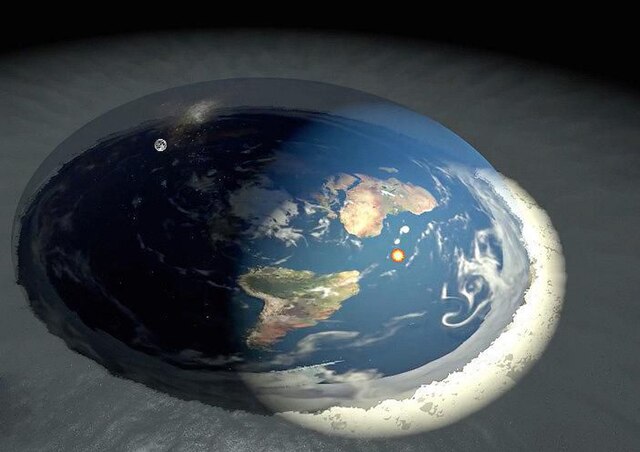
Fig. 8 – Modern depiction of how some flat earthers view the earth — an infinite plane of existence with Antarctica as a barrier of the ever expanding void.
“Geocentryzm”
by Towarzysz Przewodniczący (August 25, 2023)
CC BY-SA 4.0
Archival Status
The flat Earth question is assessed by this Directorate as the most culturally significant open cosmological question in the archival record — not because the evidence for a flat Earth is necessarily stronger than the evidence for a spherical one, but because the social, institutional, and epistemological dynamics surrounding the question are themselves extraordinary. A belief system dismissed as fringe by effectively all credentialed institutions has, in the span of a decade, attracted a research community numbering in the millions, conducted a sustained experimental programme, and developed a synthetic cosmological framework connecting geography, history, religion, and the nature of existence.
The mainstream response to this development has been, almost without exception, ridicule rather than engagement. The experimental claims have not been seriously evaluated in peer-reviewed literature. The institutional critique — that ordinary people are not permitted to independently verify the most basic claimed facts about the world they inhabit — has not been addressed. The question of whether independent verification of Antarctic geography is possible has not been tested. And the population of people asking these questions continues to grow.
This Directorate does not conclude that the Earth is flat. It concludes that the question of how a dismissed belief system can attract millions of serious researchers, produce ongoing experimental literature, and grow faster than any institutional response can contain it is one that neither the scientific establishment nor the intelligence and security communities have adequately examined. Recommended classification: COSMOLOGICAL PARADIGM CHALLENGE — SIGMA PRIORITY. Monitoring status: continuous. Archival priority: maximum.
References
- Rowbotham, S. Zetetic Astronomy: Earth Not a Globe (1881, 3rd edition) — Primary foundational text; available via Internet Archive
- Bedford Level Experiment: Wikipedia — Bedford Level Experiment
- Samuel Rowbotham biography: Wikipedia — Samuel Rowbotham
- Flat Earth International Conference proceedings: flatearth.ws (2017–2019)
- Dubay, E. The Flat Earth Conspiracy (2014) — Primary modern synthesis text
- Documentary: Behind the Curve (2018, Netflix) — mainstream documentary treatment; useful for community sociology rather than experimental content
- Smithsonian: Flat Earth Conspiracy Theory — Historical Overview
- History.com: The Flat Earth Theory: Origins
- Amusing Planet: Bedford Level Experiment — Detailed History
- Wikipedia: Flat Earth — General Overview
Last updated: March 27, 2026. · File declassified: September 27, 2025.


