REALM33
Directorate of Information Preservation and Archival
Subject Profile – File Extract
Designation: Adobe Brick
Also Known As: “The 10,000-Year Wall” · “Earth Home Suppression” · “Thermal Mass Miracle” · ███████
Technology Age: Approximately 10,000 years — oldest extant examples dated to 8,000 BCE
Primary Domain: Building Technology / Regulatory Suppression / Industry Lobbying
Trigger Event: Viral video by Lost Build Archives, March 5, 2026 — 581,000+ views within days of upload
Current Status: ACTIVE — ACCELERATING PUBLIC AWARENESS
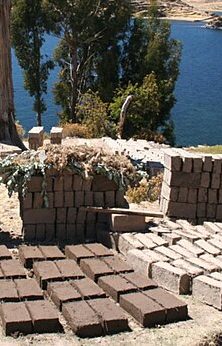
Fig. 1 – The building material used for building houses in Taos Pueblo, New Mexico — continuously occupied adobe community, standing since approximately 1000 AD. Still structurally sound. Requires no HVAC. / Public Domain
The Question Underneath the Building Code
Somewhere in New Mexico, a thousand-year-old building is still standing. Its walls are two feet thick, made from nothing more than local clay, sand, and chopped straw mixed with water and dried in the sun. Its residents do not pay heating bills. In winter it holds warmth through the night. In summer it stays cool through the afternoon heat. It has never needed a replacement roof truss, a vapour barrier, or a structural engineer’s stamp. It has outlasted every wood-framed house built in America in the last century by a factor of ten, and it will likely outlast every wood-framed house being built today by at least as much again.
The building is Taos Pueblo. The material is adobe. And in most of the United States, you cannot legally build one.
This is the situation that a viral documentary video released on March 5, 2026 by the channel Lost Build Archives brought to the attention of more than half a million viewers in its first days of circulation: that one of the oldest, most energy-efficient, most durable, and cheapest building technologies in human history has been rendered effectively illegal in most U.S. jurisdictions — not by any single explicit prohibition, but by an interlocking system of building codes, mortgage standards, insurance requirements, and industry-drafted regulatory language that makes traditional adobe construction practically impossible for the average person to use. The question the video asks, and the question this file examines, is: how did that happen, and why?

Fig. 2 – Traditional adobe brick production: local clay, sand, and straw are mixed with water, formed into moulds, and sun-dried for two to four weeks. Energy input: zero. / Public Domain
What Adobe Is — And What It Does
Adobe is not a primitive or improvised material. It is a precision-engineered composite whose specific proportions — approximately 70–80% clay, 15–25% sand, and 5–10% chopped organic fibre — have been refined through thousands of years of empirical practice across every inhabited continent. The clay provides binding cohesion; the sand provides structural compressive strength and prevents cracking; the fibre provides tensile resistance and controls shrinkage during drying. The mix is formed into bricks and dried in the sun, requiring no kilns, no industrial energy, and no supply chain beyond the ground immediately beneath the construction site.
The compressive strength of well-made natural adobe — typically 250 to 400 PSI — exceeds the International Residential Code’s minimum structural requirement of 175 PSI without any additives whatsoever. Adobe walls do not rot. They do not harbour the moisture conditions that support mould growth. They do not corrode. They do not require the vapour barriers, insulation batts, and ventilated cavities that modern wood-frame construction depends upon to manage the moisture problems that wood-frame construction itself creates. The EPA estimates that 45% of US homes currently suffer from moisture-related structural or air-quality problems. Adobe buildings, by their physical nature, do not.
But the property of adobe that made it the dominant building material across the ancient world — and that makes its modern suppression most consequential — is thermal mass. An adobe wall 18 to 24 inches thick absorbs solar radiation throughout the day, heating slowly from its outer surface inward. By the time the heat front reaches the interior surface, typically eight to twelve hours later, the outdoor temperature has already dropped. The wall then radiates that stored warmth into the interior through the night. In the morning, the cycle reverses. The result is what physicists call thermal lag: a naturally buffered interior temperature that tracks the outdoor average rather than the outdoor peak, maintaining comfortable conditions without any mechanical intervention.
The Historical Record — Ten Thousand Years of Proof
The oldest confirmed adobe structures are the mud-brick walls at Jericho in the West Bank, dated to approximately 8,000 BCE — making adobe one of the oldest human construction technologies in existence, predating metallurgy, the wheel, and written language. The material spread with human settlement across the Middle East, North Africa, Central Asia, sub-Saharan Africa, and the Americas, adapting to local soil compositions and climatic conditions while maintaining the same fundamental principles. Every culture that has access to clay-bearing soil and sunlight has independently discovered adobe, without exception.
The Great Mosque of Djenné in Mali — the largest mud-brick structure on Earth, with walls up to 16 inches thick and a floor area exceeding 2,800 square metres — has been in continuous use since its original construction in the 13th century. It requires annual maintenance: after each rainy season, the community gathers to replaster the exterior surface in a collective event that has become one of the defining cultural ceremonies of the region. This maintenance model — regular, communal, requiring no industrial materials — is exactly the model that modern building codes, insurance requirements, and mortgage standards have been constructed to prohibit.
In the American Southwest, the continuity of adobe as a living tradition is documented most visibly at Taos Pueblo, whose multi-storey adobe apartment complexes have been continuously occupied since approximately 1000 AD and remain in active use today. The pueblo has withstood centuries of freeze-thaw cycles, seismic activity, and periodic flooding without structural failure. Its residents have not needed to replace its walls. They have maintained them, generation after generation, using the same materials their ancestors used — clay from the ground, straw from the fields, water from the river.
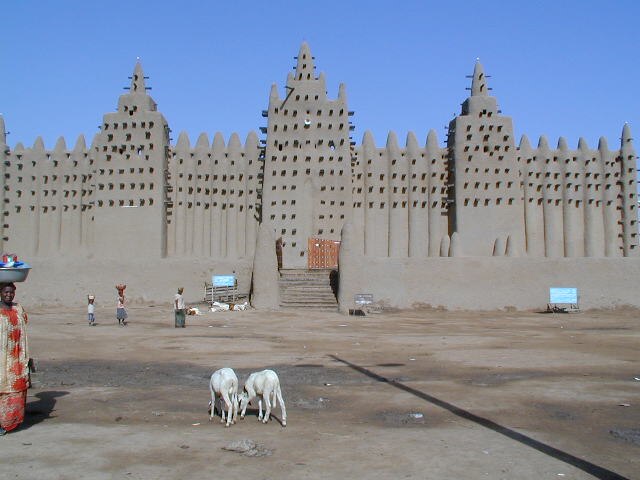
Fig. 3 – The Great Mosque of Djenné, Mali — the largest mud-brick building on Earth, in continuous use since the 13th century. Annual community replastering is its only maintenance requirement. / Public Domain
The Science — What the University Studies Actually Show
The thermal performance claims made for adobe are not anecdotal. They are supported by peer-reviewed research that the mainstream construction industry and the International Code Council have declined to incorporate into regulatory standards.
A 2018 study conducted by researchers at the University of Arizona, published in the journal Energy and Buildings, compared an adobe structure and a conventional wood-frame house of equivalent floor area under identical desert climate conditions, with outdoor temperatures cycling between 48°F at night and 108°F during the day — a 60-degree diurnal swing representative of conditions across much of the American Southwest. The wood-frame house required continuous mechanical cooling to remain habitable. The adobe structure maintained an average indoor temperature of 76°F with no mechanical cooling for ten consecutive months. Measured daily temperature fluctuation inside the adobe building was 40% lower than in the wood-frame building. Heat gain through the adobe walls was 23% lower across the measurement period.
The energy production cost of adobe bricks further distinguishes the material from its industrialised alternatives. Each sun-dried adobe brick requires approximately 2,000 BTUs of energy to produce — energy supplied entirely by solar radiation during the drying process, at zero cost. A standard fired clay brick requires approximately 30,000 BTUs of kiln energy per unit. A concrete masonry unit requires comparable or greater energy input. The 15-to-1 energy efficiency ratio between adobe and fired brick is among the largest performance differentials in any material comparison in the construction industry. If clay is available on-site — as it is in a substantial proportion of the territory of the continental United States — the raw material cost of adobe bricks is approximately three cents per unit. A 1,500-square-foot single-storey home requires between 4,000 and 6,000 bricks for its wall structure, yielding a total structural material cost of under $200.

Fig. 4 – Adobe walls in New Mexico showing the characteristic thick-wall construction responsible for the material’s thermal lag performance — 18 to 24 inches is the standard structural depth / Public Domain
How It Was Suppressed — The Regulatory Timeline
The suppression of traditional adobe construction in the United States did not occur through any single legislative act or explicit prohibition. It occurred through the accumulation, over approximately five decades, of code requirements, financing standards, and insurance underwriting rules that individually appear to be neutral safety measures but collectively function to make traditional earthen construction legally and economically impractical for the average homeowner. Understanding the mechanism requires tracing each element of this accumulation.
The 1927 Uniform Building Code, published by the Pacific Coast Building Officials Conference, contained no provisions for adobe construction whatsoever. This omission was not an oversight — adobe was widely used in the Southwest at the time — but it had immediate practical consequences. Under a building code that contains no approved specification for a given material, construction using that material requires an “alternate method” approval from the local building official, a process involving engineering analysis and independent testing that typically costs between $5,000 and $25,000 per project. For a material whose total construction cost was a few hundred dollars, this administrative requirement was effectively prohibitive for individual owner-builders.
In 1949, the Federal Housing Administration published its Minimum Property Standards, which explicitly required conventional dimension lumber framing as a condition of FHA mortgage eligibility. This single regulatory decision — made without public debate, without legislative vote, and without any documented safety rationale specific to earthen construction — rendered adobe homes ineligible for government-backed mortgage financing. For the post-war American housing market, in which FHA financing was the dominant mechanism by which middle-class families purchased homes, this exclusion was functionally decisive. A home that cannot be financed through standard mortgage channels cannot be sold at full market value, cannot be appraised at replacement cost, and cannot attract buyers who depend on financing — which is to say, the overwhelming majority of the market.
The 1970 revision of the Uniform Building Code added technical requirements that addressed the seismic vulnerability of unreinforced masonry — a legitimate engineering concern in earthquake-prone regions — but applied those requirements universally to adobe rather than geographically to high-seismic-risk zones. The requirements included steel rebar reinforcement at 24-inch intervals throughout the wall, concrete bond beams at specified heights, and 3–5% Portland cement stabilisation of the brick mix. Each of these requirements addresses a genuine structural concern in specific applications, but their universal application transformed adobe from a material that any competent owner-builder could produce and assemble into one requiring professional engineering, industrial additives, and specialised tools. The cost premium introduced by these requirements was estimated at 300–500% over traditional unstabilised construction, and the addition of Portland cement — which prevents the moisture vapour transmission that is one of adobe’s primary performance advantages — negated many of the material’s thermal and durability benefits.
The Portland Cement Association, which represents manufacturers collectively generating in excess of $18 billion in annual revenue, has been documented drafting code language for the model building codes since at least the 1940s. The National Association of Home Builders has, since the 1960s, consistently opposed owner-builder exemptions from professional contractor requirements on consumer protection grounds. Whether these organisations deliberately targeted adobe as a competitive threat or whether their general advocacy for code standardisation had the incidental effect of eliminating traditional earthen construction from the regulatory framework is a question this Directorate does not resolve. The effect, in either case, was the same.
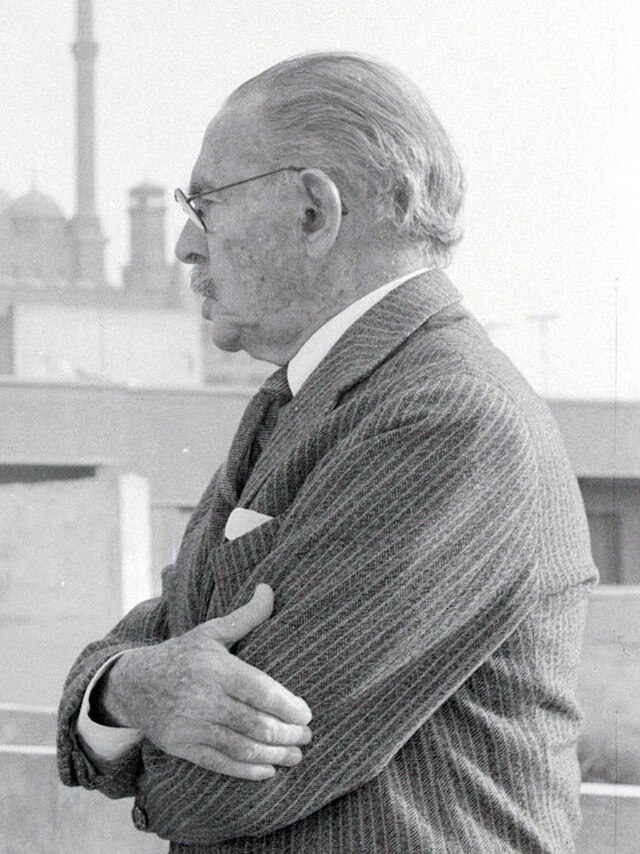
Fig. 5 – “Hassan Fathy, in Cairo” (1900–1989), Egyptian architect and the most important modern advocate for traditional earthen construction — his work demonstrated that ancient building methods could provide dignified, affordable housing at near-zero material cost / Picture by Dimitri Papadimos personal archive with his son Ioannis D.Papadimos. Creative Commons Attribution-Share Alike 3.0
Hassan Fathy and the Adobe Alliance — Proof of Concept
The most compelling evidence that the regulatory suppression of adobe is not a response to genuine technical limitations is the existence of communities where the suppression has been legally bypassed — and where the results have been, by every measurable criterion, a success.
Hassan Fathy was an Egyptian architect who spent the middle decades of the twentieth century demonstrating that traditional earthen construction — specifically the adobe and Nubian vault techniques of Upper Egypt — could produce housing of genuine quality, durability, and dignity at near-zero material cost. His most documented project, the village of New Gourna outside Luxor, begun in 1945, used local craftsmen and local materials to construct an entire community of homes, a mosque, a market, and public buildings for a population that had previously lived in informal settlements. The project encountered resistance from the Egyptian government and eventually from the residents themselves — a complex social and political history that Fathy documented in his 1973 book Architecture for the Poor — but the buildings themselves stood and continued to stand. They performed as adobe buildings perform: cool in summer, warm in winter, durable against the elements, maintainable without industrial inputs.
Fathy’s student Simone Swan brought his methods to the American Southwest in the 1990s, founding the Adobe Alliance nonprofit in Presidio County, Texas. Working within the state’s owner-builder exemption — a legal provision that allows individuals to construct their own primary residences without contractor licensing requirements — Swan and her collaborators have taught hundreds of families to build traditional unstabilised adobe homes using local materials. The total material cost of these homes has consistently fallen between $800 and $1,500. They require no mechanical heating or cooling to maintain comfortable interior temperatures in the extreme desert climate of the Trans-Pecos region, where summer temperatures regularly exceed 110°F. More than 600 such homes have been built under the Adobe Alliance programme. Decades after construction, the structures that have been monitored show no significant structural deterioration. There have been no major structural failures.
New Mexico has maintained a dedicated Traditional Adobe Code since 1991, developed with input from engineers, traditional builders, and community representatives, and covering the construction of unstabilised earthen buildings to specific structural and safety standards appropriate to the state’s climate and seismic conditions. In more than thirty years of documented use under this code, there have been no major structural failures attributable to the material. The code is the regulatory proof of concept that the International Code Council has declined to adopt nationally.
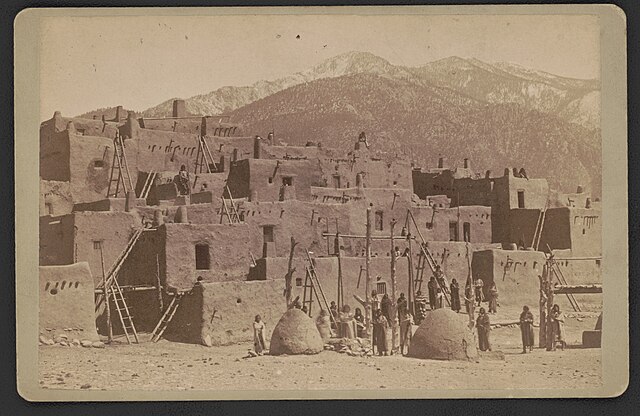
Fig. 6 – Taos Pueblo: thousand years of continuous occupation. No structural failures. No energy bills. No supply chain dependency. The building code that prohibits replication of this in most US states is less than a century old. / Public Domain
The Viral Moment — March 2026
On March 5, 2026, the independent YouTube channel Lost Build Archives published a documentary-format video titled “This Home Costs $300 to Build and $0 to Heat FOREVER. Why Is It Banned?” The video assembled the regulatory timeline, the thermal performance data, the Hassan Fathy legacy, and the Adobe Alliance success story into a forty-minute presentation that accumulated more than 581,000 views within days of upload. The comment sections across YouTube, Reddit, TikTok compilations, and sustainable-living forums that followed the video’s circulation produced a consistent pattern of responses: viewers who had never heard of adobe construction expressing a mixture of astonishment at its performance characteristics and anger at the regulatory system that had kept the knowledge from them.
The viral spread of the video is itself an informative datum. Adobe is not a secret technology. The University of Arizona study was published in a peer-reviewed journal. The history of the FHA mortgage standards is a matter of public record. The Adobe Alliance has been operating in Texas for three decades. None of this information is classified or suppressed in the conventional sense. Yet a significant proportion of the video’s audience — including, based on comment analysis, many people with construction industry backgrounds — encountered it for the first time in March 2026. The mechanism by which a technology of this demonstrated performance and this cost profile remains effectively unknown to the majority of the American public is not suppression in the crude sense of files hidden in classified archives. It is the quieter suppression of regulatory and financial incentives that redirect attention, capital, and institutional energy toward industrialised alternatives while allowing traditional knowledge to atrophy through disuse.
Controversies and Mainstream Responses
- Seismic safety and the universality objection: The most technically grounded mainstream objection to relaxing adobe building codes is the seismic vulnerability of unreinforced masonry. This is a real engineering concern, documented in the performance of adobe structures in major earthquakes including the 1994 Northridge event. Proponents respond that the appropriate regulatory response to seismic risk is geographically targeted code requirements rather than universal prohibition — the same approach applied to wood-frame construction, which has its own well-documented seismic failure modes but has not been banned on that basis. New Mexico’s thirty-year safety record with its Traditional Adobe Code in a seismically active state is cited as direct evidence that targeted regulation works.
- The Portland Cement Association and lobbying claims: The allegation that the PCA has systematically shaped building codes to protect cement market share against free local soil is supported by documented lobbying activity and code-drafting participation but falls short of proving deliberate anti-adobe intent. The alternative explanation — that code standardisation bodies relied on the technical expertise of industrial material producers and incidentally excluded non-industrial alternatives — produces the same outcome without requiring explicit conspiracy. This Directorate notes that the outcome is identical under either explanation, and that the distinction between deliberate exclusion and negligent exclusion has limited practical significance for the owner-builder who cannot build.
- Insurance and appraisal barriers: Adobe homes built outside officially recognised code provisions cannot obtain replacement-value insurance at premiums proportional to their actual construction cost. Insurers calculate replacement cost based on conventional construction rates — typically $150–$250 per square foot — applied to a building that cost $0.25 per square foot in materials. The resulting premium is economically absurd relative to actual risk and functions as a further financial barrier to adobe construction independent of any building code issue.
- Resale and mortgage eligibility: A home built outside standard code provisions cannot obtain a conventional mortgage for its purchaser, dramatically limiting the resale market and suppressing appraised value. This creates a structural disincentive for adobe construction even in jurisdictions where it is legally permitted, since the builder cannot realise the market value of the property they have built.
- Long-term maintenance requirements: Critics note that traditional earthen construction requires regular maintenance — particularly exterior replastering in climates with significant rainfall — and that the communal maintenance model that sustained the Great Mosque of Djenné for centuries does not translate straightforwardly to the individualised property ownership structure of the modern United States. Proponents acknowledge this and argue that the maintenance cost, even annualised over decades, is a small fraction of the energy and repair costs of equivalent conventional construction.
- Scalability beyond the Southwest: Adobe’s thermal performance is optimal in dry desert climates. In humid climates, the material’s moisture absorption properties become a liability rather than an asset. Proponents argue that adobe is not proposed as a universal solution but as a regionally appropriate technology for the arid and semi-arid zones of the American West, where it has been proven for a thousand years and where conventional construction’s HVAC dependency is most costly and most environmentally damaging.
Recent Developments (As of 2026)
The March 2026 viral event has produced measurable downstream effects. Several US state legislatures — including those of Arizona, Colorado, and Texas — have received formal submissions from alternative construction advocacy groups citing the Lost Build Archives video and the Adobe Alliance track record in requests for code reform hearings. The International Code Council has not publicly responded to the renewed attention to earthen construction standards. The Adobe Alliance has reported a significant increase in workshop enquiries and programme applications in the weeks following the video’s circulation.
The intersection of the adobe question with the broader housing affordability crisis has given the issue a political dimension it previously lacked. With US median home prices exceeding $400,000 and construction costs continuing to rise, the contrast between a $300 material cost and a $400,000 market price is increasingly difficult to dismiss as the inevitable result of regulatory safety requirements rather than the product of a system specifically structured to prevent the cheaper alternative from competing.
International interest has increased in parallel, particularly in regions of Africa, Latin America, and Southern Europe facing housing shortages and energy cost crises, where the Adobe Alliance model of community-based owner-builder construction using local materials has the most immediate application and where the regulatory barriers that apply in the United States are largely absent.
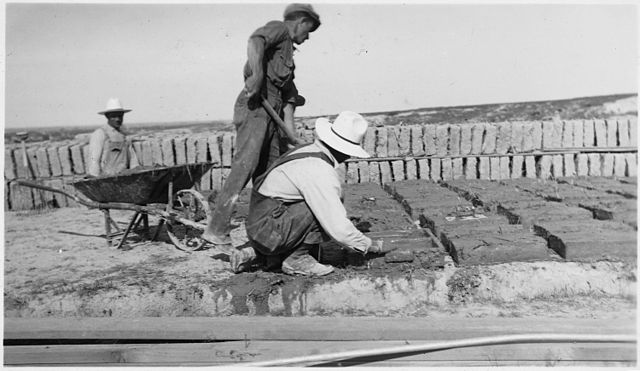
Fig. 7 – Adobe bricks drying in the sun. Clay from the ground. Straw from the field. Water from the river. A technology ten thousand years old, proven on every inhabited continent, capable of producing a home for $300 that will outlast every house built with a $30,000 HVAC system. The question of why this is not legal to build in most of the United States does not have a simple answer. But it has a documented one. / Public Domain
Archival Status
The adobe suppression question is assessed by this Directorate as a case of regulatory capture producing outcomes indistinguishable from deliberate suppression, regardless of whether deliberate suppression was the intent. The technology is documented, proven, and millennia-old. The regulatory barriers are recent, specific in their effect, and traceable to industry actors with a financial interest in their existence. The performance evidence has not been incorporated into national standards. The communities that have bypassed the barriers have produced no safety failures and substantial economic and environmental benefits.
The most consequential aspect of this file is not what it reveals about adobe. It is what it reveals about the mechanism by which the regulatory framework of a nominally free society can render a ten-thousand-year-old technology effectively unavailable to its citizens without ever explicitly prohibiting it. The pattern — omission from initial standards, industry-drafted technical requirements that favour industrial products, financing standards that exclude non-standard construction, insurance underwriting that penalises non-conventional materials — is not unique to adobe. It is a general mechanism, and its application to building technology is one of its more visible and verifiable instances.
Recommended classification: REGULATORY SUPPRESSION — DELTA PRIORITY. Monitoring status: active. Public awareness trajectory: sharply upward as of March 2026.
References
- Lost Build Archives: “This Home Costs $300 to Build and $0 to Heat FOREVER. Why Is It Banned?” — March 5, 2026; primary trigger event for current public interest
- University of Arizona / Energy and Buildings (2018) — Peer-reviewed thermal performance comparison of adobe vs. wood-frame construction under desert climate conditions
- Fathy, H. Architecture for the Poor (University of Chicago Press, 1973) — Primary source on traditional earthen construction philosophy and the New Gourna project
- Adobe Alliance: adobealliance.org — Documentation of the Presidio County, Texas owner-builder programme and its 600+ completed homes
- New Mexico Construction Industries Division: Traditional Adobe Code (1991, updated 2015) — The only US state-level regulatory framework for unstabilised earthen construction
- Taos Pueblo World Heritage Site: UNESCO World Heritage Listing — Documentation of continuous occupation since approximately 1000 AD
- Great Mosque of Djenné: UNESCO World Heritage Listing — Documentation of the world’s largest mud-brick structure
- Federal Housing Administration Minimum Property Standards (1949) — Section 20113B; the mortgage exclusion provision for non-conventional construction
- Portland Cement Association lobbying records: Available via OpenSecrets and FEC disclosure databases
- Wikimedia Commons: Adobe Construction Image Archive
Last updated: March 27, 2026. · File declassified: March 14, 2026.