

REALM33
Directorate of Information Preservation and Archival
Subject Profile – File Extract
Designation: Aether Vision
Also Known As: “Etheric Sight” · “Field Perception” · ███████
First Documented Reference: Pre-modern; modern clinical documentation from 1950s onward
Primary Domain: Perceptual Phenomena / Altered States of Consciousness / Latent Human Sensory Capacity
Classification: Disputed — Neurological Artefact vs. Genuine Environmental Perception
Current Status: ACTIVE INQUIRY · Cross-disciplinary research ongoing; mainstream consensus withheld

Fig. 1 – Naturally occurring transpartent geometric lattice structure — morphologically consistent with independently reported Aether Vision perceptual fields
Synthograph by 보이드 드벨러
Definition and Scope
Aether Vision is the term applied within this Directorate’s classification system to a cluster of documented perceptual phenomena sharing a common characteristic: the perception, under specific conditions, of structured geometric fields, lattice networks, or semi-transparent grid-like formations superimposed upon or underlying the normal visual field. The phenomenon is reported consistently across a wide range of cultural, historical, and physiological contexts, and its internal consistency across independent accounts — in the absence of any known mechanism by which such accounts could have been coordinated — constitutes the primary basis for the Directorate’s determination that the subject warrants formal investigation.
The terminology “Aether Vision” is adopted for classification purposes only. The phenomenon itself has been assigned a variety of names across different investigative traditions — including Etheric Sight, Field Perception, Grid Consciousness, and, in older European esoteric literature, simply “the sight.” No single designation has achieved consensus status, and the subject matter itself remains sufficiently contested that the absence of consensus nomenclature is itself indicative of the level of mainstream institutional engagement. The subject should be understood as a working descriptor, not an endorsed theoretical framework.
What is described, across all accounts and regardless of the conditions of observation, is broadly consistent: a perceptual overlay of structured geometric form — most commonly described as a grid, web, or field of interconnected lines or nodes — perceived as either intrinsic to the environment being observed or as a layer of reality normally beneath the threshold of ordinary human perception. The conditions under which this perception is reported to become accessible vary considerably and are addressed in detail in subsequent sections of this file.

Fig. 2 – Kirlian photography of a finger tip, demonstrating electromagnetic field effects — cited by some researchers as partial instrumental confirmation of perceptual field reports.
CC BY 4.0
File:A Kirlian Photography, male 1989.jpg
Created: 1989
Historical and Pre-Modern Documentation
Reports consistent with what is here classified as Aether Vision appear throughout recorded history across geographically and culturally isolated traditions. Ancient Indian Vedic texts reference a concept of akasha — a pervasive substrate or field permeating physical space — the direct perception of which was considered an advanced but achievable human capacity cultivated through sustained meditative practice. Greek philosophical tradition employs the concept of the aether as the fifth classical element, a medium filling the space of the cosmos, distinct from the four terrestrial elements. Medieval European mystical traditions, operating through a framework of divine illumination, document perceptions of structured luminous fields in terms that are functionally indistinguishable from modern accounts.
Of particular operational interest is the Tartarian architectural hypothesis, a contested body of research that has gained significant attention in alternative historical investigation communities since approximately 2015. Proponents of this framework argue that a substantial portion of the monumental civic architecture erected globally between approximately the fifteenth and nineteenth centuries — characterised by certain recurring structural features including domed rooftops, spired towers, and specific geometric proportioning — was not purely aesthetic in design but functionally operative: that these structures were designed and calibrated to interact with or transmit through an ambient environmental field that was then understood and practically utilised by their builders, in a manner analogous to the function of contemporary electronic antenna and resonance systems.
If this architectural hypothesis is credited, it implies that prior human civilisation possessed both the awareness of and practical working relationship with a pervasive environmental field that is now either undetected by conventional instrumentation or actively excluded from mainstream scientific inquiry. The connection to Aether Vision as defined in this file would be direct: Aether Vision, under this interpretive framework, would represent the subjective perceptual experience of a field that historical civilisation understood well enough to engineer with. The architectural evidence cited in support of this claim, while disputed by mainstream historians, is sufficiently voluminous and geographically consistent to warrant notation as a secondary evidentiary thread.

Fig. 3 – Late-19th century civic architecture exhibiting structural characteristics cited in Tartarian field-resonance hypotheses — dome and spire configurations alleged to function as environmental field antennae / Public Domain
Neurological and Pharmacological Contexts — LSD and Clinical Observation
The most extensively documented modern context in which Aether Vision phenomena are reported is the administration of lysergic acid diethylamide (LSD), a psychedelic compound first synthesised in 1938 and subject to intensive clinical research between the 1940s and early 1970s. During this period of active research, prior to the scheduling of LSD as a controlled substance in the United States and subsequently in most jurisdictions globally, clinical and research literature documented a highly consistent subset of perceptual effects that correspond precisely to the Aether Vision classification: subjects reported perceiving structured geometric overlays upon the visual field, described as grids, webs, lattices, or fields of interconnected luminous structure, perceived as if superimposed upon or emerging from behind the ordinary visual environment.
Of particular evidentiary significance is a body of early filmed documentation — black and white archival footage produced during clinical LSD research in the 1950s and 1960s — in which research subjects describe in real time, with evident coherence and attention to detail, the perceptual phenomena they are experiencing. These accounts, recorded without any prior briefing on what subjects were expected to report, describe geometric field structures, interconnected lattice formations, and the sense of perceiving a normally invisible substrate underlying ordinary visual reality. The consistency of these descriptions across subjects who had received no preparatory information about what others had reported under similar conditions is, from an investigative standpoint, the most compelling feature of the archival record.
It is important to note, for the purposes of this assessment, that the clinical research literature does not uniformly characterise these perceptions as hallucinatory artefacts generated by a drug-disrupted visual system. A subset of researchers working within this period explicitly raised the alternative hypothesis: that LSD and related compounds, rather than generating spurious perceptual data, may function to lower the perceptual threshold at which normally sub-threshold environmental information becomes consciously accessible. Under this hypothesis, the geometric fields perceived under LSD administration are not fabrications of a disordered visual cortex but features of the actual environment that are ordinarily filtered out of conscious perception by neurological processes whose function is to maintain perceptual stability and operational focus. The drug, in this reading, does not create the experience — it removes a filter.
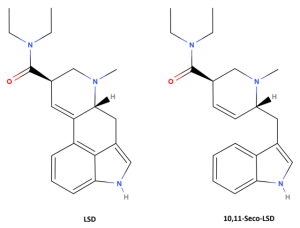
Fig. 4 – Molecular structure of lysergic acid diethylamide (LSD-25) — the compound most consistently associated with documented Aether Vision perceptual access in clinical literature / Public Domain
The Shared Experience Phenomenon — Collective Perception Events
Among the most operationally significant findings associated with Aether Vision research is the documented occurrence of what independent investigators have variously termed shared perception, collective vision, or — in clinical terminology — induced co-experience. Multiple independent accounts, drawn from widely separated sources and time periods, describe circumstances in which two or more individuals in close proximity — and, crucially, in what accounts describe as a shared attentional or psychological state — simultaneously reported identical perceptual access to the geometric field structures associated with Aether Vision, without any prior agreement on what was to be observed or any mechanism by which the perceptual content could have been communicated between parties.
This collective perception component introduces a dimension to the phenomenon that renders purely neurological explanations significantly more challenging to sustain. If Aether Vision were exclusively a product of individual neurological disruption — whether chemically induced or otherwise — the independent duplication of specific perceptual content between simultaneously experiencing individuals would require an additional explanatory mechanism that standard neurological models do not provide. The most parsimonious explanation for identical perceptual content shared between individuals without communication is that the content corresponds to an actual feature of the shared environment being perceived.
Investigators documenting this collective dimension have described it in terms of a “resonance” condition — a state in which individuals in a shared attentional space become, temporarily, capable of accessing the same underlying perceptual data. This framing is not without parallel in documented neuroscience: the concept of neural synchrony — the tendency of closely socially coupled individuals to exhibit correlated brainwave activity — is an established research area. Whether the shared Aether Vision phenomenon represents an extreme expression of neural synchrony, an actual collective perceptual access event, or something else entirely is a question that remains formally open.
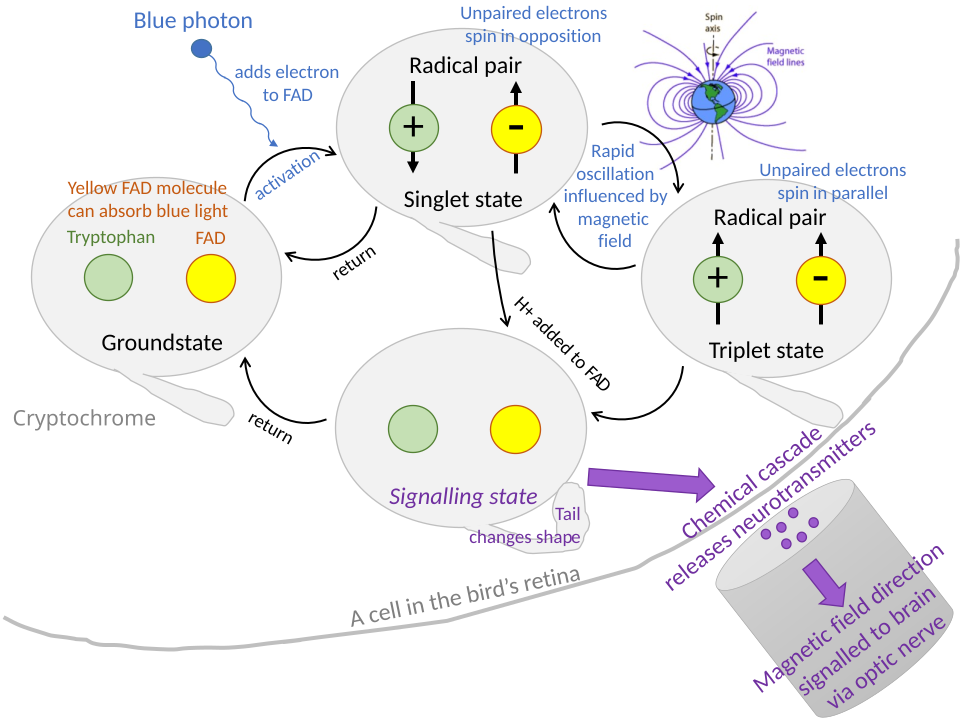
Fig. 5 – “Quantum Magnetoreception in Birds” — birds navigate using cryptochrome photoreceptors sensitive to magnetic fields; an analogous protein has been identified in the human retina / Date: 31 March 2022, Author: Chiswick Chap, Creative Commons Attribution-Share Alike 4.0 International license.
Biological Substrate — Cryptochrome and Vestigial Magnetoreception
In 2016, researchers at the University of Massachusetts Medical School published findings indicating the presence of cryptochrome 1 and cryptochrome 2 proteins in the human retina — the same class of photoreceptive proteins that function as the primary biological mechanism for magnetic field detection in migratory birds. In avian species, these proteins interact with the Earth’s geomagnetic field to generate directional navigational information that is integrated into the birds’ visual processing, providing what researchers describe as a literal visual overlay of magnetic field orientation. The bird, in effect, sees the magnetic field as a feature of its visual environment.
The presence of homologous proteins in the human retina raises a question that the mainstream literature has not yet resolved with finality: whether human cryptochrome proteins retain any functional sensitivity to magnetic or other electromagnetic field inputs, or whether they are vestigial — present structurally but non-functional in their field-detection capacity. Current consensus suggests the latter, but this consensus is based primarily on the absence of demonstrated function rather than the demonstration of functional absence — a distinction that is scientifically significant. A capability not yet detected is not equivalent to a capability demonstrated to be absent.
The relevance to Aether Vision classification is direct. If human cryptochrome proteins retain even residual functional sensitivity to electromagnetic field inputs — a sensitivity that might be expressed only under specific conditions of heightened neural activation or reduced perceptual filtering — then the reported perceptions of geometric field structures could represent not hallucinatory artefact but actual magnetic or electromagnetic field data being processed through a biological receptor system that is ordinarily either below the threshold of conscious access or suppressed by competing perceptual signals. The exponential increase in ambient electromagnetic radiation in the human environment over the last century — from broadcast radio, mobile telecommunications, satellite networks, and associated infrastructure — would, under this framework, constitute a chronic perceptual interference source capable of masking or suppressing a signal that, in a lower-radiation environment, might be more consistently accessible.
The Electromagnetic Environment Hypothesis
A hypothesis advanced by a number of independent researchers — operating outside mainstream institutional channels, as the subject remains outside the scope of funded academic inquiry — proposes that the progressive loss of Aether Vision capacity as a reliable human perceptual faculty corresponds temporally and causally with the dramatic increase in ambient artificial electromagnetic radiation beginning in the early twentieth century. The argument proceeds as follows: human beings, prior to the widespread deployment of broadcast technology, inhabited an electromagnetic environment dominated by the Earth’s geomagnetic field and solar radiation, within which any endogenous field-sensing capacity would have operated against a comparatively stable and low-noise background signal. The introduction of AM and FM broadcast radio, shortwave communications, UHF and VHF television broadcasting, mobile telecommunications networks, and satellite-based infrastructure has resulted in an ambient electromagnetic environment that is orders of magnitude more complex and energetically denser than the pre-technological baseline.
If human cryptochrome-based field sensitivity is functionally present but operating at low signal intensity, the introduction of this degree of electromagnetic noise into the environment would be expected to produce exactly the outcome that is observed: the effective suppression of field-based perception as a conscious experience in the general population, while the capacity itself remains biologically present and can be accessed under conditions that either amplify the signal or reduce the noise — including, as documented extensively, through the administration of psychedelic compounds that are known to dramatically reduce the brain’s default perceptual filtering activity.
This hypothesis is not, it must be noted, one that has been subjected to rigorous controlled experimental investigation. The obstacles to such investigation are not purely technical. A research programme designed to test whether human beings possess functional electromagnetic field perception that is masked by ambient technological radiation would require regulatory authorisation to administer controlled substances in a research context, access to electromagnetically shielded environments, and institutional support for a research question that falls entirely outside currently funded academic inquiry. None of these conditions currently obtain. The hypothesis therefore remains speculative, though it is noted that speculative status does not constitute falsification.
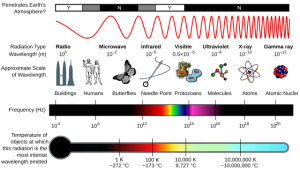
Fig. 6 – The electromagnetic spectrum — modern human environments are saturated with artificial radiation across multiple frequency bands, representing a historically unprecedented perceptual interference environment / Public Domain
The Suppression of Psychedelic Research — Institutional and Policy Context
The scheduling of LSD and psilocybin as Schedule I controlled substances in the United States in 1970 — classifications adopted with variations in jurisdiction across the majority of the world’s nations in subsequent decades — represents the most significant institutional event in the history of Aether Vision research, because it effectively terminated the most productive period of clinical investigation into the perceptual phenomena here classified. The scheduling decisions were made on the basis of assessed abuse potential and absence of accepted medical use, determinations that have been subsequently challenged by an extensive body of clinical research produced since approximately 2000, when regulatory barriers to psychedelic research began to be partially relaxed.
This subsequent research has established with considerable clinical confidence that psilocybin-assisted therapy produces statistically significant therapeutic outcomes in treatment-resistant depression, end-of-life existential anxiety, post-traumatic stress disorder, and substance use disorders including alcohol dependence. These findings have been reproduced across multiple independent research centres, including Johns Hopkins University, Imperial College London, and New York University, and have resulted in regulatory reclassification proceedings in several jurisdictions. The therapeutic efficacy of psychedelic compounds is, as of the date of this file’s classification, no longer scientifically controversial in the way that it was at the time of the original scheduling decisions.
A minority of observers — primarily operating outside mainstream institutional frameworks — have advanced the hypothesis that the original scheduling decisions were motivated not solely or even primarily by public health considerations, but by an interest in suppressing a class of compounds whose primary effect is to reduce the brain’s ordinary perceptual filtering activity, thereby making accessible perceptual data — including, potentially, field-based environmental data of the kind associated with Aether Vision — that, if widely experienced and correctly understood, could fundamentally alter the population’s relationship with perceived reality. This hypothesis is not one for which direct evidentiary support exists in the public record. It is noted here because it is a significant strand of the public discourse associated with the subject matter of this file, and because the institutional suppression of psychedelic research during precisely the period when Aether Vision phenomena were most actively being documented is a factual datum that admits of multiple interpretations.

Fig. 7 – Neural synaptic junction — psychedelic compounds act at serotonin receptors at this level, producing measurable reductions in default perceptual filtering activity / Public Domain
Simulation Theory and the Geometric Field — A Speculative Framework
A subset of researchers and theorists has proposed a connection between the Aether Vision phenomenon and the simulation hypothesis — the proposition, advanced in formal philosophical and theoretical physics literature, that observed physical reality may represent a computed or rendered environment rather than a substrate-independent material world. This connection is noted here as a documented strand of speculative inquiry associated with the subject, not as an endorsed hypothesis.
The argument as advanced runs as follows: the geometric grid and lattice structures reported in Aether Vision accounts bear a notable morphological resemblance to the structural assumptions of computational rendering systems — specifically the polygonal mesh structures that form the substrate of three-dimensional computer graphics. If physical reality is in any sense analogous to a rendered computational environment, one would expect that at certain levels of resolution or under certain perceptual conditions, the underlying structural geometry of that rendering — its equivalent of a mesh or grid — might become detectable. The Aether Vision phenomenon, under this reading, represents not the detection of an electromagnetic field but the direct perceptual access to the structural substrate of reality itself — its rendering architecture.
It is further argued by proponents of this framework that the restriction of access to compounds capable of producing this perceptual experience — and the consistent suppression of documented accounts of successful Aether Vision access — would represent, if the simulation hypothesis has merit, one of the most consequential acts of information control in human history: the deliberate restriction of human access to awareness of the actual nature of the environment they inhabit. This argument is noted for completeness. No determination is offered by this Directorate regarding its merit.
Controversies and Points of Active Dispute
- Neurological artefact hypothesis: The mainstream position holds that all visual phenomena reported under the influence of psychedelic compounds are products of drug-induced neural disruption, with no correspondence to external environmental features. This position is weakened but not disproven by the collective perception events documented in independent accounts, for which the artefact hypothesis provides no adequate mechanism.
- The cryptochrome question: Scientific consensus holds that human retinal cryptochrome proteins are non-functional with respect to magnetic field detection. This consensus rests on absence of demonstrated function rather than demonstrated absence of function. The distinction is methodologically significant, and the question has not been systematically investigated in the context of altered states of consciousness.
- Electromagnetic interference hypothesis: The proposal that modern ambient electromagnetic radiation suppresses latent human field perception remains entirely uninvestigated by mainstream research. The barriers to investigation are regulatory and institutional rather than purely technical.
- The Tartarian architecture thesis: The claim that pre-twentieth-century monumental architecture was designed to interact with an environmental field currently unrecognised by mainstream physics is regarded by academic historians as without evidential basis. Proponents argue that the evidential record has not been systematically examined under the relevant interpretive framework.
- Selective suppression of psychedelic research: The scheduling of psychedelic compounds occurred during the most productive period of clinical research into the perceptual phenomena associated with Aether Vision. Whether this represents coincidence, policy response to social and cultural concerns, or something more directed is a question that available declassified documentation does not resolve.
- Therapeutic suppression implications: The demonstrated therapeutic efficacy of psychedelic compounds — established in post-2000 clinical research — raises questions about the continued scheduling of these compounds that have not been adequately addressed by regulatory bodies, given that the original scheduling justification relied substantially on absence of demonstrated therapeutic utility.
- The simulation substrate question: The proposal that geometric field perceptions represent direct access to computational rendering architecture requires acceptance of the simulation hypothesis as a precondition. This hypothesis, while taken seriously in theoretical physics and philosophy of mind, is not a mainstream scientific position.

Fig. 8 – The Mandelbrot set: infinitely complex geometric structure emerging from simple iterative rules — cited by field theorists as analogous to the lattice structures reported in Aether Vision accounts / Public Domain
Current Status and Ongoing Inquiry
As of the date of this file’s classification, Aether Vision research exists in a formally anomalous position. The phenomena it encompasses are too consistently documented across too many independent sources to be dismissed as anecdotal noise. They are simultaneously too far outside the current boundaries of mainstream scientific inquiry to receive the institutional attention and resources that would be required to resolve the most significant open questions. The regulatory status of the compounds most reliably associated with perceptual access to the phenomena creates a structural barrier to the most direct investigative pathway.
Active independent research continues in distributed networks operating outside institutional frameworks. The renewed clinical interest in psychedelic therapeutics has produced a generation of researchers with both institutional credentials and personal investigative experience of the perceptual phenomena associated with the subject. Whether this generation will pursue the Aether Vision question through mainstream channels, and whether the regulatory and institutional conditions necessary for such investigation will be established, is assessed as the most significant variable in the near-term development of this subject.
This Directorate assesses the Aether Vision subject as warranting ongoing priority classification on the following grounds: the biological evidence for vestigial human electromagnetic field sensitivity is real and has not been adequately investigated; the consistent documentation of collective perception events is not explained by available mainstream models; the connection to the suppression of psychedelic research creates an institutional history that merits formal examination; and the potential implications — should any of the primary hypotheses prove correct — range from the significant to the total restructuring of the human understanding of sensory reality.
Recommended classification: PERCEPTUAL ANOMALY – SIGMA PRIORITY. Suppression assessment: partial institutional, mechanism unclear. Archival priority: maximum. Reason: if human beings possess a functional but suppressed capacity to perceive the electromagnetic or structural substrate of their environment, and if that suppression is attributable to identifiable causes — whether technological, pharmacological, or deliberate — then the restoration of that capacity constitutes a matter of fundamental human epistemic interest.
References and Source Record
- Ritz, T. et al. — Cryptochrome and magnetic field detection in vertebrates; Biophysical Journal, various publications 2000–2016
- Niessner, C. et al. — Human cryptochrome retinal proteins; University of Frankfurt / University of Massachusetts research, 2016
- Strassman, R. — DMT: The Spirit Molecule (2001) — clinical documentation of consistent geometric field perceptions in psychedelic research subjects
- Grof, S. — LSD Psychotherapy (1980) — systematic clinical documentation including geometric field perception reports from pre-scheduling research era
- Hofmann, A. — LSD: My Problem Child (1980) — primary account of LSD discovery and early perceptual research
- Archived clinical LSD research footage — U.S. government and academic research programmes, 1950s–1960s; partial declassification ongoing
- Carhart-Harris, R. et al. — Psilocybin and neural default mode network suppression; Imperial College London, 2012–present
- Bostrom, N. — “Are You Living In a Computer Simulation?” Philosophical Quarterly, 2003 — foundational simulation hypothesis text
- Tartarian architecture research corpus — multiple independent investigators, circulated via independent publishing platforms, 2015–present; institutional peer review status: nil
- Community documentation of shared Aether Vision events — Realm33 internal archive, ongoing; source identities protected
Last updated: March 27, 2026. · File classified: March 27, 2026. · Classification level: SIGMA-OPEN


