
Celebrity Cloning / Replacement

REALM33
Directorate of Information Preservation and Archival
Subject Profile – File Extract
Designation: Celebrity Replacement / Clone Theory
Also Known As: “Body Double Hypothesis” · “Clone Swap” · ███████
Period of Modern Activity: 1966 (Paul McCartney) — Present
Primary Domain: Public Identity / Media Manipulation / Elite Control Narratives
Most Recent Trigger: Jim Carrey at the 51st César Awards, Paris — February 26, 2026
Current Status: ACTIVE — RECURRING PATTERN DOCUMENTED ·
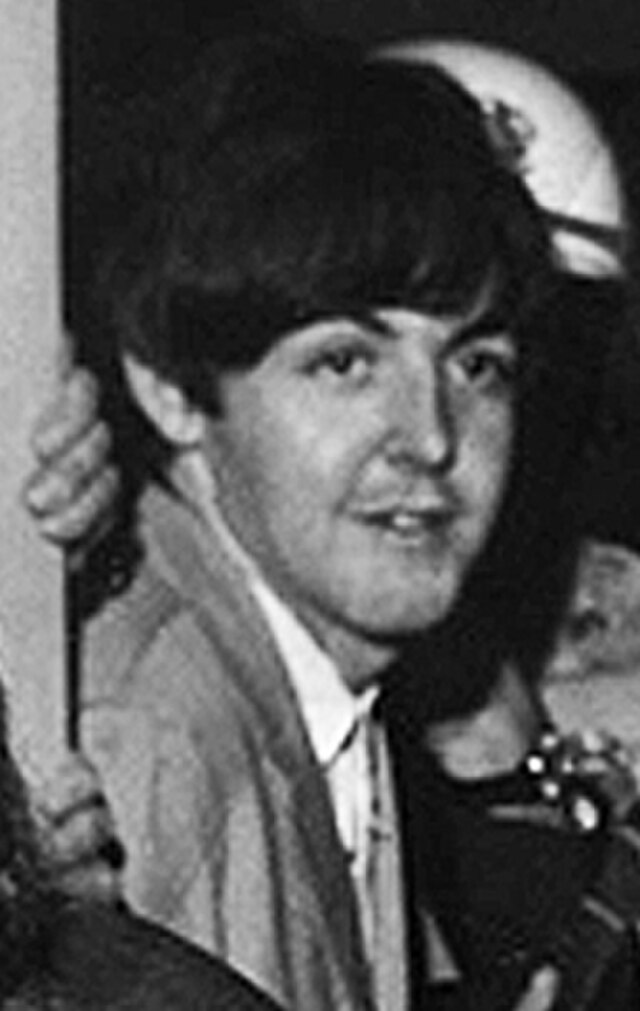
Fig. 1 – Paul McCartney, circa 1964 — the individual around whom the first systematic modern celebrity replacement narrative was constructed, beginning in 1969 / Public Domain
The Pattern Beneath the Rumour
The celebrity replacement theory is one of the most widely dismissed categories of popular conspiracy belief, and also one of the most persistently recurring. It reappears, in substantially the same structural form, whenever a well-known public figure makes a rare or unexpected appearance and is perceived to look, sound, or behave differently from the stored mental image their audience holds of them. The theory’s critics attribute its persistence to pareidolia, to the distorting effects of parasocial attachment, and to the conspiratorial disposition of an online culture that has been trained to find hidden meanings in public events. These explanations have real substance. They do not, however, fully account for the pattern’s specific features: its consistency across cases, its rapid propagation through social media, its tendency to generate institutional denials that themselves become fodder for the theory, and the particular vulnerability of celebrities who occupy the specific cultural territory of transformation, performance, and the deliberate construction of public identity.
This file examines that pattern — from its founding case in 1966 through its most significant modern iterations, culminating in the February 2026 Jim Carrey incident that generated more mainstream media coverage of the replacement theory than any previous case in its history. It does not conclude that any celebrity has been replaced or cloned. It examines why the theory keeps returning, what structural features of modern celebrity culture make it particularly hospitable to replacement claims, and what the recurring pattern itself reveals about the relationship between public figures and the populations that observe them.
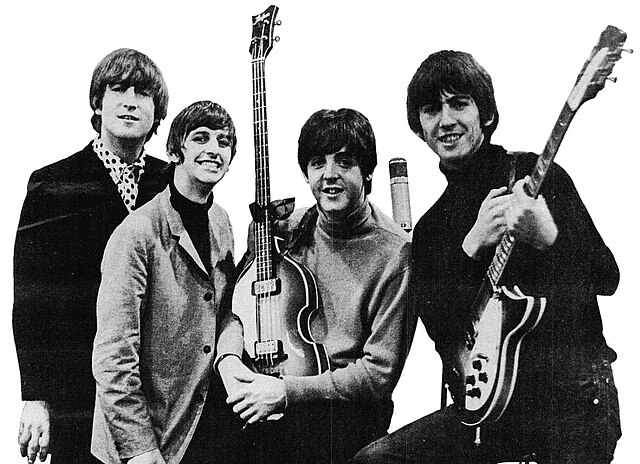
Fig. 2 – The Beatles, 1965 — the group within which the first systematic modern replacement narrative was constructed. Paul McCartney’s alleged 1966 death and substitution by “William Campbell” established the template all subsequent cases follow. / Public Domain
Origins — Paul Is Dead and the Template
The modern celebrity replacement narrative begins in earnest in September 1969, when a Detroit DJ named Russ Gibb received a call from a listener directing him to play the Beatles’ “Revolution 9” backwards. In the reversed audio, the phrase “turn me on, dead man” was audible — or at least audible enough to those primed to hear it. Over the following weeks, a mythology assembled itself with remarkable speed across university campuses and radio stations: Paul McCartney had died in a car crash in November 1966, and had been secretly replaced by a look-alike whose identity was variously given as William Campbell, William Shears, or simply “the imposter.” The remaining Beatles, bound by contractual and commercial obligations and by grief, had coded evidence of the substitution into their subsequent albums: the bare feet on the Abbey Road cover, the out-of-step drumstick tap on “A Day in the Life,” the reversed audio fragments, the ambiguous lyrical references.
Paul McCartney himself responded to the rumours with a combination of bemusement and irritation. His continued public presence — he gave interviews, made recordings, married Linda Eastman in 1969, and embarked on a solo career following the Beatles’ dissolution — was treated by the theory’s proponents not as disconfirming evidence but as further evidence of the substitution: of course the replacement would be indistinguishable in performance, that was the point. The theory had constructed itself in such a way that any evidence against it became evidence for it, a logical architecture that would become characteristic of all subsequent replacement narratives.
The “Paul Is Dead” case established the template from which every subsequent celebrity replacement theory derives: a triggering observation (an apparent change in appearance, behaviour, or context), a period of rapid online or broadcast propagation, the assembly of supporting “clues” from existing public material interpreted in light of the replacement hypothesis, institutional denial by the celebrity or their representatives, and the persistence of the theory among a committed community despite the denial. Every element of this template is present in the Avril Lavigne case, the Eminem case, and the Jim Carrey case. The specific claims differ. The structure is identical.
The Biological Dimension — Cloning and Its Limits
The transition from “body double” to “clone” as the operative mechanism in celebrity replacement theories is directly traceable to a single event in the history of biology: the birth of Dolly the sheep on July 5, 1996, at the Roslin Institute in Edinburgh. Dolly, created by the somatic cell nuclear transfer technique developed by Ian Wilmut and his team, was the first mammal to be cloned from an adult somatic cell — demonstrating, for the first time, that the nucleus of a non-reproductive adult cell could be reprogrammed to produce a complete organism genetically identical to the donor. The implications were immediately understood by the public in terms that biology took pains to moderate: human cloning was theoretically possible in principle, practically remote, and ethically prohibited in virtually every jurisdiction.
The gap between “theoretically possible in principle” and “actually occurring in secret elite programmes” is, in the popular imagination, considerably smaller than it is in the laboratory. Dolly’s birth provided the replacement theory with a mechanism that sounded scientifically grounded rather than purely fictional: not a look-alike trained to impersonate a celebrity, but a biological duplicate produced through technology that actually existed. The fact that producing a cloned human would require decades of gestation and development — meaning that any clone of a 30-year-old celebrity would itself be a child — is not a detail that the theory typically engages with. The mechanism is invoked for its plausibility-by-association rather than its operational coherence.
As of 2026, no credible evidence of successful human cloning exists in the peer-reviewed scientific literature. The theoretical path to human cloning remains open; the practical barriers — involving egg cell availability, gestation, the development timeline, and the fundamental fact that a genetic duplicate is not a psychological or experiential duplicate — remain insurmountable for any purpose consistent with the celebrity replacement hypothesis.
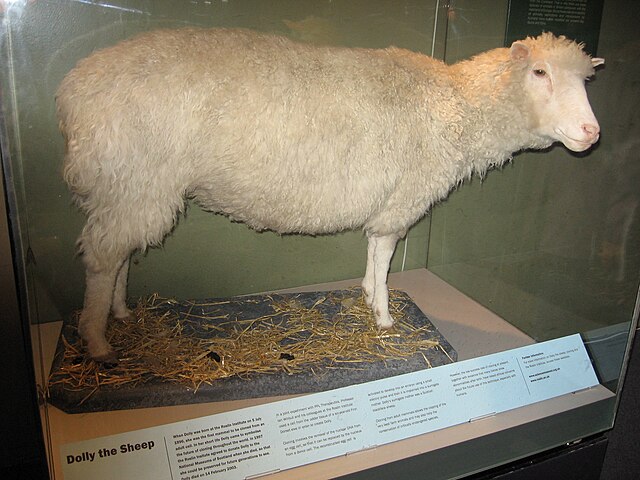
Fig. 3 – Dolly the sheep (1996–2003), the first mammal cloned from an adult somatic cell. Her birth at the Roslin Institute gave the celebrity replacement theory a biological mechanism and a vocabulary it has used ever since. / Public Domain
The Avril Lavigne Case — Anatomy of a Modern Replacement Claim
The Avril Lavigne replacement narrative is the most developed and extensively documented case study in the post-internet era of celebrity replacement theory. It began as a Brazilian blog post in 2011 — attributed to a blogger named Melissa — that presented a detailed comparison of photographs of Lavigne from different periods of her career alongside lyrical analysis and biographical timeline anomalies. The claim was that Lavigne had died by suicide in 2003, shortly after the global success of Let Go, and had been replaced by a look-alike named Melissa Vandella — a name chosen, in the theory’s internal logic, to explain why the replacement left her own name embedded in the blog post that exposed her.
The theory spread slowly for several years, confined to alternative conspiracy forums, before achieving mainstream viral circulation in 2015 when English-language summaries began circulating on Twitter and Tumblr. At its peak circulation, the theory was covered by the BBC, The Guardian, Rolling Stone, and dozens of other mainstream publications — not as a serious claim but as an object of cultural analysis, the coverage itself serving to amplify the claim to audiences who would never have encountered the original blog post. Lavigne’s response was characteristically direct: she told CBS This Morning that the theory was “the dumbest thing I’ve ever heard.”
The forensic analysis that forms the evidentiary core of the Lavigne theory — comparing facial measurements, bone structure, mole placement, and ear lobe shape across photographs from different periods — represents a more methodologically sophisticated approach than simple visual impression, and it is worth examining what it actually shows. The measurements that proponents cite as evidence of substitution are, in virtually every instance, explicable by the combined effects of angle, lighting, focal length, camera distance, age-related facial development, and the well-documented phenomenon of photographer’s distortion. The ear lobe comparison that features prominently in the theory requires ignoring the effect of different focal lengths on ear lobe appearance — a variable that can produce apparent size differences of 20–30% in otherwise identical subjects. The facial structure comparisons require ignoring the changes that occur in a human face between the ages of 17 and 25, a developmental period during which facial bone structure, subcutaneous fat distribution, and muscle development produce changes that can make a person appear substantially different in photographs taken six years apart.
None of this means the observations are wrong. It means the observations are consistent with the null hypothesis — ordinary change over time — as well as with the replacement hypothesis, and that distinguishing between the two requires more than visual comparison of photographs taken under different conditions.

Fig. 4 – Avril Lavigne, 2002 — the year before her alleged death and replacement. Photographic comparisons between her appearance at 17 and at 23 form the primary evidence base of the most extensively documented celebrity replacement theory in the internet era.
By Neal Jennings (10 September 2002)
CC BY-SA 2.0
The Jim Carrey César Awards Incident — February 2026
The Jim Carrey incident at the 51st César Awards on February 26, 2026 is the most recent and, in terms of mainstream media reach, the most significant celebrity replacement episode in the theory’s history. It is also the most complex, because it involved not just the usual elements of the replacement template but an additional layer of deliberate ambiguity introduced by a professional transformation artist — an ambiguity that was not resolved but rather amplified by the artist’s own public statements.
Carrey, 64, appeared at the ceremony at the L’Olympia Bruno Coquatrix theatre in Paris to accept the Honorary César — the French film industry’s equivalent of a lifetime achievement award, previously given to Julia Roberts. He had been largely absent from public life for several years, his last significant public appearance before the César being his introduction of Soundgarden at the Rock & Roll Hall of Fame Induction Ceremony in November 2025. He delivered his acceptance speech entirely in French — a gesture of preparation and respect that the ceremony’s organisers noted he had worked on for months, asking specifically about pronunciation. He was accompanied by his partner Min Ah, his daughter Jane, his grandson Jackson, twelve close friends and family members, his longtime publicist, and his collaborator Michel Gondry, who had directed him in Eternal Sunshine of the Spotless Mind.
What circulated on social media within hours of the ceremony was not a celebration of a heartfelt speech delivered in French by a 64-year-old man honouring a fifty-year career. It was a wave of side-by-side comparisons, viral videos, and commentary claiming that the person who had appeared on stage was not Jim Carrey. The observations driving this claim were specific: his face appeared fuller and smoother than in recent memory, his energy level seemed different from his historically manic public persona, and he was speaking a language he had not publicly spoken before. The replacement theory had all the raw material it needed.
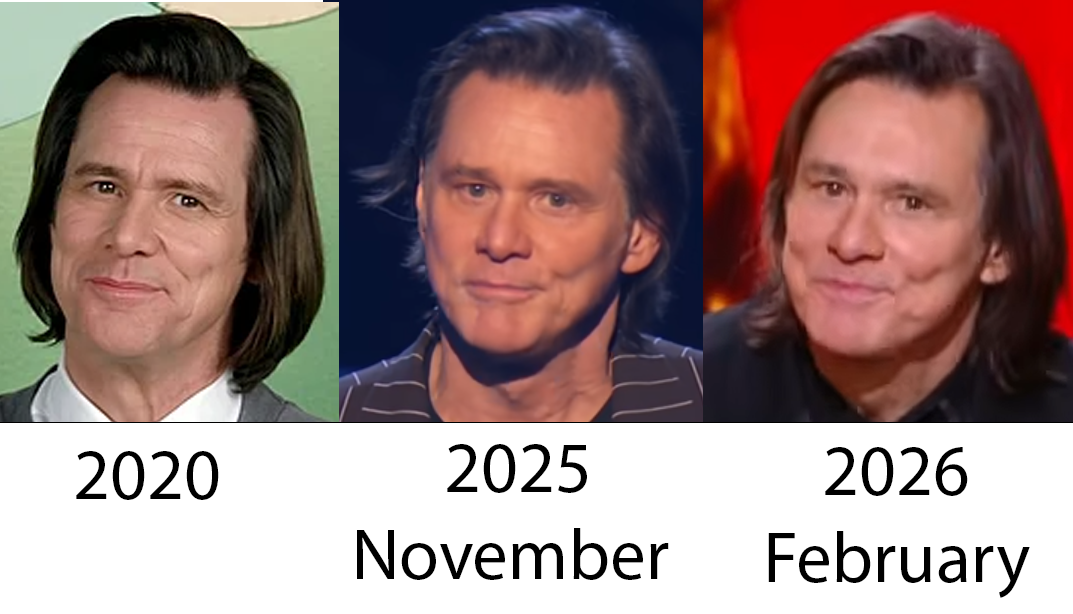
Fig. 5 – Comparison of Jim Carrey: older reference (left), Rock & Roll Hall of Fame November 2025 (centre), 51st César Awards February 2026 (right). The facial appearance change between November 2025 and February 2026 is the primary visual trigger for the replacement claims. Plastic surgeon Dr. Terry Dubrow attributed the difference primarily to ageing, noting specifically elevated brows and reduced upper eyelid skin.
The Alexis Stone Complication
What transformed the Carrey incident from a straightforward replacement theory episode into something genuinely more ambiguous was the intervention of Alexis Stone — a British drag artist and transformation performer with a documented history of producing hyper-realistic celebrity impersonations using prosthetic masks, wigs, and full-coverage makeup. Within days of the ceremony, Stone posted on Instagram a series of images showing photographs of Carrey at the César Awards alongside a prosthetic mask, fake teeth, and a dark wig, captioned simply: “Alexis Stone as Jim Carrey in Paris.”
The post did not include transformation footage, a process video, or any documentation that Stone had actually been present at the ceremony. Stone’s representatives did not provide a statement confirming or denying the claim. The post appeared designed to be maximally ambiguous — suggestive enough to fuel the conspiracy without providing the verification that would make it conclusive in either direction. Megan Fox, encountering the post, commented publicly: “I can’t handle any more stress right now, I need to know if this is real.”
The institutional response was rapid and unambiguous. Gregory Caulier, the general delegate of the César Awards, told Variety that the incident was a “non-issue” and described in detail the eight months of preparation that preceded Carrey’s appearance. Carrey’s publicist Marleah Leslie confirmed to CNN, Entertainment Weekly, and TMZ: “Jim Carrey attended the César Awards, where he accepted his Honorary César Award.” The guest list — partner, daughter, grandson, publicist, and old friend Michel Gondry — was itemised. Carrey’s ancestral connection to France, which he had researched and referenced in his speech, was noted as evidence of the personal significance of the occasion.
Stone later appeared to clarify, or semi-clarify, posting text characterised by some observers as confirming the prank and by others as continuing the ambiguity: “Makeup artist Alexis Stone claims that he was Jim Carrey in Paris. We owe the conspiracy theorists an apology.” Whether this was a straightforward admission that the original post was a hoax, a continuation of the persona, or something else entirely was not resolved in any definitive public statement. Snopes, which investigated the claim, noted that Stone’s original post used verified Getty Images photographs of Carrey at the awards rather than any original photography, and that Stone never released the transformation process video that would be expected to accompany a genuine impersonation of this complexity.
The conclusion of this Directorate: Carrey was present at the ceremony. The facial change that triggered the replacement claims is consistent with the cosmetic surgical changes that multiple plastic surgeons publicly assessed — particularly elevated brow position and reduced upper eyelid skin — combined with the natural ageing of a 64-year-old who has spent three years largely out of public view. The Alexis Stone post was a deliberate provocation, not a disclosure. It exploited the conspiratorial environment that Carrey’s unusual appearance had created and amplified it for an audience primed to interpret ambiguity as confirmation.

Fig. 6 – Jim Carrey accepting the Honorary César at the 51st César Awards, Paris, February 26, 2026. He delivered his entire acceptance speech in French, tracing his ancestral roots to Saint-Malo and paying tribute to his father Percy Joseph Carrey. He was accompanied by his partner, daughter, and grandson.
Why Replacement Claims Recur — The Structural Analysis
The celebrity replacement theory is not random in its targets. It attaches with particular consistency to individuals who share a specific set of characteristics, and understanding those characteristics explains both why the theory recurs and why it attaches to some celebrities and not others.
The most important characteristic is transformation. The celebrities most consistently targeted by replacement theories — McCartney, Lavigne, Eminem, Carrey — are all figures whose public personas are defined by an unusual degree of change, performance, and the construction of identity through art. McCartney’s musical evolution across the Beatles’ career was itself dramatic enough to prompt commentary about the direction he was taking the band. Lavigne’s persona shift between her punk-adjacent debut and her subsequent commercial pop period was jarring to a portion of her fanbase who experienced it as a kind of betrayal. Eminem’s physical appearance changes between his mid-career peak and later albums were striking enough to generate widespread comment before any conspiracy emerged. And Carrey has built his entire career on the premise that the face and body are infinitely malleable performance surfaces — that a person can become someone else entirely, that the self is not fixed.
This is not coincidental. Celebrities who specialise in transformation — who have demonstrated, as a core professional attribute, the ability to become someone other than themselves — are more vulnerable to replacement theories because the idea of replacement is, in a sense, already embedded in their professional identity. An actor famous for playing the same character across thirty years is not plausibly replaced; a comedian famous for becoming other people entirely is a different matter. The theory exploits the psychological reality that has always attended the celebrity-audience relationship: the audience’s investment in a public persona that is, by definition, a constructed artefact rather than a direct window into a person.
The second characteristic is absence. Every major replacement theory case involves a period of reduced public visibility before the triggering appearance. McCartney’s replacement was allegedly accomplished during the period when the Beatles had ceased touring. Lavigne’s alleged death occurred during a period of documented personal difficulty. Eminem’s appearance changes accompanied a period of reduced musical output and publicised health issues. Carrey had spoken openly about semi-retirement, taken up painting, and reduced his public appearances to near-zero before the César event. In each case, the absence creates a gap in the audience’s continuous updating of the celebrity’s image — a gap large enough that a subsequent appearance triggers genuine dissonance.
The third characteristic, in the most significant cases, is an explicit or implicit engagement with themes of identity, authenticity, and reality in the celebrity’s own artistic output. McCartney’s post-Beatles work was deeply concerned with authenticity and personal truth. Lavigne’s persona was built around the genuine versus the constructed, the real girl versus the pop product. And Carrey — whose most significant dramatic performances in The Truman Show, Man on the Moon, and Eternal Sunshine of the Spotless Mind are all centrally concerned with the constructed nature of identity, the performance of self, and the question of what is real behind the performance — had himself blurred those lines in public statements, telling interviewers at various points that Jim Carrey was a character he played, that the self was an illusion, and that he had experienced periods of profound disidentification from the persona that bore his name.

Fig. 7 – Eminem in performance — another figure whose physical appearance changes between career phases have generated replacement claims, and whose artistic output is centrally concerned with multiple competing identities and the constructed nature of the self. / Public Domain
The MKUltra Connection and Elite Control Frameworks
The celebrity replacement theory does not exist in isolation from the broader landscape of conspiracy frameworks. In its more elaborated versions, it connects to two distinct but overlapping alternative narratives: the MKUltra / mind control tradition and the elite control / Illuminati tradition.
The MKUltra connection draws on the documented history of the CIA‘s MKULTRA programme — which operated from the 1950s through the early 1970s and involved, among other things, experiments with hypnosis, drug-induced state alteration, and various psychological conditioning techniques, some conducted without subjects’ knowledge or consent. The programme was real, its documented activities were disturbing, and its full extent remains incompletely disclosed. The celebrity conspiracy tradition extrapolates from the documented programme to a hypothetical successor operation in which entertainment industry figures are subjected to behavioural conditioning techniques that periodically require “reprogramming” — producing the behavioural changes that observers attribute to replacement or cloning. In this framework, the celebrity who “looks different” or “acts differently” has not been substituted but altered.
The Illuminati / elite control tradition provides a motivational framework: celebrities are assets of a controlling class whose continued public presence serves specific social functions — the management of popular culture, the direction of public attention, the modelling of social values — and whose replacement or conditioning is part of the maintenance of that control function. Whether the mechanism is biological cloning, psychological conditioning, or simple body-double substitution is secondary to the claimed motivation, which is the same in all variants: that the people presented to the public as celebrities are not fully autonomous individuals but managed assets whose presentation is controlled by interests that do not share the public’s.
The evidentiary basis for both frameworks, as applied to celebrity replacement specifically, is circumstantial. The documented history of MKULTRA establishes that the CIA did conduct experiments of this type; it does not establish that any such programme was applied to entertainment industry figures, nor that any such programme is currently active. The Illuminati framework has no documentary evidentiary basis beyond a pattern-matching approach to public events that is consistent with the hypothesis but not specifically predicted by it.
Controversies and the Honest Assessment
- Visual evidence and its limits: The photographic comparison methodology central to all celebrity replacement claims is inherently unreliable. The same face, photographed under different lighting conditions, at different focal lengths, from different angles, with different makeup and styling, and at different ages, can produce images that appear to belong to different people. This is not a failure of the method applied to false claims — it is a fundamental property of photography that applies to true claims as well. The methodology cannot distinguish between genuine replacement and ordinary variation within a single individual’s appearance over time.
- The denial-as-confirmation problem: The replacement theory is structurally resistant to institutional denial because denial is predicted by the hypothesis: of course the celebrity’s representatives would deny replacement. This does not make denials meaningless — in the Jim Carrey case, the specificity of the denial (eight months of preparation, full family attendance, documented preparation for the French speech, old friend Gondry’s presence) provides corroborating detail that goes well beyond a bare denial — but the theoretical structure makes it impossible for any denial, however specific, to be treated as conclusive by committed adherents.
- The Alexis Stone problem: Stone’s ambiguous Instagram post in the Carrey case illustrates a new category of complicating factor that did not exist in the McCartney era: the deliberate introduction of ambiguity by a third party with their own interest in the attention the controversy generates. The post was almost certainly a deliberate provocation rather than a disclosure. Its effect was to make the question significantly harder to resolve for anyone who encountered it without background knowledge of Stone’s prior work and method.
- The psychological literature: The tendency to perceive identity discontinuity in public figures is well-documented in the psychology of parasocial relationships. Audiences form attachment relationships with public personas that are, by construction, more stable and idealised than real persons. When a real person changes in ways that violate the stable parasocial image — through ageing, illness, surgical alteration, or simply the accumulation of time — the perceived discontinuity can feel more dissonant than equivalent change in a personal relationship precisely because the audience has no direct experience of the change unfolding gradually. Replacement theory is one resolution of this dissonance.
- The genuine cases of substitution: The replacement theory typically fails to distinguish between the implausible (cloning, systematic identity substitution) and the documented (celebrity body doubles for security and crowd management, documented in Carrey’s own television appearances, and the use of photo-realistic masks and prosthetics for performance art, as in Stone’s work). The existence of documented body-double practices in some contexts does not validate the replacement hypothesis in any specific case, but it provides a kernel of real-world precedent that sustains the theory’s plausibility.
Archival Status
The celebrity replacement theory is assessed by this Directorate as a cultural phenomenon of genuine interest that reveals more about the structure of celebrity culture, the psychology of parasocial attachment, and the dynamics of digital information propagation than it does about any actual substitution of public figures. The theory persists because the conditions that generate it — highly processed and managed public personas, extended absences that create image gaps, institutional cultures of denial, and the genuine documented existence of body doubles and transformation artists — are structural features of contemporary entertainment culture rather than incidental factors that could be eliminated.
The Jim Carrey César case is the most instructive episode in the theory’s history precisely because it occurred in public, with extensive documentation, in the presence of multiple independent witnesses, and still generated a replacement controversy of sufficient intensity to require institutional denial from the awards organisation, the celebrity’s publicist, and multiple major news organisations. If a fully documented, publicly witnessed, family-attended awards ceremony cannot foreclose a replacement claim, the theory has effectively become unfalsifiable — which tells us something about the theory’s relationship to evidence, and something about what the theory is actually performing in the culture that produces it.
Recommended classification: CULTURAL PHENOMENON — DELTA PRIORITY. Monitoring status: ongoing. Recurrence assessment: guaranteed — the next unexpectedly altered celebrity appearance will generate a new iteration of the same pattern.
References
- Wikipedia: Paul Is Dead — Comprehensive history of the founding case
- Wikipedia: Avril Lavigne Replacement Conspiracy Theory
- Rolling Stone: Paul McCartney Is Dead Conspiracy
- BBC: The Avril Lavigne Conspiracy Theory Returns
- Variety: César Awards Say Jim Carrey “Worked on His Speech in French for Months” Amid Clone Conspiracy (March 2, 2026)
- CNN: Jim Carrey’s Face Is Up for Debate. No, Seriously. (March 2, 2026)
- Snopes: Jim Carrey Body Double or Clone — Fact Check (March 5, 2026)
- The Cinema Machina: Jim Carrey’s Shocking New Look Sparks Clone Rumors — includes Dr. Terry Dubrow’s plastic surgery assessment
- VICE: Celebrity Clone Theories
- Snopes: Eminem Clone Claim — Fact Check
- Forbes: The Weird World of Celebrity Clone Conspiracies
- Psychology Today: Why People Believe in Conspiracy Theories
- Wilmut, I. et al. “Viable offspring derived from fetal and adult mammalian cells.” Nature 385, 810–813 (1997) — The Dolly paper; primary source for cloning technical context
Last updated: March 27, 2026. · File declassified: September 25, 2025.


